




Leonard Mixing Valves


 --%3E %3Csvg version='1.1' id='No-RB' xmlns='http://www.w3.org/2000/svg' xmlns:xlink='http://www.w3.org/1999/xlink' x='0px' y='0px' viewBox='0 0 100 100' enable-background='new 0 0 100 100' xml:space='preserve'%3E %3Cpath fill='%23CECECE' d='M79.44,0.95H20.56C9.78,0.95,0.95,9.78,0.95,20.56v58.87c0,10.79,8.82,19.61,19.61,19.61h58.87 c10.79,0,19.61-8.83,19.61-19.61V20.56C99.05,9.78,90.22,0.95,79.44,0.95z M65.38,58.24l9.38,29.58L49.69,69.78L24.5,87.82 l9.34-29.6L8.8,39.6l30.73-0.17c0,0,6.98-19.61,10-28.93c0.54,1.36,9.88,29.1,9.88,29.1H91.2L65.38,58.24z'/%3E %3C/svg%3E)
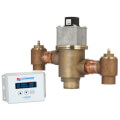


Leonard mixing valves are thermostatic devices that blend hot and cold water to a set, stable temperature at the point of use, adjusting automatically as incoming water pressure or temperature shifts. The product line covers connection sizes from half inch through two inch and handles flow rates from a fraction of a gallon per minute up to more than 200 GPM, covering single fixtures as well as whole-building master mixing applications. Every Leonard valve meets the relevant ASSE performance standards for thermostatic mixing valves, and current production is certified lead-free to the 0.25 percent weighted-average requirement on wetted surfaces. Facilities managers and plumbing contractors specify Leonard valves anywhere consistent water temperature protects against scalding or supports process equipment that needs a steady supply temperature.
Subcategories
- ECO-MIX Bi-Metal Thermostatic Valves: ECO-MIX valves use a bi-metal thermostatic element to respond quickly to temperature swings at a single fixture or small group of fixtures. Facilities standardize on the ECO-MIX line where a compact, lead-free valve needs to hold a set temperature at handwashing sinks or similar low-flow points. Connections on this line run from half inch up through the smaller pipe sizes common in individual fixture branch lines.
- Master Mixing Valves: Master mixing valves temper hot water for an entire building or a large zone before it branches out to individual fixtures, rather than tempering at each point of use. Building engineers rely on master mixers to hold storage tank output, often well above scald temperature, down to a safe distribution temperature across the whole system. Larger connection sizes on this line accommodate the higher flow rates a building-wide application demands.
- High-Flow Mixing Valves: High-flow mixing valves handle applications running toward the upper end of Leonard's rated flow range, up to 216 GPM, for large commercial and institutional buildings with heavy simultaneous hot water demand. Hospitals, hotels, and multi-family buildings with high fixture counts specify high-flow models to keep temperature stable even when many fixtures draw at once. The two inch connection size on this line matches the larger supply piping typical of these installations.
- Emergency and Eyewash Mixing Valves: Emergency mixing valves temper water for eyewash stations and emergency showers so the tepid water requirement in safety codes is met even when incoming hot or cold supply temperatures vary. Facilities with on-site chemical handling or lab space specify emergency mixing valves to keep response time to an incident from being slowed by water that's too hot or too cold. These valves are built to activate reliably even after sitting unused for long stretches between emergencies.
Buying Guide
Choosing a Leonard mixing valve starts with the application: a single fixture or small group calls for a compact thermostatic valve like the ECO-MIX line, while a whole building or large zone needs a master mixing valve sized for the full simultaneous demand downstream. Confirming expected flow rate against the valve's rated range keeps temperature control accurate, since an undersized valve will struggle to hold a set temperature once multiple fixtures draw at once.
Connection size follows from that same flow calculation. Leonard's line spans half inch connections for individual fixtures up to two inch connections for high-flow, building-wide applications, so matching pipe size to actual system demand avoids installing an oversized valve that responds sluggishly to small draws. For Leonard Mixing Valves specifically, checking the ASSE standard that applies to the installation, whether it's a general mixing valve standard or an emergency fixture standard, determines which model in the lineup is actually code-compliant for that use.
Lead-free compliance matters on any potable water installation. Current Leonard valves meet the 0.25 percent weighted-average lead requirement on wetted surfaces, which is worth confirming against local plumbing code before specifying an older or replacement model. Facilities with emergency eyewash or shower stations should also confirm tepid water requirements specific to that application, since a standard mixing valve is not automatically code-compliant for emergency fixture use.
Frequently Asked Questions
What's the difference between a single-fixture mixing valve and a master mixing valve?
A single-fixture valve, like Leonard's ECO-MIX line, tempers water for one fixture or a small group right at the point of use. A master mixing valve tempers water for an entire building or zone before it branches out, so it needs to be sized for the full simultaneous flow demand downstream rather than one fixture's draw.
Are Leonard mixing valves lead-free?
Current production meets the 0.25 percent weighted-average lead requirement on wetted surfaces, which covers most state low-lead plumbing codes. Confirming compliance against local code is still worth doing before specifying a valve, especially on older installations being retrofitted.
What flow rate range do Leonard mixing valves cover?
The line spans from about half a gallon per minute up to 216 GPM, covering single-fixture applications on the low end and whole-building master mixing on the high end. Matching the valve's rated flow to actual system demand keeps temperature control accurate under load.
Do emergency eyewash stations need a different mixing valve than a standard fixture?
Yes, emergency mixing valves are built to meet tepid water requirements specific to eyewash and emergency shower codes, which differ from a standard fixture mixing valve's rating. Specifying a standard mixing valve for an emergency fixture risks missing the code-required response time and temperature range.
What connection sizes are available on Leonard mixing valves?
Connections run from half inch up to two inch across the product line, with smaller sizes serving individual fixtures and the larger two inch connections supporting high-flow, building-wide master mixing applications. Choosing the right size depends on the flow rate the application demands, not just the pipe size already in place.
