




Filters
SORT
Product Availability –
Size –
PEX Size –
Review Score –
 --%3E %3Csvg version='1.1' id='Fill' xmlns='http://www.w3.org/2000/svg' xmlns:xlink='http://www.w3.org/1999/xlink' x='0px' y='0px' viewBox='0 0 100 100' enable-background='new 0 0 100 100' xml:space='preserve'%3E %3Cpath fill='%23F15C02' d='M79.44,0.95H20.56C9.78,0.95,0.95,9.78,0.95,20.56v58.87c0,10.79,8.82,19.61,19.61,19.61h58.87 c10.79,0,19.61-8.83,19.61-19.61V20.56C99.05,9.78,90.22,0.95,79.44,0.95z M65.38,58.24l9.38,29.58L49.69,69.78L24.5,87.82 l9.34-29.6L8.8,39.6l30.73-0.17c0,0,6.98-19.61,10-28.93c0.54,1.36,9.88,29.1,9.88,29.1H91.2L65.38,58.24z'/%3E %3C/svg%3E)
Price Range –
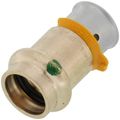
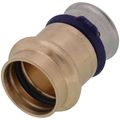
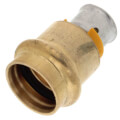
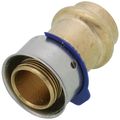
PEX Press ProPress Adapters



 --%3E %3Csvg version='1.1' id='No-RB' xmlns='http://www.w3.org/2000/svg' xmlns:xlink='http://www.w3.org/1999/xlink' x='0px' y='0px' viewBox='0 0 100 100' enable-background='new 0 0 100 100' xml:space='preserve'%3E %3Cpath fill='%23CECECE' d='M79.44,0.95H20.56C9.78,0.95,0.95,9.78,0.95,20.56v58.87c0,10.79,8.82,19.61,19.61,19.61h58.87 c10.79,0,19.61-8.83,19.61-19.61V20.56C99.05,9.78,90.22,0.95,79.44,0.95z M65.38,58.24l9.38,29.58L49.69,69.78L24.5,87.82 l9.34-29.6L8.8,39.6l30.73-0.17c0,0,6.98-19.61,10-28.93c0.54,1.36,9.88,29.1,9.88,29.1H91.2L65.38,58.24z'/%3E %3C/svg%3E)

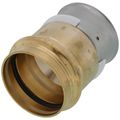
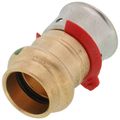
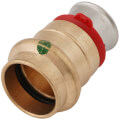
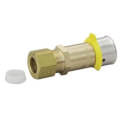

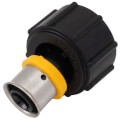
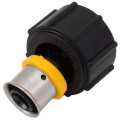


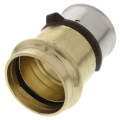
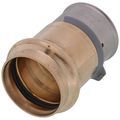
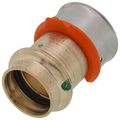
PEX Press ProPress Adapters bridge two of the most common mechanical joining methods in modern plumbing: PEX press connections and copper ProPress connections. Each adapter is built from bronze with an EPDM sealing element, so a technician can transition from a PEX press fitting straight into a ProPress copper fitting without soldering, crimping, or threading a joint. That single-fitting transition matters most on repair and retrofit jobs, where a line already run in copper needs to tie into new PEX branch piping, or vice versa. Because the connection is fully mechanical, the joint can be pressed wet or dry and inspected immediately, cutting the wait time that solvent or solder joints require. Crews already carrying a PureFlow press tool and matching press jaws can complete both ends of the adapter with the same equipment, no separate crimp tool needed on jobs already set up for ProPress. For plumbers standardizing on press-fit systems across mixed-material buildings, these adapters remove one of the last gaps between PEX and copper rough-in work, keeping the whole job on one joining method instead of two.
Subcategories
- PEX Press to ProPress Male Adapters: Male adapters terminate a PEX press run into a ProPress copper fitting or valve that expects a male connection. Residential and light commercial plumbers use them where a copper manifold or copper valve body needs a PEX branch tied in. The bronze body and EPDM seal are rated for potable water service.
- PEX Press to ProPress Female Adapters: Female adapters accept a ProPress male end and convert it to a PEX press connection on the opposite side. Service techs reach for these when replacing a section of copper branch line with PEX without recutting the existing copper stub. The zero-lead bronze construction keeps the fitting compliant for drinking water lines.
- Straight Transition Adapters: Straight adapters carry a single PEX press end and a single ProPress end in a fixed inline body, used for simple point-to-point transitions in a straight run. Installers pick these for the most common case: one copper stub, one PEX continuation, no offset needed.
- Reducing Adapters: Reducing adapters step down between a larger copper size and a smaller PEX branch, or the reverse, in a single fitting. Contractors use them on distribution runs where a main trunk in copper feeds smaller PEX branches to fixtures, avoiding a separate reducer and coupling.
Buying Guide
Start with what's already installed on each end of the joint. If one side of the transition is existing copper pipe or a copper valve body, match that end to a ProPress connection; if the other side is PEX tubing or a PEX manifold, match it to a PEX press connection. PEX Press ProPress Adapters only make sense once both ends of the transition are confirmed, so measure the copper OD and the PEX tubing size before ordering rather than guessing from memory. Next, confirm tooling on the truck. Completing a PEX Press ProPress Adapter installation requires a press tool with jaws sized for both the PEX press profile and the ProPress profile on the same fitting, so crews without a dual-capable press tool should check jaw compatibility before starting the job. Bronze construction with an EPDM seal is standard across this category and suits potable water, hydronic heating, and general plumbing service lines. Choose a male or female adapter based on which end of the existing connection needs to accept the mating fitting, and choose a reducing size only when the copper and PEX diameters actually differ. Always deburr and fully seat the tubing into the fitting before pressing, since a joint that isn't bottomed out won't seal even though the press cycle completes. Keep a few spare EPDM seals and adapters on the truck for repair calls that turn up unexpected copper-to-PEX transitions mid-job.
Frequently Asked Questions
What's the difference between a PEX Press ProPress Adapter and a standard PEX-to-copper coupling?
PEX Press ProPress Adapters are built specifically to combine a PEX press connection on one end with a ProPress copper connection on the other, using a single bronze body and EPDM seal. A standard coupling typically joins two connections of the same type and doesn't bridge press-fit copper and press-fit PEX in one fitting.
Do PEX Press ProPress Adapters require a special tool?
Completing both ends of a PEX Press ProPress Adapter needs a press tool with jaws sized for the PEX press profile and the ProPress profile, since each end of the fitting presses differently. Crews already running a PureFlow and ProPress compatible press tool with the right jaw sets can install the adapter without adding new equipment.
Can PEX Press ProPress Adapters be used on potable water lines?
The bronze body and EPDM sealing element used in these adapters are built for potable water and general plumbing service, and the zero-lead construction keeps the fitting compliant for drinking water applications. Confirm local code requirements before final sign-off on any potable water installation.
Do I need to solder or solvent-weld anything when using these adapters?
No soldering, solvent welding, or crimping is required. PEX Press ProPress Adapters rely entirely on a mechanical press connection, so the joint is formed by pressing each end with the correct tool and jaw.
How do I choose between a male and female adapter?
Match the adapter to whichever end already exists on the job. A male adapter is used when the existing ProPress fitting or valve expects a male connection, and a female adapter is used when the existing fitting presents a male end that needs a female mate. Check the existing fitting before ordering to avoid a mismatch.
