




Filters
SORT
Product Availability –
Size –
Review Score –
 --%3E %3Csvg version='1.1' id='Fill' xmlns='http://www.w3.org/2000/svg' xmlns:xlink='http://www.w3.org/1999/xlink' x='0px' y='0px' viewBox='0 0 100 100' enable-background='new 0 0 100 100' xml:space='preserve'%3E %3Cpath fill='%23F15C02' d='M79.44,0.95H20.56C9.78,0.95,0.95,9.78,0.95,20.56v58.87c0,10.79,8.82,19.61,19.61,19.61h58.87 c10.79,0,19.61-8.83,19.61-19.61V20.56C99.05,9.78,90.22,0.95,79.44,0.95z M65.38,58.24l9.38,29.58L49.69,69.78L24.5,87.82 l9.34-29.6L8.8,39.6l30.73-0.17c0,0,6.98-19.61,10-28.93c0.54,1.36,9.88,29.1,9.88,29.1H91.2L65.38,58.24z'/%3E %3C/svg%3E)
Price Range –
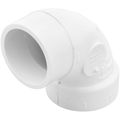
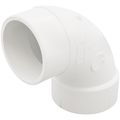
PVC DWV 90° Street Elbows


 --%3E %3Csvg version='1.1' id='No-RB' xmlns='http://www.w3.org/2000/svg' xmlns:xlink='http://www.w3.org/1999/xlink' x='0px' y='0px' viewBox='0 0 100 100' enable-background='new 0 0 100 100' xml:space='preserve'%3E %3Cpath fill='%23CECECE' d='M79.44,0.95H20.56C9.78,0.95,0.95,9.78,0.95,20.56v58.87c0,10.79,8.82,19.61,19.61,19.61h58.87 c10.79,0,19.61-8.83,19.61-19.61V20.56C99.05,9.78,90.22,0.95,79.44,0.95z M65.38,58.24l9.38,29.58L49.69,69.78L24.5,87.82 l9.34-29.6L8.8,39.6l30.73-0.17c0,0,6.98-19.61,10-28.93c0.54,1.36,9.88,29.1,9.88,29.1H91.2L65.38,58.24z'/%3E %3C/svg%3E)
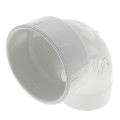
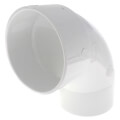
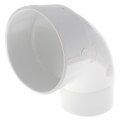
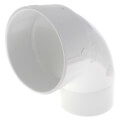
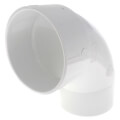

PVC DWV 90° Street Elbows are drain, waste, and vent fittings that make a 90 degree turn in a slip connection PVC run. The street style end joins straight into another fitting, which removes the need for a short pipe stub in tight layouts. The listing includes short radius and long sweep patterns, such as the 4 inch Bluefin PVA90SE400 and the Spears P309-015 and P309-020 in 1-1/2 inch and 2 inch. The Bluefin PVA90SE400 meets ASTM D2665 and ASTM D3311. Contractors use these fittings on drainage and vent piping where a tight offset or a close connection to another fitting is needed. Short radius and long sweep elbows are not interchangeable in every layout, so confirm the pattern before ordering. Choosing the correct radius, size, and listing before rough-in matters because DWV layouts leave little room to change fittings once pipe is cemented and inspected.
Subcategories
- Short Radius Street Elbows: Short radius street elbows make a compact 90 degree turn with a slip connection. Plumbers use them where space is tight on drain and vent runs. The Bluefin PVA90SE400 is a 4 inch model that meets ASTM D2665 and ASTM D3311. Confirm the radius suits the layout before cementing.
- Long Sweep Street Elbows: Long sweep street elbows make a gentler 90 degree turn than a short radius pattern. Installers choose them on drainage runs where a wider radius is preferred. The Spears P309-015 is a 1-1/2 inch model and the P309-020 is a 2 inch model. Both are PVC DWV fittings with a long sweep pattern.
- Standard Street 90° Elbows: Standard street 90° elbows turn a DWV run 90 degrees and join straight into the next fitting. Rough-in crews use them to cut pipe stubs on drain and vent branches. The Spears P302-040 is a 4 inch PVC DWV street 90° elbow. Match the size to the fitting it connects into.
- Street Elbows with Low Heel Inlet: Street elbows with a low heel inlet combine the 90 degree turn with a smaller inlet connection. The Spears P310-338 is a 3 inch by 3 inch by 2 inch model with a 2 inch low heel inlet. Plumbers use it where a 2 inch branch joins a 3 inch run at the turn. Verify the inlet size against the branch before ordering.
Buying Guide
Start with pipe size and pattern. Short radius and long sweep patterns change how much room the fitting needs. Short radius suits tight spaces, while long sweep gives a gentler turn on drainage runs. Match the nominal size to the pipe and fitting it connects to, such as 1-1/2 inch, 2 inch, or 4 inch.
Next, check the listing. When comparing PVC DWV 90° Street Elbows, look for ASTM D2665 on the product page, as shown on the Bluefin PVA90SE400, which also lists ASTM D3311. Pattern, size, and listing should all match the specification for the job. Listings matter on inspected work.
Then decide on the connection. Street elbows join straight into another fitting, so confirm the mating fitting is the correct size and type before cementing. A low heel inlet style such as the Spears P310-338 adds a 2 inch inlet to a 3 inch elbow, so verify the branch size first. Standard street 90° elbows such as the Spears P302-040 suit simple turns at 4 inch.
Finally, plan the whole assembly. Confirm the pipe, fittings, primer, and cement are compatible for DWV use and follow local code and the manufacturer's instructions. Check dimensions on each product page before ordering, since a wrong pattern is costly to correct after rough-in.
Frequently Asked Questions
What's the difference between a street elbow and a regular PVC DWV 90?
PVC DWV 90° Street Elbows have a street style end that joins straight into another fitting, while a standard DWV 90° elbow, such as the Spears P300-015, takes pipe on both ends. Street styles remove a short pipe stub where space is limited. Match the style to the layout before ordering.
Are short radius or long sweep street elbows better for drain lines?
Long sweep PVC DWV 90° Street Elbows make a gentler turn, which is generally preferred on drainage runs. Short radius versions such as the Bluefin PVA90SE400 fit tighter spaces. Check local code for where each pattern is permitted.
What standards do PVC DWV 90° street elbows meet?
The Bluefin PVA90SE400, a 4 inch PVC DWV street 90° short radius elbow, meets ASTM D2665 and ASTM D3311. Standards vary by model, so confirm the listing on each product page. PVC DWV 90° Street Elbows from other brands may list different approvals.
What sizes do PVC DWV 90° Street Elbows come in?
The PVC DWV 90° Street Elbows listing includes 1-1/2 inch and 2 inch long sweep models from Spears, the P309-015 and P309-020, and a 4 inch Spears P302-040. Bluefin lists a 4 inch short radius model, the PVA90SE400. A 3 inch by 3 inch by 2 inch low heel inlet model, the Spears P310-338, is also listed.
Can PVC DWV 90° Street Elbows be used on vent lines?
PVC DWV 90° Street Elbows are drain, waste, and vent fittings, so vent runs fall within their intended use. Match the size to the pipe the run uses. Confirm the pattern and size against local code before installing.
