



Filters
SORT
Product Availability –
Size –
Review Score –
 --%3E %3Csvg version='1.1' id='Fill' xmlns='http://www.w3.org/2000/svg' xmlns:xlink='http://www.w3.org/1999/xlink' x='0px' y='0px' viewBox='0 0 100 100' enable-background='new 0 0 100 100' xml:space='preserve'%3E %3Cpath fill='%23F15C02' d='M79.44,0.95H20.56C9.78,0.95,0.95,9.78,0.95,20.56v58.87c0,10.79,8.82,19.61,19.61,19.61h58.87 c10.79,0,19.61-8.83,19.61-19.61V20.56C99.05,9.78,90.22,0.95,79.44,0.95z M65.38,58.24l9.38,29.58L49.69,69.78L24.5,87.82 l9.34-29.6L8.8,39.6l30.73-0.17c0,0,6.98-19.61,10-28.93c0.54,1.36,9.88,29.1,9.88,29.1H91.2L65.38,58.24z'/%3E %3C/svg%3E)
Price Range –
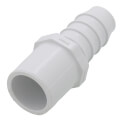
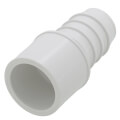
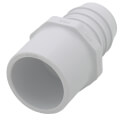
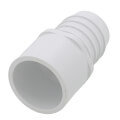
PVC Barbed Insert Adapter (Insert x IPS Spigot)


 --%3E %3Csvg version='1.1' id='Half' xmlns='http://www.w3.org/2000/svg' xmlns:xlink='http://www.w3.org/1999/xlink' x='0px' y='0px' viewBox='0 0 100 100' enable-background='new 0 0 100 100' xml:space='preserve'%3E %3Cg%3E %3Cpath fill='%23F15C02' d='M30.05,70.23l3.79-12.01L8.8,39.6l30.73-0.17c0,0,6.98-19.61,10-28.93c0.54,1.36,9.88,29.1,9.88,29.1h1.58 L93.71,7.18c-3.58-3.82-8.66-6.23-14.28-6.23H20.56C9.78,0.95,0.95,9.78,0.95,20.56v58.87c0,5.41,2.22,10.32,5.79,13.88 L30.05,70.23z'/%3E %3C/g%3E %3Cpath fill='%23FBC8B4' d='M93.71,7.18L60.98,39.6H91.2L65.38,58.24l9.38,29.58L49.69,69.78L24.5,87.82l5.55-17.59L6.75,93.32 c3.55,3.54,8.44,5.73,13.82,5.73h58.87c10.79,0,19.61-8.83,19.61-19.61V20.56C99.05,15.4,97.01,10.69,93.71,7.18z'/%3E %3C/svg%3E)

 --%3E %3Csvg version='1.1' id='No-RB' xmlns='http://www.w3.org/2000/svg' xmlns:xlink='http://www.w3.org/1999/xlink' x='0px' y='0px' viewBox='0 0 100 100' enable-background='new 0 0 100 100' xml:space='preserve'%3E %3Cpath fill='%23CECECE' d='M79.44,0.95H20.56C9.78,0.95,0.95,9.78,0.95,20.56v58.87c0,10.79,8.82,19.61,19.61,19.61h58.87 c10.79,0,19.61-8.83,19.61-19.61V20.56C99.05,9.78,90.22,0.95,79.44,0.95z M65.38,58.24l9.38,29.58L49.69,69.78L24.5,87.82 l9.34-29.6L8.8,39.6l30.73-0.17c0,0,6.98-19.61,10-28.93c0.54,1.36,9.88,29.1,9.88,29.1H91.2L65.38,58.24z'/%3E %3C/svg%3E)
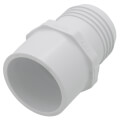
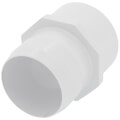
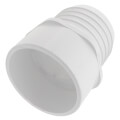
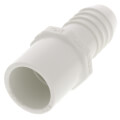
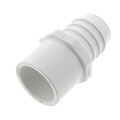
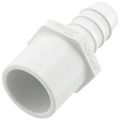
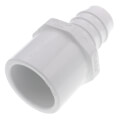
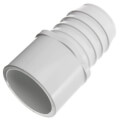
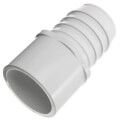
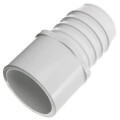

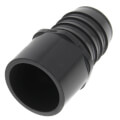
PVC barbed insert adapters (insert x IPS spigot) are two-ended PVC fittings that connect flexible tubing or hose on one end to solvent-weld pipe on the other, letting plumbers and irrigation installers transition between pipe types without an extra coupling. The barbed insert end grips flexible tubing with raised ribs, while the spigot end matches the outside diameter of Schedule 40 IPS pipe for a standard solvent weld joint. Spears manufactures these adapters in the U.S. from PVC Type I, Cell Classification 12454 meeting ASTM D1784, in sizes from 1/2 inch through 4 inch, plus gray PVC and CPVC variants. NSF certification rates the standard PVC line for potable water service in addition to irrigation and drainage use. Having one fitting handle both a barbed and a solvent-weld connection saves a coupling and a joint on jobs that mix tubing with rigid pipe, which cuts installation time and reduces potential leak points.
Subcategories
- 1/2 Inch and 3/4 Inch Adapters: The 1/2 inch (model 460-005) and 3/4 inch (model 460-007) insert x IPS spigot adapters are the most common sizes for residential potable water and irrigation branch lines. The barbed insert end accepts flexible tubing in the matching size while the spigot end solvent welds into Schedule 40 PVC pipe. Irrigation installers use these sizes constantly to transition from poly tubing at a valve box into rigid PVC supply lines. Both sizes are manufactured to ASTM D1784 Cell Classification 12454 and carry NSF certification for potable water use.
- 1 Inch and 2 Inch Adapters: 1 inch (model 460-010) and 2 inch (model 460-020) adapters step up to larger flexible-to-rigid transitions found on irrigation mainlines, well casings, and pump discharge lines. The spigot end still matches standard Schedule 40 pipe outside diameter at each size, so it solvent welds into any fitting or pipe of the same nominal size. Contractors specify these larger sizes when flow volume exceeds what a 1/2 inch or 3/4 inch line can carry. Spears manufactures both sizes in the U.S. to the same ASTM D1784 material standard as the smaller adapters.
- CPVC Insert x Spigot Adapters: CPVC versions of the insert x IPS spigot adapter are offered in sizes from 1/2 inch through 2 inch for applications where the connecting pipe is CPVC rather than PVC. The spigot end matches CPVC pipe dimensions so it solvent welds with CPVC-rated cement instead of standard PVC cement. Plumbers reach for this material when a job's rigid piping is already CPVC, commonly on hot water distribution lines. Using a PVC adapter with CPVC cement or pipe risks an improper bond, so matching material is important.
- PVC Gray Insert x Spigot Adapters: Gray PVC insert x IPS spigot adapters are manufactured in the same size range as the standard white line, from 1/2 inch through 4 inch. The gray color distinguishes these fittings on a job where color coding separates one piping system from another. Installation and solvent welding follow the same method as white PVC adapters. Spears produces the gray version alongside its standard white and CPVC offerings.
Buying Guide
Matching the adapter size to both the tubing and the pipe on either end is the first step, since the barbed insert has to fit snugly inside the flexible tubing's inside diameter while the spigot end has to match the outside diameter of the Schedule 40 pipe it welds into. Measuring both connection points before ordering avoids a mismatched fitting that leaks under pressure or vibration. Confirm the material next, since Spears offers this fitting in standard white PVC, gray PVC, and CPVC, and the connecting pipe's material should match to keep the solvent weld cement compatible. A PVC barbed insert adapter (insert x IPS spigot) built to ASTM D1784 and NSF certified works for drinking water lines, while irrigation-only systems have more flexibility on material grade. Check the application's air or gas exposure too: these fittings are rated for oil-free air handling up to 25 PSI and aren't built for distributing compressed air or gas, so a pneumatic application needs a fitting rated for that use instead. For the tubing side, a hose clamp over the barbed end adds security in high-pressure or high-vibration applications, even though the ribbed barb alone often holds under normal irrigation pressure. On the spigot side, primer and solvent weld cement rated for the specific pipe material create the permanent joint, and following the cement manufacturer's cure time before pressurizing the line prevents a blown joint. Buying a few extra adapters for a job with multiple tubing-to-pipe transitions beats making a second trip for one missing size.
Frequently Asked Questions
What's the difference between the insert end and the spigot end?
The insert end has raised barbs that grip flexible tubing, hose, or vinyl line from the outside, while the spigot end is smooth and sized to match Schedule 40 PVC pipe for a solvent weld connection. One end makes a mechanical friction connection and the other makes a permanent glued joint. Combining both on one fitting lets installers transition between flexible and rigid piping without adding a second coupling.
Are these adapters rated for drinking water?
PVC barbed insert adapters manufactured to ASTM D1784 Cell Classification 12454 and certified by NSF are rated for potable water service in the standard white PVC line. Checking for the NSF mark on the fitting confirms that rating before installing it on a drinking water line. CPVC and gray PVC variants should be checked individually since certification can differ by material.
Does the barbed end need a hose clamp?
The ribbed barb alone creates a mechanical grip on flexible tubing and often holds under normal irrigation pressure, but a hose clamp adds a margin of security on higher-pressure or high-vibration lines. Many contractors clamp every barbed connection as standard practice regardless of pressure. A clamp is a small step compared with a callback for a leaking joint.
Can these adapters be used for compressed air lines?
Spears rates this fitting for oil-free air handling up to 25 PSI only, and specifically not for distributing compressed air or gas. A pneumatic or gas application needs a fitting rated for that specific use rather than a standard PVC barbed insert adapter. Checking the pressure and media rating before installing on any air or gas line prevents a fitting failure.
What sizes are available for irrigation mainlines versus branch lines?
Smaller 1/2 inch (460-005) and 3/4 inch (460-007) adapters typically handle residential branch lines and drip irrigation transitions, while 1 inch (460-010) and 2 inch (460-020) sizes serve mainlines, wells, and higher-flow systems, with sizes available up to 4 inch. Picking the size based on the flow rate and existing pipe diameter keeps pressure loss to a minimum. All sizes share the same insert-to-spigot configuration, just scaled up or down.
