




Radiant Heat Packages
Radiant heat packages bundle the major components needed for a defined radiant heating zone, covering panel-based systems like Joist Trak and Quik Trak, slab installations for new construction, and suspended pipe kits for installing tubing in joist spaces below an existing subfloor.
Choosing a package type depends heavily on the construction stage and floor assembly, since slab packages suit new pours while suspended pipe and panel systems retrofit into existing joist spaces. Working from a matched package simplifies takeoff since the major components are already sized to work together.
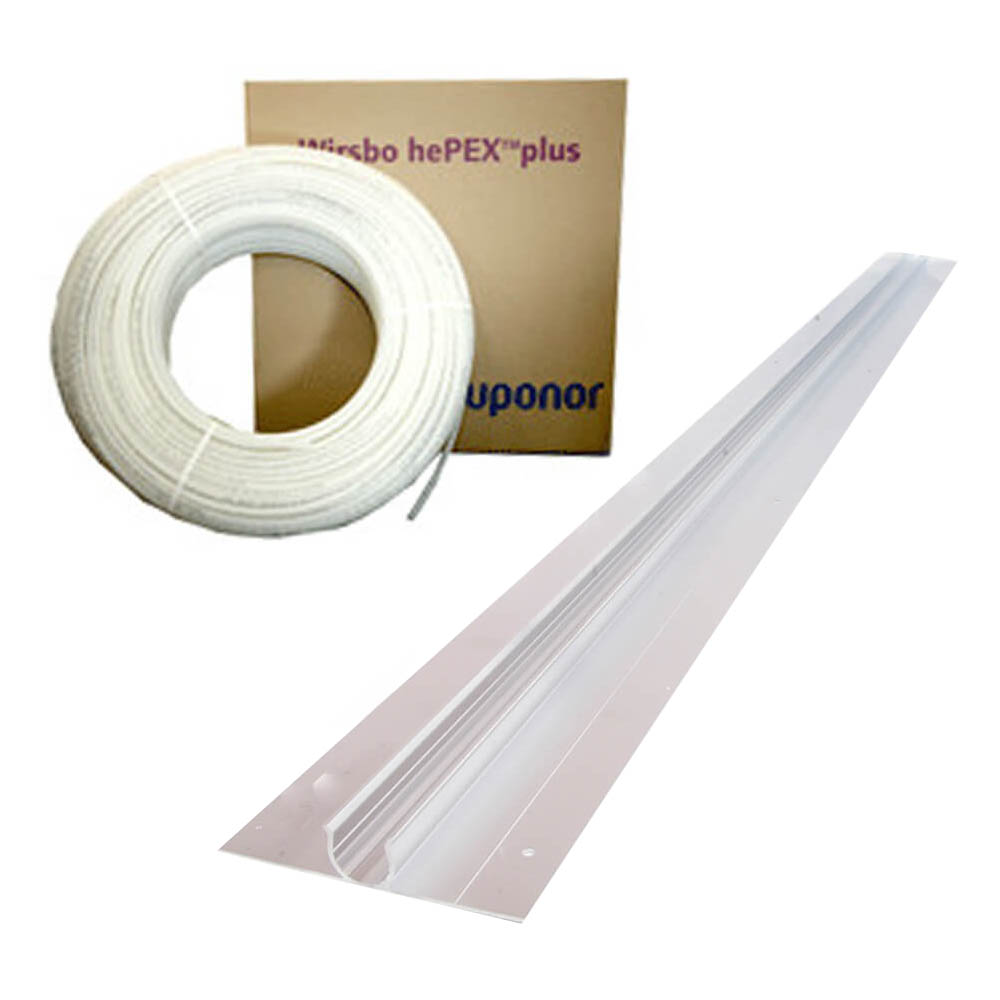

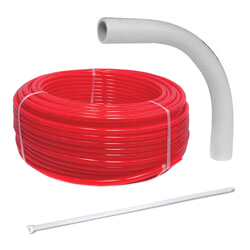
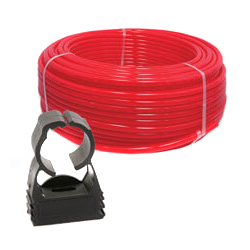
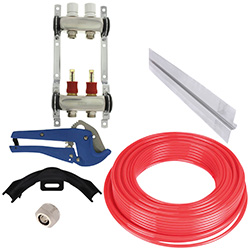

Joist Trak Radiant Heat Packages use Uponor Joist Trak aluminum heat transfer panels installed in the joist spaces beneath an existing subfloor. The aluminum panels contain 1/2" grooves that lock 1/2" PEX tubing firmly in place, and heat conducts from the tubing through the aluminum directly to the subfloor above. Joist Trak is preferred when an existing floor is in place but the joist spaces below are accessible. Packages are available for areas from 250 to 1000 square feet.
Quik Trak Radiant Heat Packages use Uponor Quik Trak wooden panels with an aluminum heat transfer plate and grooves for 5/16" Uponor hePEX plus tubing. Panels measure 7" wide by 48" long and are installed directly on top of the existing subfloor, raising the finished floor height by approximately 1/2". Quik Trak is preferred when a modest floor height increase is acceptable but a full 2" topping slab is not practical. Panels are available in straight-run and return-bend configurations.
Slab Radiant Heat Packages are designed for new construction or major renovation projects where PEX tubing is laid out before a concrete slab is poured over it. Slab installation is the most thermally efficient method because the high mass of the concrete stores a large amount of heat and maintains a stable floor temperature with minimal energy cycling. Pressure testing the tubing before the slab is poured is critical, as post-pour leak repair requires concrete cutting.
Suspended Pipe Radiant Heat Packages install PEX tubing in the joist spaces below a subfloor without aluminum heat transfer plates. Heat from the circulating water transfers to the surrounding joist cavity air and to the underside of the subfloor above. Suspended pipe systems have lower installation costs than Joist Trak because they do not require aluminum panels, but they are less energy efficient. They are well suited for applications where budget is the primary constraint.
Bluefin Radiant Heat Packages feature Bluefin oxygen barrier PEX tubing and compatible accessories for slab, joist, and suspended pipe installations. Bluefin is a SupplyHouse.com house brand offering oxygen barrier PEX with a 25-year warranty. Packages include tubing, manifold tails, and the installation hardware appropriate for the selected installation method and are available in multiple size configurations.
Selecting the correct radiant heat package begins with identifying the floor construction and available clearance. Slab packages are for new construction. Quik Trak packages are for existing floors where raising the finished floor by 1/2" is acceptable. Joist Trak packages are for existing floors with accessible joist spaces below. Suspended pipe packages are the lowest-cost option for joist installations where maximum heat output is not required.
Oxygen barrier PEX tubing is included in all standard radiant heat packages and is required for hydronic radiant systems that include cast iron or ferrous metal components. The EVOH oxygen barrier layer prevents dissolved oxygen from entering the system and corroding boiler sections, pump bodies, and manifold components.
Pressure testing is required before finishing any radiant installation and is especially critical for slab installations. The tubing should be pressurized to at least 100 PSI with compressed air or water and monitored for a minimum of 30 minutes before the slab is poured or the subfloor is closed in. Any pressure loss indicates a leak that must be located and repaired before proceeding.
What is the difference between Joist Trak and suspended pipe radiant heat?
Joist Trak uses aluminum heat transfer panels that make direct contact with the subfloor above, conducting heat from the PEX tubing to the floor surface. Suspended pipe systems attach PEX tubing between the joists without plates, relying on convective air movement in the joist cavity. Joist Trak delivers more heat per square foot and responds more quickly, but costs more due to the aluminum panels.
Do radiant heat packages include a manifold?
Most standard radiant heat packages include PEX tubing, installation accessories, and manifold tail connections, but the manifold itself is typically ordered separately. The manifold is sized by the number of zones or loops in the system. Confirm what is included in the specific package being ordered before assuming the manifold is included.
Can radiant heat packages be used for a heated driveway or snowmelt application?
Standard residential radiant heat packages are designed for in-floor heating applications. Snowmelt systems require higher tubing density, a glycol-based antifreeze solution, and a heat source sized for much higher loads. Dedicated snowmelt packages with appropriate tubing and glycol-compatible components are available for those applications.
How do I calculate how much tubing I need for a radiant heat project?
At 12 inch spacing, approximately 1 linear foot of tubing is required per square foot of floor area. At 9 inch spacing, approximately 1.33 linear feet per square foot. At 6 inch spacing, approximately 2 linear feet per square foot. Loop lengths should not exceed 250 to 300 feet for 1/2" PEX to keep pressure drop within the range of a standard circulator pump.
What is the benefit of Uponor hePEX plus for Quik Trak installations?
Uponor hePEX plus is a PEX-a tubing that combines an oxygen barrier layer with the high flexibility and material memory of the Engel cross-linking method. PEX-a tubing can be kinked and then restored to its original shape by applying heat, which simplifies installation in tight panel grooves and around return bends. The 5/16" diameter allows tighter bend radii than 1/2" tubing, completing return bends within the panel without separate fittings.
Resources

 --%3E %3C!DOCTYPE svg PUBLIC '-//W3C//DTD SVG 1.1//EN' 'http://www.w3.org/Graphics/SVG/1.1/DTD/svg11.dtd'%3E %3Csvg version='1.1' id='Layer_1' xmlns='http://www.w3.org/2000/svg' xmlns:xlink='http://www.w3.org/1999/xlink' x='0px' y='0px' width='90px' height='90px' viewBox='0 0 90 90' enable-background='new 0 0 90 90' xml:space='preserve'%3E %3Crect x='27' y='23' fill='%23FFFFFF' width='43' height='44'/%3E %3Cg%3E %3Cdefs%3E %3Crect id='SVGID_1_' width='90' height='90'/%3E %3C/defs%3E %3CclipPath id='SVGID_2_'%3E %3Cuse xlink:href='%23SVGID_1_' overflow='visible'/%3E %3C/clipPath%3E %3Cpath clip-path='url(%23SVGID_2_)' fill='%234186AD' d='M45,0C20.1,0,0,20.1,0,45c0,24.9,20.1,45,45,45c24.9,0,45-20.1,45-45 C90,20.1,69.9,0,45,0'/%3E %3C/g%3E %3Cpath fill='%23FFFFFF' d='M60.6,47.4l-22.5,14c-0.5,0.3-1,0.399-1.5,0.399s-0.9-0.1-1.4-0.399c-0.9-0.5-1.4-1.4-1.4-2.5v-28 c0-1,0.6-2,1.4-2.5c0.9-0.5,2-0.5,2.9,0.1l22.5,14.1C61.4,43.1,61.9,44,61.9,45S61.4,46.9,60.6,47.4'/%3E %3C/svg%3E)
Joist Trak Radiant Heat Packages use Uponor Joist Trak aluminum heat transfer panels installed in the joist spaces beneath an existing subfloor. The aluminum panels contain 1/2" grooves that lock 1/2" PEX tubing firmly in place, and heat conducts from the tubing through the aluminum directly to the subfloor above. Joist Trak is preferred when an existing floor is in place but the joist spaces below are accessible. Packages are available for areas from 250 to 1000 square feet.
Quik Trak Radiant Heat Packages use Uponor Quik Trak wooden panels with an aluminum heat transfer plate and grooves for 5/16" Uponor hePEX plus tubing. Panels measure 7" wide by 48" long and are installed directly on top of the existing subfloor, raising the finished floor height by approximately 1/2". Quik Trak is preferred when a modest floor height increase is acceptable but a full 2" topping slab is not practical. Panels are available in straight-run and return-bend configurations.
Slab Radiant Heat Packages are designed for new construction or major renovation projects where PEX tubing is laid out before a concrete slab is poured over it. Slab installation is the most thermally efficient method because the high mass of the concrete stores a large amount of heat and maintains a stable floor temperature with minimal energy cycling. Pressure testing the tubing before the slab is poured is critical, as post-pour leak repair requires concrete cutting.
Suspended Pipe Radiant Heat Packages install PEX tubing in the joist spaces below a subfloor without aluminum heat transfer plates. Heat from the circulating water transfers to the surrounding joist cavity air and to the underside of the subfloor above. Suspended pipe systems have lower installation costs than Joist Trak because they do not require aluminum panels, but they are less energy efficient. They are well suited for applications where budget is the primary constraint.
Bluefin Radiant Heat Packages feature Bluefin oxygen barrier PEX tubing and compatible accessories for slab, joist, and suspended pipe installations. Bluefin is a SupplyHouse.com house brand offering oxygen barrier PEX with a 25-year warranty. Packages include tubing, manifold tails, and the installation hardware appropriate for the selected installation method and are available in multiple size configurations.
Selecting the correct radiant heat package begins with identifying the floor construction and available clearance. Slab packages are for new construction. Quik Trak packages are for existing floors where raising the finished floor by 1/2" is acceptable. Joist Trak packages are for existing floors with accessible joist spaces below. Suspended pipe packages are the lowest-cost option for joist installations where maximum heat output is not required.
Oxygen barrier PEX tubing is included in all standard radiant heat packages and is required for hydronic radiant systems that include cast iron or ferrous metal components. The EVOH oxygen barrier layer prevents dissolved oxygen from entering the system and corroding boiler sections, pump bodies, and manifold components.
Pressure testing is required before finishing any radiant installation and is especially critical for slab installations. The tubing should be pressurized to at least 100 PSI with compressed air or water and monitored for a minimum of 30 minutes before the slab is poured or the subfloor is closed in. Any pressure loss indicates a leak that must be located and repaired before proceeding.
What is the difference between Joist Trak and suspended pipe radiant heat?
Joist Trak uses aluminum heat transfer panels that make direct contact with the subfloor above, conducting heat from the PEX tubing to the floor surface. Suspended pipe systems attach PEX tubing between the joists without plates, relying on convective air movement in the joist cavity. Joist Trak delivers more heat per square foot and responds more quickly, but costs more due to the aluminum panels.
Do radiant heat packages include a manifold?
Most standard radiant heat packages include PEX tubing, installation accessories, and manifold tail connections, but the manifold itself is typically ordered separately. The manifold is sized by the number of zones or loops in the system. Confirm what is included in the specific package being ordered before assuming the manifold is included.
Can radiant heat packages be used for a heated driveway or snowmelt application?
Standard residential radiant heat packages are designed for in-floor heating applications. Snowmelt systems require higher tubing density, a glycol-based antifreeze solution, and a heat source sized for much higher loads. Dedicated snowmelt packages with appropriate tubing and glycol-compatible components are available for those applications.
How do I calculate how much tubing I need for a radiant heat project?
At 12 inch spacing, approximately 1 linear foot of tubing is required per square foot of floor area. At 9 inch spacing, approximately 1.33 linear feet per square foot. At 6 inch spacing, approximately 2 linear feet per square foot. Loop lengths should not exceed 250 to 300 feet for 1/2" PEX to keep pressure drop within the range of a standard circulator pump.
What is the benefit of Uponor hePEX plus for Quik Trak installations?
Uponor hePEX plus is a PEX-a tubing that combines an oxygen barrier layer with the high flexibility and material memory of the Engel cross-linking method. PEX-a tubing can be kinked and then restored to its original shape by applying heat, which simplifies installation in tight panel grooves and around return bends. The 5/16" diameter allows tighter bend radii than 1/2" tubing, completing return bends within the panel without separate fittings.