

CONTACT & SUPPORT
Live Chat: Online Now


0
CART

Radiant Heat Packages
Radiant Heat is only growing in popularity and is now being used in many new constructions. We make installing a radiant heat system that much easier with these pre-packaged sets.

Resources
FAQs, Manuals & Videos

Videos
Articles
More About Radiant Heat Packages
Radiant Heat Calculator - estimate system requirements.
Quik Trak Calculator - determine how many panels you need.
PEX Radiant Heat Packages offer a great means of getting started on your first PEX radiant heat project. Radiant heat is growing in popularity, and is now the preferred heating system in new homes. Radiant heat provides more comfort throughout the home than standard baseboard heat. PEX tubing is installed beneath the floor and heats the home from the ground up. As the floor becomes warm, the room is heated evenly and efficiently. Radiant heat is silent, producing no creaking, banging, or humming sounds, such as those commonly heard in other heating systems. Radiant heat allows the thermostat to be set a few degrees lower than it would normally be set, while still providing the same warmth. This cuts energy bills and saves you money.
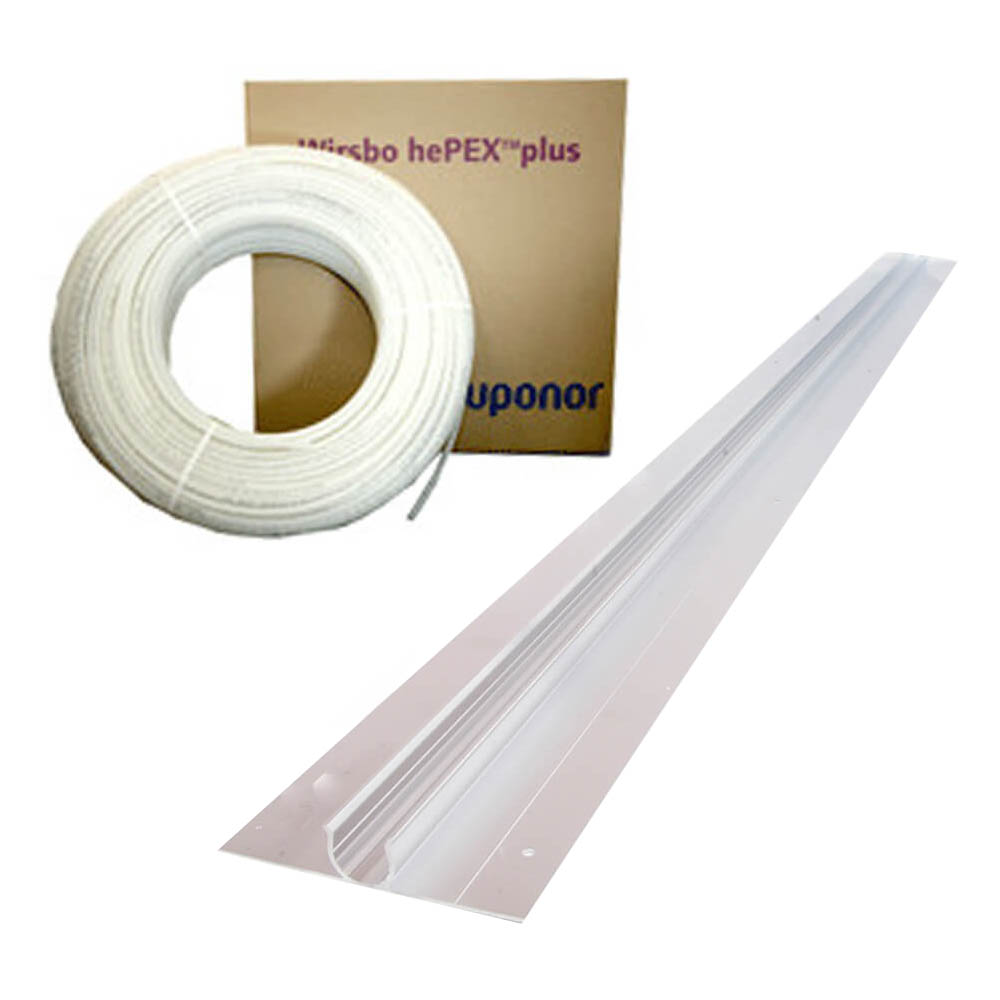
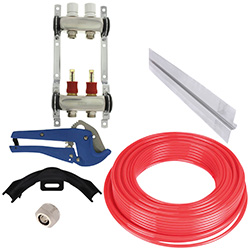
The various types of radiant heat installation packages available on our website are Joist Trak, Quik Trak, Slab, and Suspended Pipe. Each of these packages is available in several sizes to meet a variety of application needs. All of our radiant heating packages contain the necessary accessories, tubing, and fittings required for installation. However, these packages do not include pumps, controls, or valves that may be necessary to complete the installation. Each installation package type is available with several tubing brands, including Rifeng, ThermaPEX and Uponor. Our packages are appropriate for applications ranging from 250 to 2000 square feet, except for Joist Trak packages which range from 250 to 1000 square feet
Joist Trak Heat Packages
Uponor (Wirsbo) Joist Trak is the best option when an existing floor is in place, but access to the joist spaces beneath them is still available. Joist Trak panels are made of a thick aluminum alloy which is great for heat transfer. These aluminum panels contain 1/2" grooves that allow 1/2" PEX tubing to be installed firmly into place. Joist Trak panels heat up as hot water passes through the PEX tubing. The aluminum panels are installed securely in joist spaces beneath the wood subfloor and transfer heat to the floor above. To determine the amount of Joist Trak and PEX Tubing needed for your project use the Joist Trak Calculator located here.
Quik Trak Heating Packages
Uponor (Wirsbo) Quik Trak is best when a foundation is present and you can raise your floors by 1/2" but not 2". Quik Trak panels are wooden panels that contain an aluminum heat transfer plate on one side, and grooves that allow 5/16" PEX tubing to be installed firmly into place on the opposite side. All Uponor (Wirsbo) Quik Trak Panels measure 7" wide x 48" long and are designed for use with Uponor (Wirsbo) 5/16" hePEX plus only. Similar to a Joist Trak panel, a Quik Trak transfer plate heats up as hot water passes through the PEX tubing. These unique panels are available in straight runs or return bends to create loops. They can easily be cut or combined to fit the size and shape of any room. To determine the amount of Quik Trak and PEX Tubing needed for your project use the Quik Trak Calculator located here.
Slab Radiant Heat Packages
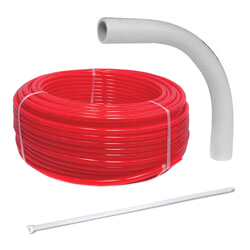
Slab Radiant Heat Packages are ideal in new construction or large remodel applications where the concrete slab has not yet been poured. In this application, PEX tubing is laid out and then the concrete slab is poured over the tubing. As hot water circulates through the PEX, the entire slab rises in temperature and heats the room. The slab becomes a large thermal mass and will stay warm for a long time, which means that the room will stay warm for a long time with little energy usage. For this reason, a slab installation is the most cost effective method. It is especially important to pressure test when installing in a slab. If there is a leak, it must be located before the concrete is poured.
Suspended Pipe Radiant Heating Packages
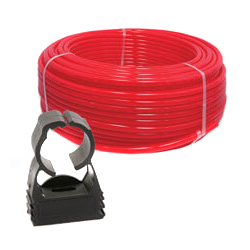
Suspended pipe radiant heat packages are similar to Joist Trak in that they both are installed within the joists under a subfloor. As hot water passes through PEX tubing, the tubing gives off heat which warms the joist cavity. The tubing's exterior also gives off heat to the surrounding air which creates circulation within the joist cavities. The warm air flows across the underside of the subfloor transferring more heat to it. Suspended tube systems have lower installation costs because they don't require heat transfer plates. However, they are not as energy efficient.
Quik Trak Calculator - determine how many panels you need.
PEX Radiant Heat Packages offer a great means of getting started on your first PEX radiant heat project. Radiant heat is growing in popularity, and is now the preferred heating system in new homes. Radiant heat provides more comfort throughout the home than standard baseboard heat. PEX tubing is installed beneath the floor and heats the home from the ground up. As the floor becomes warm, the room is heated evenly and efficiently. Radiant heat is silent, producing no creaking, banging, or humming sounds, such as those commonly heard in other heating systems. Radiant heat allows the thermostat to be set a few degrees lower than it would normally be set, while still providing the same warmth. This cuts energy bills and saves you money.
The various types of radiant heat installation packages available on our website are Joist Trak, Quik Trak, Slab, and Suspended Pipe. Each of these packages is available in several sizes to meet a variety of application needs. All of our radiant heating packages contain the necessary accessories, tubing, and fittings required for installation. However, these packages do not include pumps, controls, or valves that may be necessary to complete the installation. Each installation package type is available with several tubing brands, including Rifeng, ThermaPEX and Uponor. Our packages are appropriate for applications ranging from 250 to 2000 square feet, except for Joist Trak packages which range from 250 to 1000 square feet
Joist Trak Heat Packages
Uponor (Wirsbo) Joist Trak is the best option when an existing floor is in place, but access to the joist spaces beneath them is still available. Joist Trak panels are made of a thick aluminum alloy which is great for heat transfer. These aluminum panels contain 1/2" grooves that allow 1/2" PEX tubing to be installed firmly into place. Joist Trak panels heat up as hot water passes through the PEX tubing. The aluminum panels are installed securely in joist spaces beneath the wood subfloor and transfer heat to the floor above. To determine the amount of Joist Trak and PEX Tubing needed for your project use the Joist Trak Calculator located here.
Quik Trak Heating Packages
Uponor (Wirsbo) Quik Trak is best when a foundation is present and you can raise your floors by 1/2" but not 2". Quik Trak panels are wooden panels that contain an aluminum heat transfer plate on one side, and grooves that allow 5/16" PEX tubing to be installed firmly into place on the opposite side. All Uponor (Wirsbo) Quik Trak Panels measure 7" wide x 48" long and are designed for use with Uponor (Wirsbo) 5/16" hePEX plus only. Similar to a Joist Trak panel, a Quik Trak transfer plate heats up as hot water passes through the PEX tubing. These unique panels are available in straight runs or return bends to create loops. They can easily be cut or combined to fit the size and shape of any room. To determine the amount of Quik Trak and PEX Tubing needed for your project use the Quik Trak Calculator located here.
Slab Radiant Heat Packages
Slab Radiant Heat Packages are ideal in new construction or large remodel applications where the concrete slab has not yet been poured. In this application, PEX tubing is laid out and then the concrete slab is poured over the tubing. As hot water circulates through the PEX, the entire slab rises in temperature and heats the room. The slab becomes a large thermal mass and will stay warm for a long time, which means that the room will stay warm for a long time with little energy usage. For this reason, a slab installation is the most cost effective method. It is especially important to pressure test when installing in a slab. If there is a leak, it must be located before the concrete is poured.
Suspended Pipe Radiant Heating Packages
Suspended pipe radiant heat packages are similar to Joist Trak in that they both are installed within the joists under a subfloor. As hot water passes through PEX tubing, the tubing gives off heat which warms the joist cavity. The tubing's exterior also gives off heat to the surrounding air which creates circulation within the joist cavities. The warm air flows across the underside of the subfloor transferring more heat to it. Suspended tube systems have lower installation costs because they don't require heat transfer plates. However, they are not as energy efficient.
Resources
Videos

 --%3E %3C!DOCTYPE svg PUBLIC '-//W3C//DTD SVG 1.1//EN' 'http://www.w3.org/Graphics/SVG/1.1/DTD/svg11.dtd'%3E %3Csvg version='1.1' id='Layer_1' xmlns='http://www.w3.org/2000/svg' xmlns:xlink='http://www.w3.org/1999/xlink' x='0px' y='0px' width='90px' height='90px' viewBox='0 0 90 90' enable-background='new 0 0 90 90' xml:space='preserve'%3E %3Crect x='27' y='23' fill='%23FFFFFF' width='43' height='44'/%3E %3Cg%3E %3Cdefs%3E %3Crect id='SVGID_1_' width='90' height='90'/%3E %3C/defs%3E %3CclipPath id='SVGID_2_'%3E %3Cuse xlink:href='%23SVGID_1_' overflow='visible'/%3E %3C/clipPath%3E %3Cpath clip-path='url(%23SVGID_2_)' fill='%234186AD' d='M45,0C20.1,0,0,20.1,0,45c0,24.9,20.1,45,45,45c24.9,0,45-20.1,45-45 C90,20.1,69.9,0,45,0'/%3E %3C/g%3E %3Cpath fill='%23FFFFFF' d='M60.6,47.4l-22.5,14c-0.5,0.3-1,0.399-1.5,0.399s-0.9-0.1-1.4-0.399c-0.9-0.5-1.4-1.4-1.4-2.5v-28 c0-1,0.6-2,1.4-2.5c0.9-0.5,2-0.5,2.9,0.1l22.5,14.1C61.4,43.1,61.9,44,61.9,45S61.4,46.9,60.6,47.4'/%3E %3C/svg%3E)
Radiant Heating Systems
More About Radiant Heat Packages
Radiant Heat Calculator - estimate system requirements.
Quik Trak Calculator - determine how many panels you need.
PEX Radiant Heat Packages offer a great means of getting started on your first PEX radiant heat project. Radiant heat is growing in popularity, and is now the preferred heating system in new homes. Radiant heat provides more comfort throughout the home than standard baseboard heat. PEX tubing is installed beneath the floor and heats the home from the ground up. As the floor becomes warm, the room is heated evenly and efficiently. Radiant heat is silent, producing no creaking, banging, or humming sounds, such as those commonly heard in other heating systems. Radiant heat allows the thermostat to be set a few degrees lower than it would normally be set, while still providing the same warmth. This cuts energy bills and saves you money.
The various types of radiant heat installation packages available on our website are Joist Trak, Quik Trak, Slab, and Suspended Pipe. Each of these packages is available in several sizes to meet a variety of application needs. All of our radiant heating packages contain the necessary accessories, tubing, and fittings required for installation. However, these packages do not include pumps, controls, or valves that may be necessary to complete the installation. Each installation package type is available with several tubing brands, including Rifeng, ThermaPEX and Uponor. Our packages are appropriate for applications ranging from 250 to 2000 square feet, except for Joist Trak packages which range from 250 to 1000 square feet
Joist Trak Heat Packages
Uponor (Wirsbo) Joist Trak is the best option when an existing floor is in place, but access to the joist spaces beneath them is still available. Joist Trak panels are made of a thick aluminum alloy which is great for heat transfer. These aluminum panels contain 1/2" grooves that allow 1/2" PEX tubing to be installed firmly into place. Joist Trak panels heat up as hot water passes through the PEX tubing. The aluminum panels are installed securely in joist spaces beneath the wood subfloor and transfer heat to the floor above. To determine the amount of Joist Trak and PEX Tubing needed for your project use the Joist Trak Calculator located here.
Quik Trak Heating Packages
Uponor (Wirsbo) Quik Trak is best when a foundation is present and you can raise your floors by 1/2" but not 2". Quik Trak panels are wooden panels that contain an aluminum heat transfer plate on one side, and grooves that allow 5/16" PEX tubing to be installed firmly into place on the opposite side. All Uponor (Wirsbo) Quik Trak Panels measure 7" wide x 48" long and are designed for use with Uponor (Wirsbo) 5/16" hePEX plus only. Similar to a Joist Trak panel, a Quik Trak transfer plate heats up as hot water passes through the PEX tubing. These unique panels are available in straight runs or return bends to create loops. They can easily be cut or combined to fit the size and shape of any room. To determine the amount of Quik Trak and PEX Tubing needed for your project use the Quik Trak Calculator located here.
Slab Radiant Heat Packages
Slab Radiant Heat Packages are ideal in new construction or large remodel applications where the concrete slab has not yet been poured. In this application, PEX tubing is laid out and then the concrete slab is poured over the tubing. As hot water circulates through the PEX, the entire slab rises in temperature and heats the room. The slab becomes a large thermal mass and will stay warm for a long time, which means that the room will stay warm for a long time with little energy usage. For this reason, a slab installation is the most cost effective method. It is especially important to pressure test when installing in a slab. If there is a leak, it must be located before the concrete is poured.
Suspended Pipe Radiant Heating Packages
Suspended pipe radiant heat packages are similar to Joist Trak in that they both are installed within the joists under a subfloor. As hot water passes through PEX tubing, the tubing gives off heat which warms the joist cavity. The tubing's exterior also gives off heat to the surrounding air which creates circulation within the joist cavities. The warm air flows across the underside of the subfloor transferring more heat to it. Suspended tube systems have lower installation costs because they don't require heat transfer plates. However, they are not as energy efficient.
Quik Trak Calculator - determine how many panels you need.
PEX Radiant Heat Packages offer a great means of getting started on your first PEX radiant heat project. Radiant heat is growing in popularity, and is now the preferred heating system in new homes. Radiant heat provides more comfort throughout the home than standard baseboard heat. PEX tubing is installed beneath the floor and heats the home from the ground up. As the floor becomes warm, the room is heated evenly and efficiently. Radiant heat is silent, producing no creaking, banging, or humming sounds, such as those commonly heard in other heating systems. Radiant heat allows the thermostat to be set a few degrees lower than it would normally be set, while still providing the same warmth. This cuts energy bills and saves you money.
The various types of radiant heat installation packages available on our website are Joist Trak, Quik Trak, Slab, and Suspended Pipe. Each of these packages is available in several sizes to meet a variety of application needs. All of our radiant heating packages contain the necessary accessories, tubing, and fittings required for installation. However, these packages do not include pumps, controls, or valves that may be necessary to complete the installation. Each installation package type is available with several tubing brands, including Rifeng, ThermaPEX and Uponor. Our packages are appropriate for applications ranging from 250 to 2000 square feet, except for Joist Trak packages which range from 250 to 1000 square feet
Joist Trak Heat Packages
Uponor (Wirsbo) Joist Trak is the best option when an existing floor is in place, but access to the joist spaces beneath them is still available. Joist Trak panels are made of a thick aluminum alloy which is great for heat transfer. These aluminum panels contain 1/2" grooves that allow 1/2" PEX tubing to be installed firmly into place. Joist Trak panels heat up as hot water passes through the PEX tubing. The aluminum panels are installed securely in joist spaces beneath the wood subfloor and transfer heat to the floor above. To determine the amount of Joist Trak and PEX Tubing needed for your project use the Joist Trak Calculator located here.
Quik Trak Heating Packages
Uponor (Wirsbo) Quik Trak is best when a foundation is present and you can raise your floors by 1/2" but not 2". Quik Trak panels are wooden panels that contain an aluminum heat transfer plate on one side, and grooves that allow 5/16" PEX tubing to be installed firmly into place on the opposite side. All Uponor (Wirsbo) Quik Trak Panels measure 7" wide x 48" long and are designed for use with Uponor (Wirsbo) 5/16" hePEX plus only. Similar to a Joist Trak panel, a Quik Trak transfer plate heats up as hot water passes through the PEX tubing. These unique panels are available in straight runs or return bends to create loops. They can easily be cut or combined to fit the size and shape of any room. To determine the amount of Quik Trak and PEX Tubing needed for your project use the Quik Trak Calculator located here.
Slab Radiant Heat Packages
Slab Radiant Heat Packages are ideal in new construction or large remodel applications where the concrete slab has not yet been poured. In this application, PEX tubing is laid out and then the concrete slab is poured over the tubing. As hot water circulates through the PEX, the entire slab rises in temperature and heats the room. The slab becomes a large thermal mass and will stay warm for a long time, which means that the room will stay warm for a long time with little energy usage. For this reason, a slab installation is the most cost effective method. It is especially important to pressure test when installing in a slab. If there is a leak, it must be located before the concrete is poured.
Suspended Pipe Radiant Heating Packages
Suspended pipe radiant heat packages are similar to Joist Trak in that they both are installed within the joists under a subfloor. As hot water passes through PEX tubing, the tubing gives off heat which warms the joist cavity. The tubing's exterior also gives off heat to the surrounding air which creates circulation within the joist cavities. The warm air flows across the underside of the subfloor transferring more heat to it. Suspended tube systems have lower installation costs because they don't require heat transfer plates. However, they are not as energy efficient.