




Radiant Heat Panels
Radiant heat panels transfer heat from PEX tubing into a floor assembly, covering aluminum heat transfer plates that mount below a subfloor and above-subfloor panel systems that install directly under finished flooring. The category includes Uponor's Joist Trak and Quik Trak lines along with the lighter Ultra-Fin panel system.
Aluminum panels improve heat transfer efficiency compared to bare PEX tubing pressed into a subfloor, spreading heat more evenly across the floor surface. Choosing between above and below-subfloor panel systems depends on whether the installation is new construction or a retrofit into existing joist spaces.
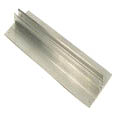

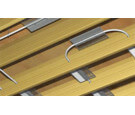


Uponor Joist Trak Panels are heavy-gauge aluminum heat transfer plates installed in joist bays beneath the subfloor, gripping 1/2 inch PEX tubing routed between joists. The panels clip onto the PEX tubing and press against the underside of the subfloor, conducting heat from the water in the tubing through the aluminum into the subfloor and floor covering above. Because Joist Trak installs below the existing subfloor, it does not raise the floor height and is compatible with any floor covering.
Uponor Quik Trak Radiant Heat System is an above-subfloor panel system consisting of tongue-and-groove OSB panels with routed channels and aluminum heat transfer plates that accept 5/16 inch PEX tubing. Quik Trak panels are stapled to the top of the existing subfloor, raising the floor height by approximately 7/16 to 1/2 inch. Quik Trak is well suited to renovation projects where joist bay access is not available and the floor height increase is acceptable.
Ultra-Fin Radiant Panel System consists of lightweight aluminum panels that hang approximately 2 inches below the subfloor in the joist bay, suspending the PEX tubing against the back of the panel. Ultra-Fin panels create a small air gap between the panel and the subfloor that allows convective air circulation in the joist bay, supplementing conductive heat transfer. The system uses 1/2 inch PEX tubing and is compatible with standard radiant heat supply water temperatures.
The primary factor determining which panel system to use is whether access is available to the joist bays from below. In renovations without joist bay access, Quik Trak is installed on top of the subfloor before the finish floor is laid. Floor covering compatibility must be verified: hardwood and engineered wood floors limit radiant floor surface temperature to 80 to 85 degrees Fahrenheit, constraining supply water temperature and system output per square foot.
Supply water temperature for panel radiant systems is typically 100 to 140 degrees Fahrenheit. Lower supply temperatures improve efficiency when using a condensing boiler. An outdoor reset control that reduces supply temperature as outdoor temperature rises improves efficiency throughout the heating season. A room-by-room heat loss calculation is the basis for specifying tube spacing, loop lengths, and supply water temperature.
What is the difference between Joist Trak panels and Quik Trak panels?
Joist Trak panels are installed from below the subfloor in joist bays and do not raise the floor height, using 1/2 inch PEX tubing. Quik Trak panels are installed on top of the subfloor before the finish floor is laid, raising the floor height approximately 1/2 inch, and use 5/16 inch PEX tubing. Joist Trak is the choice when joist bay access is available; Quik Trak is the choice when joist bay access is not available and the floor height increase is manageable.
Can radiant heat panels work with any floor covering?
Radiant heat panels are compatible with most floor coverings, but each has a maximum allowable surface temperature. Hardwood and engineered wood floors limit the radiant floor surface temperature to 80 to 85 degrees Fahrenheit, which constrains supply water temperature and heat output per square foot. Ceramic tile, porcelain, and stone are the most compatible floor coverings for radiant heating because of their high thermal conductivity and high allowable surface temperatures.
How much does Quik Trak raise the floor height?
Quik Trak panels raise the finished floor height by approximately 7/16 to 1/2 inch above the existing subfloor level. This height increase must be accommodated at all door thresholds, transitions to adjacent rooms, and at plumbing fixture rough-in dimensions. Where the floor height change cannot be managed, Joist Trak or Ultra-Fin installed from below is the alternative if joist bay access is available.
What supply water temperature do radiant heat panels require?
Most radiant heat panel systems operate with supply water temperatures in the range of 100 to 140 degrees Fahrenheit, with the specific temperature determined by panel type, tube spacing, floor covering, and room heat loss. Systems with tile floors and close tube spacing can often meet their heating load with supply temperatures of 100 to 110 degrees Fahrenheit, within the condensing range for a condensing boiler.
Can radiant heat panels be installed in a bathroom with tile?
Radiant heat panels are an excellent choice for bathrooms with tile floors. Tile's high thermal conductivity allows efficient heat transfer from the panel to the floor surface with no maximum surface temperature limitation constraining system output. Where joist bay access exists, Joist Trak panels can be installed without disturbing the tile floor. New tile can be installed directly over Quik Trak panels in new construction or full renovation.
Resources

 --%3E %3C!DOCTYPE svg PUBLIC '-//W3C//DTD SVG 1.1//EN' 'http://www.w3.org/Graphics/SVG/1.1/DTD/svg11.dtd'%3E %3Csvg version='1.1' id='Layer_1' xmlns='http://www.w3.org/2000/svg' xmlns:xlink='http://www.w3.org/1999/xlink' x='0px' y='0px' width='90px' height='90px' viewBox='0 0 90 90' enable-background='new 0 0 90 90' xml:space='preserve'%3E %3Crect x='27' y='23' fill='%23FFFFFF' width='43' height='44'/%3E %3Cg%3E %3Cdefs%3E %3Crect id='SVGID_1_' width='90' height='90'/%3E %3C/defs%3E %3CclipPath id='SVGID_2_'%3E %3Cuse xlink:href='%23SVGID_1_' overflow='visible'/%3E %3C/clipPath%3E %3Cpath clip-path='url(%23SVGID_2_)' fill='%234186AD' d='M45,0C20.1,0,0,20.1,0,45c0,24.9,20.1,45,45,45c24.9,0,45-20.1,45-45 C90,20.1,69.9,0,45,0'/%3E %3C/g%3E %3Cpath fill='%23FFFFFF' d='M60.6,47.4l-22.5,14c-0.5,0.3-1,0.399-1.5,0.399s-0.9-0.1-1.4-0.399c-0.9-0.5-1.4-1.4-1.4-2.5v-28 c0-1,0.6-2,1.4-2.5c0.9-0.5,2-0.5,2.9,0.1l22.5,14.1C61.4,43.1,61.9,44,61.9,45S61.4,46.9,60.6,47.4'/%3E %3C/svg%3E)
Other Resources
Uponor Joist Trak Panels are heavy-gauge aluminum heat transfer plates installed in joist bays beneath the subfloor, gripping 1/2 inch PEX tubing routed between joists. The panels clip onto the PEX tubing and press against the underside of the subfloor, conducting heat from the water in the tubing through the aluminum into the subfloor and floor covering above. Because Joist Trak installs below the existing subfloor, it does not raise the floor height and is compatible with any floor covering.
Uponor Quik Trak Radiant Heat System is an above-subfloor panel system consisting of tongue-and-groove OSB panels with routed channels and aluminum heat transfer plates that accept 5/16 inch PEX tubing. Quik Trak panels are stapled to the top of the existing subfloor, raising the floor height by approximately 7/16 to 1/2 inch. Quik Trak is well suited to renovation projects where joist bay access is not available and the floor height increase is acceptable.
Ultra-Fin Radiant Panel System consists of lightweight aluminum panels that hang approximately 2 inches below the subfloor in the joist bay, suspending the PEX tubing against the back of the panel. Ultra-Fin panels create a small air gap between the panel and the subfloor that allows convective air circulation in the joist bay, supplementing conductive heat transfer. The system uses 1/2 inch PEX tubing and is compatible with standard radiant heat supply water temperatures.
The primary factor determining which panel system to use is whether access is available to the joist bays from below. In renovations without joist bay access, Quik Trak is installed on top of the subfloor before the finish floor is laid. Floor covering compatibility must be verified: hardwood and engineered wood floors limit radiant floor surface temperature to 80 to 85 degrees Fahrenheit, constraining supply water temperature and system output per square foot.
Supply water temperature for panel radiant systems is typically 100 to 140 degrees Fahrenheit. Lower supply temperatures improve efficiency when using a condensing boiler. An outdoor reset control that reduces supply temperature as outdoor temperature rises improves efficiency throughout the heating season. A room-by-room heat loss calculation is the basis for specifying tube spacing, loop lengths, and supply water temperature.
What is the difference between Joist Trak panels and Quik Trak panels?
Joist Trak panels are installed from below the subfloor in joist bays and do not raise the floor height, using 1/2 inch PEX tubing. Quik Trak panels are installed on top of the subfloor before the finish floor is laid, raising the floor height approximately 1/2 inch, and use 5/16 inch PEX tubing. Joist Trak is the choice when joist bay access is available; Quik Trak is the choice when joist bay access is not available and the floor height increase is manageable.
Can radiant heat panels work with any floor covering?
Radiant heat panels are compatible with most floor coverings, but each has a maximum allowable surface temperature. Hardwood and engineered wood floors limit the radiant floor surface temperature to 80 to 85 degrees Fahrenheit, which constrains supply water temperature and heat output per square foot. Ceramic tile, porcelain, and stone are the most compatible floor coverings for radiant heating because of their high thermal conductivity and high allowable surface temperatures.
How much does Quik Trak raise the floor height?
Quik Trak panels raise the finished floor height by approximately 7/16 to 1/2 inch above the existing subfloor level. This height increase must be accommodated at all door thresholds, transitions to adjacent rooms, and at plumbing fixture rough-in dimensions. Where the floor height change cannot be managed, Joist Trak or Ultra-Fin installed from below is the alternative if joist bay access is available.
What supply water temperature do radiant heat panels require?
Most radiant heat panel systems operate with supply water temperatures in the range of 100 to 140 degrees Fahrenheit, with the specific temperature determined by panel type, tube spacing, floor covering, and room heat loss. Systems with tile floors and close tube spacing can often meet their heating load with supply temperatures of 100 to 110 degrees Fahrenheit, within the condensing range for a condensing boiler.
Can radiant heat panels be installed in a bathroom with tile?
Radiant heat panels are an excellent choice for bathrooms with tile floors. Tile's high thermal conductivity allows efficient heat transfer from the panel to the floor surface with no maximum surface temperature limitation constraining system output. Where joist bay access exists, Joist Trak panels can be installed without disturbing the tile floor. New tile can be installed directly over Quik Trak panels in new construction or full renovation.