




Refrigerant Copper Press Long Radius 90° Elbows


 --%3E %3Csvg version='1.1' id='No-RB' xmlns='http://www.w3.org/2000/svg' xmlns:xlink='http://www.w3.org/1999/xlink' x='0px' y='0px' viewBox='0 0 100 100' enable-background='new 0 0 100 100' xml:space='preserve'%3E %3Cpath fill='%23CECECE' d='M79.44,0.95H20.56C9.78,0.95,0.95,9.78,0.95,20.56v58.87c0,10.79,8.82,19.61,19.61,19.61h58.87 c10.79,0,19.61-8.83,19.61-19.61V20.56C99.05,9.78,90.22,0.95,79.44,0.95z M65.38,58.24l9.38,29.58L49.69,69.78L24.5,87.82 l9.34-29.6L8.8,39.6l30.73-0.17c0,0,6.98-19.61,10-28.93c0.54,1.36,9.88,29.1,9.88,29.1H91.2L65.38,58.24z'/%3E %3C/svg%3E)



 --%3E %3Csvg version='1.1' id='Fill' xmlns='http://www.w3.org/2000/svg' xmlns:xlink='http://www.w3.org/1999/xlink' x='0px' y='0px' viewBox='0 0 100 100' enable-background='new 0 0 100 100' xml:space='preserve'%3E %3Cpath fill='%23F15C02' d='M79.44,0.95H20.56C9.78,0.95,0.95,9.78,0.95,20.56v58.87c0,10.79,8.82,19.61,19.61,19.61h58.87 c10.79,0,19.61-8.83,19.61-19.61V20.56C99.05,9.78,90.22,0.95,79.44,0.95z M65.38,58.24l9.38,29.58L49.69,69.78L24.5,87.82 l9.34-29.6L8.8,39.6l30.73-0.17c0,0,6.98-19.61,10-28.93c0.54,1.36,9.88,29.1,9.88,29.1H91.2L65.38,58.24z'/%3E %3C/svg%3E)
 --%3E %3Csvg version='1.1' id='Half' xmlns='http://www.w3.org/2000/svg' xmlns:xlink='http://www.w3.org/1999/xlink' x='0px' y='0px' viewBox='0 0 100 100' enable-background='new 0 0 100 100' xml:space='preserve'%3E %3Cg%3E %3Cpath fill='%23F15C02' d='M30.05,70.23l3.79-12.01L8.8,39.6l30.73-0.17c0,0,6.98-19.61,10-28.93c0.54,1.36,9.88,29.1,9.88,29.1h1.58 L93.71,7.18c-3.58-3.82-8.66-6.23-14.28-6.23H20.56C9.78,0.95,0.95,9.78,0.95,20.56v58.87c0,5.41,2.22,10.32,5.79,13.88 L30.05,70.23z'/%3E %3C/g%3E %3Cpath fill='%23FBC8B4' d='M93.71,7.18L60.98,39.6H91.2L65.38,58.24l9.38,29.58L49.69,69.78L24.5,87.82l5.55-17.59L6.75,93.32 c3.55,3.54,8.44,5.73,13.82,5.73h58.87c10.79,0,19.61-8.83,19.61-19.61V20.56C99.05,15.4,97.01,10.69,93.71,7.18z'/%3E %3C/svg%3E)


 --%3E %3Csvg version='1.1' id='With-RB' xmlns='http://www.w3.org/2000/svg' xmlns:xlink='http://www.w3.org/1999/xlink' x='0px' y='0px' viewBox='0 0 100 100' enable-background='new 0 0 100 100' xml:space='preserve'%3E %3Cpath fill='%23FBC8B4' d='M79.44,0.95H20.56C9.78,0.95,0.95,9.78,0.95,20.56v58.87c0,10.79,8.82,19.61,19.61,19.61h58.87 c10.79,0,19.61-8.83,19.61-19.61V20.56C99.05,9.78,90.22,0.95,79.44,0.95z M65.38,58.24l9.38,29.58L49.69,69.78L24.5,87.82 l9.34-29.6L8.8,39.6l30.73-0.17c0,0,6.98-19.61,10-28.93c0.54,1.36,9.88,29.1,9.88,29.1H91.2L65.38,58.24z'/%3E %3C/svg%3E)


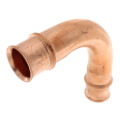

Refrigerant copper press long radius 90-degree elbows are direction-change fittings that turn a refrigerant line a full quarter turn using a wider bend radius than a standard short-radius elbow. A press connection joins the fitting to the tube with a mechanical crimp instead of a brazed joint, letting a technician complete the turn without an open flame. The longer radius reduces the pressure drop and turbulence that a tighter bend introduces into the refrigerant flow, which matters most on longer line sets or systems sensitive to pressure loss. Installers reach for this style when routing a line through tight framing bays or around obstacles where a smooth, gradual turn keeps the system running efficiently. Because the fitting relies on a proper crimp rather than solder, correct press tool and jaw selection are as important as choosing the right elbow radius for the job.
Subcategories
- Standard Diameter Long Radius Elbows: These cover the tube sizes most commonly used on residential and light commercial line sets, giving technicians a direct turn option without stacking two shorter-radius fittings. Choosing the diameter that matches the tube on hand keeps the crimp profile consistent. Contractors typically stock a range of sizes to cover the line sets they see most often.
- Large Diameter Long Radius Elbows: Larger diameter elbows serve bigger line sets on commercial refrigeration and larger tonnage HVAC systems, where minimizing pressure drop across a turn matters even more due to the higher flow volume. Technicians select these for equipment rooms with larger suction and liquid lines. The wider bend radius on a larger diameter fitting still requires adequate clearance to install without kinking the tube.
- Press Elbow Accessories: O-rings and jaw inserts sized to match each elbow diameter keep a service truck ready to install without a parts run. Keeping spare O-rings on hand matters since a nicked or reused ring is a common cause of a slow leak at the joint. Matching jaw size to elbow diameter is what keeps the crimp seated correctly.
Buying Guide
Choosing between a long radius and short radius elbow comes down to available space and how much the system is sensitive to pressure drop. A long radius elbow takes up more room to make the same 90-degree turn but reduces turbulence in the flow, making it the better choice on longer runs or larger tonnage systems.
Diameter needs to match the tube being joined exactly, since a press fitting depends on a precise fit between tube and fitting body for the crimp to seal properly. Refrigerant copper press long radius 90-degree elbows come in a range of sizes, so confirming tube diameter before ordering avoids a fitting that doesn't seat correctly under the press tool jaw.
Available clearance in the installation space matters just as much as the elbow's rated capacity. A long radius bend needs more physical room in a framing bay or equipment room than a short radius fitting, so measuring the actual space before committing to a routing plan prevents a redesign mid-installation.
Press tool and jaw compatibility should be confirmed before purchasing, since not every press tool brand works with every fitting manufacturer's jaw profile. Checking this ahead of time avoids a fitting that arrives on site but can't be installed with the tool already on the truck.
Stocking a small range of elbow diameters and matching jaw inserts, rather than ordering a single size at a time, keeps a technician ready for whatever line set diameter shows up on the next call.
Frequently Asked Questions
What is the difference between a long radius and short radius elbow?
A long radius elbow uses a wider bend to make the same 90-degree turn, which reduces turbulence and pressure drop in the refrigerant flow compared to a tighter short radius elbow. The tradeoff is that a long radius fitting needs more physical space to install.
Why choose a long radius elbow over a short radius one?
Long radius elbows are chosen when minimizing pressure drop matters most, such as on longer line sets or larger tonnage systems where flow volume is higher. Short radius elbows are more common in tight spaces where clearance is limited.
Do press elbows require a special tool to install?
Yes. Installing a press elbow requires a press tool with a jaw sized to match the fitting diameter. Confirming that the jaw profile matches the fitting manufacturer before starting the job avoids an incomplete crimp.
Can a press elbow be used on an existing, charged refrigerant line?
A press elbow can be installed on an existing line once the refrigerant has been properly recovered from the affected section and the tube is cut and prepared to the fitting manufacturer's specifications.
What causes a press elbow joint to leak?
A leak at a press elbow is most often caused by a tube end that wasn't cleanly cut and deburred, a nicked or reused O-ring, or a jaw insert that didn't match the fitting size during the crimp.
