




Refrigerant Copper Press Reducing Bushings
 --%3E %3Csvg version='1.1' id='No-RB' xmlns='http://www.w3.org/2000/svg' xmlns:xlink='http://www.w3.org/1999/xlink' x='0px' y='0px' viewBox='0 0 100 100' enable-background='new 0 0 100 100' xml:space='preserve'%3E %3Cpath fill='%23CECECE' d='M79.44,0.95H20.56C9.78,0.95,0.95,9.78,0.95,20.56v58.87c0,10.79,8.82,19.61,19.61,19.61h58.87 c10.79,0,19.61-8.83,19.61-19.61V20.56C99.05,9.78,90.22,0.95,79.44,0.95z M65.38,58.24l9.38,29.58L49.69,69.78L24.5,87.82 l9.34-29.6L8.8,39.6l30.73-0.17c0,0,6.98-19.61,10-28.93c0.54,1.36,9.88,29.1,9.88,29.1H91.2L65.38,58.24z'/%3E %3C/svg%3E)

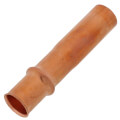

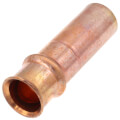
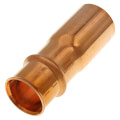


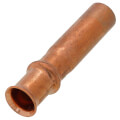
Refrigerant Copper Press Reducing Bushings change copper line set sizing at a single fitting, connecting two different pipe diameters without a brazing torch. RLS reducing bushings carry a UL 207 listing rated to 700 psi, the same certification standard used across refrigerant containing components and accessories. Techs installing or servicing heat pumps, split system air conditioners, and commercial refrigeration equipment use reducing bushings whenever a condenser's factory line set size doesn't match the indoor coil or existing line set already in the wall. Because the fitting presses onto the copper rather than requiring heat, it fits jobs where an open flame near insulation, framing, or an occupied space isn't practical. ICC-ES evaluation and compliance with current International Mechanical Code, International Residential Code, and Uniform Mechanical Code editions give inspectors a documented basis for approving the connection on both new construction and retrofit work.
Subcategories
- Small Diameter Reducing Bushings: Small diameter reducing bushings cover sizes like 3/8 inch to 1/2 inch, or 1/2 inch to 5/8 inch, the range most common on mini split and ductless line sets. Installers reach for this size range when a condenser's factory connection is smaller than the line set already run to the indoor head, a common mismatch on ductless retrofit jobs. Each bushing carries the same UL 207 listing rated to 700 psi as the rest of the RLS line, so pressure capacity doesn't change with the smaller size. The press connection also avoids running a torch near a wall mounted indoor unit or finished ceiling.
- Residential Split System Reducing Bushings: Residential split system reducing bushings cover the 5/8 inch to 7/8 inch range most common on single family and light commercial condensers and coils. Techs use this size range on straightforward AC and heat pump changeouts where the new condenser's line connections don't match the existing line set in the wall. UL 207 listing to 700 psi applies across this range as well. Because the fitting presses on rather than requiring brazing, a changeout can move forward even when nitrogen purging equipment isn't set up on site.
- Large Diameter Commercial Reducing Bushings: Large diameter reducing bushings cover sizes from 7/8 inch up through 1-3/8 inch and larger, sizing typically found on VRF systems, chillers, and commercial refrigeration equipment. Commercial service techs use these bushings when connecting new equipment to an existing larger diameter line set or when a manufacturer's connection size differs from the site's installed piping. The same UL 207, 700 psi rating applies at this larger end of the line. Reducing bushings at this size also cut down on labor time compared to brazing a reducing coupling on larger diameter copper.
Buying Guide
Confirm the exact pipe diameters on both sides of the reduction before ordering, since a bushing sized for 7/8 inch to 3/4 inch won't work as a substitute for a 3/4 inch to 5/8 inch reduction even though both involve a 3/4 inch pipe. Measuring the outside diameter of the existing line set, rather than assuming a nominal size, catches mismatches before a fitting shows up that doesn't seat correctly. Pressure rating is one area where these fittings don't require much cross checking. Refrigerant Copper Press Reducing Bushings across the RLS line carry a single UL 207 listing rated to 700 psi, so the certification doesn't change based on which reduction size gets ordered. What does change job to job is whether a press connection makes sense over a brazed reducing coupling. Retrofit and repair calls in occupied spaces, tight mechanical rooms, or anywhere a hot work permit would slow down the job benefit most from a press fitting, since the connection completes without a torch or nitrogen purge. New construction runs with open access and no fire watch requirements may still call for brazed fittings depending on the specifying engineer's requirements, so checking the job's mechanical spec before substituting a press fitting avoids a rejected inspection. Keeping a stock of the common reduction sizes, from small diameter mini split bushings up through the larger commercial sizes, covers most line set mismatches found on residential and light commercial service calls.
Frequently Asked Questions
What pressure rating do refrigerant copper press reducing bushings carry?
RLS refrigerant copper press reducing bushings carry a UL 207 listing rated to 700 psi across the full size range. The listing covers the fitting under the same nonelectrical refrigerant containing components standard used for other press and brazed refrigeration fittings. Pressure rating stays consistent regardless of which reduction size gets installed.
Can a press reducing bushing replace a brazed reducing coupling in every situation?
A press reducing bushing can replace a brazed coupling on most residential and light commercial jobs, particularly retrofit and repair work where a torch isn't practical. Some new construction specifications still call for brazed connections depending on the engineer's requirements, so checking the job's mechanical spec before substituting is worth the extra step. Both connection types carry code recognition, but the specifying documents for a given job determine which one is required.
How is the correct reducing bushing size determined?
Correct sizing depends on measuring the outside diameter of both pipes being joined, since a bushing is specified by the exact pair of sizes it reduces between, such as 7/8 inch to 3/4 inch. Assuming a nominal pipe size instead of measuring the actual outside diameter is a common source of an incorrectly ordered fitting. Checking both the existing line set and the new equipment's connection size before ordering avoids a mismatch.
What applications use refrigerant copper press reducing bushings?
Heat pumps, residential and commercial air conditioning, chillers, VRF systems, and refrigeration equipment like coolers and freezers all use reducing bushings wherever a size mismatch exists between a line set and equipment connection. Retrofit and changeout jobs make up much of the demand, since replacement equipment doesn't always share the same connection size as the unit being removed. Sizes range from small diameter mini split connections up through larger commercial diameters.
Why choose a press fitting over a brazed connection for a reducing bushing?
Press fittings connect without an open flame, which removes the need for brazing equipment, filler material, a hot work permit, and nitrogen purging on the job. The advantage matters most in occupied buildings, tight mechanical rooms, or anywhere fire watch requirements would slow down a repair. Installation time also drops significantly since the press connection completes in seconds rather than requiring a full braze and cool down cycle.
