




Refrigerant Y-Joints

 --%3E %3Csvg version='1.1' id='No-RB' xmlns='http://www.w3.org/2000/svg' xmlns:xlink='http://www.w3.org/1999/xlink' x='0px' y='0px' viewBox='0 0 100 100' enable-background='new 0 0 100 100' xml:space='preserve'%3E %3Cpath fill='%23CECECE' d='M79.44,0.95H20.56C9.78,0.95,0.95,9.78,0.95,20.56v58.87c0,10.79,8.82,19.61,19.61,19.61h58.87 c10.79,0,19.61-8.83,19.61-19.61V20.56C99.05,9.78,90.22,0.95,79.44,0.95z M65.38,58.24l9.38,29.58L49.69,69.78L24.5,87.82 l9.34-29.6L8.8,39.6l30.73-0.17c0,0,6.98-19.61,10-28.93c0.54,1.36,9.88,29.1,9.88,29.1H91.2L65.38,58.24z'/%3E %3C/svg%3E)

 --%3E %3Csvg version='1.1' id='Fill' xmlns='http://www.w3.org/2000/svg' xmlns:xlink='http://www.w3.org/1999/xlink' x='0px' y='0px' viewBox='0 0 100 100' enable-background='new 0 0 100 100' xml:space='preserve'%3E %3Cpath fill='%23F15C02' d='M79.44,0.95H20.56C9.78,0.95,0.95,9.78,0.95,20.56v58.87c0,10.79,8.82,19.61,19.61,19.61h58.87 c10.79,0,19.61-8.83,19.61-19.61V20.56C99.05,9.78,90.22,0.95,79.44,0.95z M65.38,58.24l9.38,29.58L49.69,69.78L24.5,87.82 l9.34-29.6L8.8,39.6l30.73-0.17c0,0,6.98-19.61,10-28.93c0.54,1.36,9.88,29.1,9.88,29.1H91.2L65.38,58.24z'/%3E %3C/svg%3E)
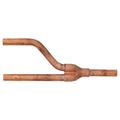
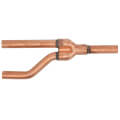
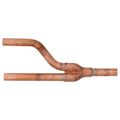
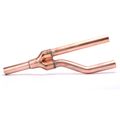
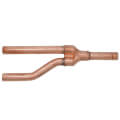
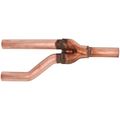
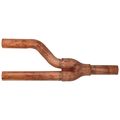
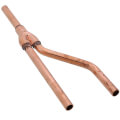
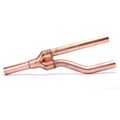

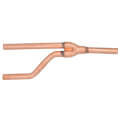
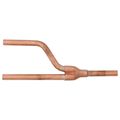
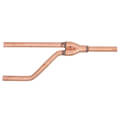
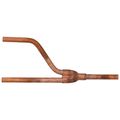
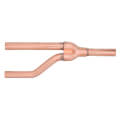
Refrigerant Y-joints are braze-free copper press fittings designed to split a single refrigerant line into two branches, allowing one upstream line to feed two downstream connections without an open flame or hot work permit. RLS refrigerant Y-joints are the primary option in this category, engineered to create a permanent mechanical joint in as little as 10 seconds using a battery-powered press tool. Rated to 700 PSI and UL-207 listed, RLS Y-joints handle the operating pressures of both legacy refrigerants like R-410A and newer A2L refrigerants including R-32, R-454B, and R-1234yf. Sizes span 3/8" through 1-3/8" OD, covering the most common line sizes found in residential and light-commercial HVAC/R work. For multi-zone applications, liquid-line branch splits, or any situation where a refrigerant circuit needs to branch, refrigerant Y-joints deliver a code-compliant connection without the complications of a torch setup.
KEY SUBCATEGORIES / PRODUCT TYPES
RLS Y-Joints: Press-to-Connect Branch Fittings for HVAC/R Lines
RLS Y-joints are three-port copper press fittings that split one refrigerant line into two outlets using RLS Rapid Locking System press technology, with no brazing required. A single press cycle creates two 360-degree metal-to-metal connections per end, and the whole joint is done in under 10 seconds. HVAC/R contractors use RLS Y-joints wherever a refrigerant circuit needs to branch, including multi-zone mini-split piping, commercial refrigeration branch runs, and split-system liquid-line distribution. SKUs available on SupplyHouse include RPYJ038 (3/8"), RPYJ050 (1/2"), RPYJ058 (5/8"), RPYJ075 (3/4"), RPYJ078 (7/8"), RPYJ118 (1-1/8"), and RPYJ138 (1-3/8").
Braze-Free vs. Brazed Y-Fittings
The decision between a press-connect Y-joint and a traditional brazed Y-fitting often comes down to job-site conditions. Brazed copper Y-fittings have been the default for decades and remain code-acceptable in virtually every jurisdiction. Press-connect Y-joints like those in the RLS lineup eliminate the need for nitrogen purging, fire spotters, hot work permits, and cooling time after the joint is made. On occupied buildings, data centers, hospitals, and any site where an open flame creates liability, press-connect Y-joints aren't just faster. They're often the only practical option. RLS Y-joints are designed for copper-to-copper connections only. Connecting to dissimilar metals can cause galvanic corrosion and may compromise joint integrity.
Refrigerant Compatibility: A1 and A2L Lines
Refrigerant compatibility is a critical selection variable as the industry transitions away from R-410A. RLS Y-joints are approved for use with a wide range of A1 and A2L refrigerants, including R-32, R-134a, R-404A, R-407C, R-410A, R-448A, R-449A, R-454B, R-1234yf, and R-1234ze, among others. That approval list matters now, not just eventually, because new equipment is already shipping with A2L refrigerants in many product categories. Contractors should always verify the specific refrigerant approval against RLS engineering documentation before specifying for a new refrigerant type, and should check local codes to confirm press fittings are permitted for the refrigerant in use.
Press Tool and Jaw Compatibility
RLS Y-joints require an RLS-approved press tool and correctly sized RLS jaws. No other tool combination is permitted for installation. RLS jaws are compatible with RIDGID press tools including the RP 100, RP 200, RP 210, RP 240, and RP 241 models, as well as Klauke-manufactured RLS tools. Milwaukee-compatible RLS jaws are also available. The correct jaw must be matched to the fitting size being pressed. A minimum installation envelope of 11 inches by 7 inches is recommended around the fitting to allow proper jaw placement and tool operation. Contractors working in tight mechanical spaces should verify clearance before selecting a connection location.
BUYING GUIDE / HOW TO CHOOSE
The first question when specifying refrigerant Y-joints is line size. Pipe the upstream run first, confirm the required OD for each branch, and match the Y-joint size accordingly. RLS Y-joints run from 3/8" through 1-3/8", which covers the vast majority of residential and light-commercial HVAC/R piping. For branch runs where the two outlets need to be different sizes, a combination of a standard Y-joint and a reducer coupling may be required. Always check the equipment manufacturer's piping guide, not just the unit's connection sizes, since branch piping in multi-zone systems sometimes carries capacity requirements that affect line sizing upstream of the indoor units.
Refrigerant type is the next filter. With A2L refrigerants now appearing in new equipment, confirming that any press fitting is approved for the specific refrigerant in the system isn't optional. RLS publishes an ICC-ES report with a full list of approved refrigerant types. For R-410A legacy systems, R-32 systems, and most common A2L blends, RLS Y-joints are approved. For less common or newly introduced refrigerant blends, check the current ICC-ES listing before ordering.
Job-site conditions drive the press-vs-braze decision. Anywhere hot work permits are required, nitrogen purge equipment is unavailable, or the space makes torch access difficult, braze-free press Y-joints are the practical answer. Factor in that press connections eliminate nitrogen purge time entirely, which on larger branch runs can add up fast. The press tool and RLS-compatible jaws are a required investment, but on a job where multiple Y-joint connections are needed, the 40-60% labor time savings reported by contractors using braze-free fittings tends to recoup that cost quickly.
Finally, verify clearance. A minimum installation envelope of 11 inches by 7 inches is recommended around any RLS fitting. Tight mechanical rooms and drop-ceiling spaces can limit where a press joint is practical. Plan the branch location with that clearance in mind before cutting the line.
FAQs
How do I size a refrigerant Y-joint for a mini-split branch run?
Sizing a refrigerant Y-joint starts with the upstream line size, then confirming the OD required for each branch leg. RLS Y-joints are available in seven sizes from 3/8" through 1-3/8" OD to cover most residential and light-commercial branch configurations. Always cross-reference the equipment manufacturer's piping documentation rather than relying on rule-of-thumb sizing, since multi-zone systems can have specific line sizing requirements for each zone that affect the upstream run as well.
What insertion depth is required for RLS refrigerant Y-joints?
Insertion depth for RLS Y-joints varies by size and must be met before pressing to get a leak-free joint. For 3/8" Y-joints, the minimum insertion depth is 1 inch (25.4 mm). For 1/2" through 7/8" sizes, the minimum is 1-1/4 inches (31.8 mm), and the 1-3/8" size requires a minimum of 1-1/2 inches (38.1 mm). RLS offers a depth gauge tool to confirm correct insertion before pressing. An improperly seated tube is one of the most common causes of joint issues, so verifying insertion depth before pressing is worth the extra few seconds.
How close to an RLS Y-joint can brazing be performed on the same piping assembly?
When brazing is required elsewhere on the same piping assembly, RLS specifies minimum distances from the fitting body to protect the O-ring material. For 3/8" tubing, the minimum distance is 5 inches (127 mm). For 5/8", it's 7 inches (178 mm). For 3/4", it's 8 inches (203 mm), and for 7/8" through 1", it's 9 inches (229 mm). Brazing too close to an installed RLS Y-joint can melt the O-ring and compromise the joint. If an RLS fitting leaks after pressing, the correct response is replacement, not brazing over it.
Which refrigerants are RLS Y-joints approved for?
RLS Y-joints are approved for a broad range of A1 and A2L refrigerants, including R-32, R-134a, R-404A, R-407C, R-410A, R-448A, R-449A, R-454B, R-1234yf, and R-1234ze. The complete approved refrigerant list is published in RLS engineering documentation and ICC-ES reports, which should be reviewed before specifying for any less common or newly introduced refrigerant blend. Local codes may impose additional requirements for A2L refrigerants, so checking jurisdiction-specific rules before installation is recommended.
Can RLS Y-joints be used on soft-drawn copper tubing?
RLS press fittings including Y-joints are designed for hard-drawn copper tubing conforming to ASTM B280, B88, or B1003. Per IMC and UMC requirements, mechanical press joints may not be used on annealed (soft) temper copper tube in sizes larger than 7/8" OD. For 7/8" and smaller, local code jurisdiction requirements should be confirmed before specifying soft copper with press fittings, as requirements can vary by region.
