




Filters
SORT
Product Availability –
Brand –
Product Type –
Review Score –
 --%3E %3Csvg version='1.1' id='Fill' xmlns='http://www.w3.org/2000/svg' xmlns:xlink='http://www.w3.org/1999/xlink' x='0px' y='0px' viewBox='0 0 100 100' enable-background='new 0 0 100 100' xml:space='preserve'%3E %3Cpath fill='%23F15C02' d='M79.44,0.95H20.56C9.78,0.95,0.95,9.78,0.95,20.56v58.87c0,10.79,8.82,19.61,19.61,19.61h58.87 c10.79,0,19.61-8.83,19.61-19.61V20.56C99.05,9.78,90.22,0.95,79.44,0.95z M65.38,58.24l9.38,29.58L49.69,69.78L24.5,87.82 l9.34-29.6L8.8,39.6l30.73-0.17c0,0,6.98-19.61,10-28.93c0.54,1.36,9.88,29.1,9.88,29.1H91.2L65.38,58.24z'/%3E %3C/svg%3E)
Price Range –
Staple Guns

 --%3E %3Csvg version='1.1' id='No-RB' xmlns='http://www.w3.org/2000/svg' xmlns:xlink='http://www.w3.org/1999/xlink' x='0px' y='0px' viewBox='0 0 100 100' enable-background='new 0 0 100 100' xml:space='preserve'%3E %3Cpath fill='%23CECECE' d='M79.44,0.95H20.56C9.78,0.95,0.95,9.78,0.95,20.56v58.87c0,10.79,8.82,19.61,19.61,19.61h58.87 c10.79,0,19.61-8.83,19.61-19.61V20.56C99.05,9.78,90.22,0.95,79.44,0.95z M65.38,58.24l9.38,29.58L49.69,69.78L24.5,87.82 l9.34-29.6L8.8,39.6l30.73-0.17c0,0,6.98-19.61,10-28.93c0.54,1.36,9.88,29.1,9.88,29.1H91.2L65.38,58.24z'/%3E %3C/svg%3E)

Staple guns drive fasteners into wood, fabric, and other soft materials for jobs ranging from upholstery and insulation to roofing underlayment and general trim work. Manual, electric, and pneumatic versions cover different volumes of work, from occasional repairs to all-day production use on a job site. Trade professionals often keep more than one type on hand, since a pneumatic gun isn't practical for a quick repair away from a compressor. The classic manual staple gun, the T50 pattern, uses 20-gauge staples available in six leg lengths from 1/4 inch to 9/16 inch, which covers most general-purpose fastening jobs without switching tools. Electric models add a motor to reduce hand fatigue on repetitive tasks, while pneumatic guns run off compressed air for contractors doing high-volume work all day. Choosing the right type and staple gauge for the material at hand keeps the fastener seated properly instead of splitting the material or pulling through it.
Subcategories
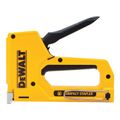
- Manual Staple Guns: Manual staple guns rely on hand pressure and an internal spring to drive the staple, with no cord, battery, or compressor needed. The T50 pattern, the most common manual design, fires 20-gauge staples in six leg lengths from 1/4 inch to 9/16 inch, covering upholstery, insulation, and general trim work with one tool. Their all-steel construction holds up to repeated use on a job site without the maintenance a motor or air system requires. Contractors keep one in a tool bag for quick fixes where running a cord or hose isn't worth the setup.
- Electric Staple Guns: Electric staple guns use a motor, corded or battery-powered, to drive the staple instead of relying on hand strength. Models like the ET501F fire up to 60 shots per minute, which speeds up repetitive tasks like attaching insulation or fastening lightweight wood compared to a manual tool. Contractors doing medium-duty production work over a full shift favor electric models since the motor absorbs the fastening force instead of the user's hand and wrist. Corded versions skip battery charging entirely for continuous use at a fixed work station.
- Cordless Electric Staple Guns: Cordless electric staple guns run on a rechargeable battery, trading the corded model's constant power for mobility around a job site. The E21 model, for example, fires up to 1,000 shots on a full charge, enough for most single-task jobs without a recharge. Crews moving between rooms or floors during insulation or trim work favor cordless models since there's no cord to manage or reposition. Battery capacity becomes the main planning factor on larger jobs that might outlast a single charge.
- Pneumatic Staple Guns: Pneumatic staple guns run off compressed air from a shop or portable compressor instead of a battery, motor, or hand spring. The PT50 model runs oil-free, which cuts down on maintenance and avoids oil staining on fabric or finished material during upholstery work. Production crews doing high-volume fastening throughout the day favor pneumatic tools since they don't fatigue the hand the way a manual trigger tacker does over hundreds of repetitions. A compressor and hose add setup time, which makes pneumatic guns better suited to a shop or job site than a quick one-off repair.
Buying Guide
Start with how often the tool sees use. A manual staple gun like the T50 pattern, firing 20-gauge staples in leg lengths from 1/4 inch to 9/16 inch, covers occasional repairs, light upholstery, and general trim work without a cord, battery, or compressor to manage. Power source becomes the next decision for higher-volume work. Electric models, corded or cordless, add a motor that reduces hand fatigue on repetitive tasks; a corded electric gun firing up to 60 shots per minute suits a fixed work station, while a cordless model running up to 1,000 shots per charge fits crews moving between rooms or job sites during the day. Pneumatic Staple Guns take that a step further for genuinely high-volume production, running off a shop or portable compressor instead of a battery or motor, which keeps the tool light in the hand even after hundreds of repetitions. The tradeoff is setup: a hose and compressor take longer to stage than picking up a manual or cordless tool for a five-minute fix. Staple gauge matters as much as the gun itself, and checking which gauge a specific tool accepts, like the T50 pattern's 20-gauge staples, avoids buying staples that don't fit the magazine. Matching gauge, leg length, and power source to the actual job, rather than defaulting to whichever staple gun happens to already be in the truck, keeps the fastener seated properly instead of splitting the material or pulling loose.
Frequently Asked Questions
What's the difference between manual, electric, and pneumatic staple guns?
Manual staple guns rely on hand pressure and an internal spring, needing no cord, battery, or compressor, and the T50 pattern fires 20-gauge staples in six leg lengths for general-purpose work. Electric staple guns add a motor, corded or cordless, to reduce hand fatigue on repetitive tasks, with models like the ET501F firing up to 60 shots per minute. Pneumatic staple guns run off compressed air for high-volume production work, like the oil-free PT50 model, and hold up better than a manual tool over hundreds of repetitions in a shift.
What staple gauge does a T50-style staple gun use?
T50-pattern staple guns use 20-gauge staples available in six leg lengths, from 1/4 inch up to 9/16 inch, covering upholstery, insulation, trim work, and general fastening jobs. Checking a specific tool's accepted gauge and leg length range before buying staples avoids picking up the wrong size for the magazine. The T50 pattern remains one of the most common formats for this reason, since replacement staples are widely available in that gauge.
How many shots can a cordless staple gun fire on one charge?
Cordless models vary by battery capacity and motor design, and the E21 cordless staple gun fires up to 1,000 shots on a full charge. A charge like that covers most single-task jobs, such as light trim work or craft projects, without needing a recharge mid-task. Larger jobs spanning multiple rooms or a full day of fastening may call for a spare battery or a corded alternative instead.
Are pneumatic staple guns worth it for occasional use?
Pneumatic staple guns need a compressor and hose to operate, which adds setup time that doesn't make sense for a quick, one-off repair. Their advantage shows up in high-volume production work, where an oil-free design like the PT50 keeps maintenance low and the tool light in the hand over hundreds of repetitions. A manual or cordless electric staple gun typically covers occasional use more practically than staging air equipment for a single task.
What's the benefit of an electric staple gun over a manual one?
Electric staple guns use a motor to drive the staple instead of hand strength, which reduces fatigue on repetitive tasks like attaching insulation or fastening lightweight wood. A model like the ET501F fires up to 60 shots per minute, speeding up production compared to squeezing a manual trigger tacker repeatedly. Manual staple guns remain lighter and simpler for occasional use, so the better choice depends on the volume of fastening the job requires.
