




T304 Stainless Steel 45° Elbows


 --%3E %3Csvg version='1.1' id='No-RB' xmlns='http://www.w3.org/2000/svg' xmlns:xlink='http://www.w3.org/1999/xlink' x='0px' y='0px' viewBox='0 0 100 100' enable-background='new 0 0 100 100' xml:space='preserve'%3E %3Cpath fill='%23CECECE' d='M79.44,0.95H20.56C9.78,0.95,0.95,9.78,0.95,20.56v58.87c0,10.79,8.82,19.61,19.61,19.61h58.87 c10.79,0,19.61-8.83,19.61-19.61V20.56C99.05,9.78,90.22,0.95,79.44,0.95z M65.38,58.24l9.38,29.58L49.69,69.78L24.5,87.82 l9.34-29.6L8.8,39.6l30.73-0.17c0,0,6.98-19.61,10-28.93c0.54,1.36,9.88,29.1,9.88,29.1H91.2L65.38,58.24z'/%3E %3C/svg%3E)

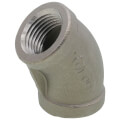
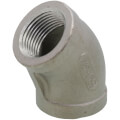


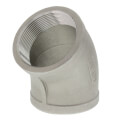

T304 stainless steel 45-degree elbows are pipe fittings that change the direction of a run by a 45-degree angle, made from the T304 grade of stainless steel valued for its corrosion resistance and ability to hold up in demanding environments. They're used across food and beverage processing, potable water systems, and industrial piping where the fluid being carried, or the surrounding environment, would corrode standard carbon steel or galvanized fittings over time. A 45-degree bend produces less flow turbulence and pressure drop than a 90-degree elbow, which makes it the better choice on runs where minimizing resistance matters.
Because the material carries a higher cost than standard steel, contractors typically limit stainless elbows to the sections of a system where corrosion resistance is genuinely needed, such as runs exposed to moisture, chemicals, or sanitary washdown, rather than specifying it across an entire installation.
Subcategories
- Threaded T304 Elbows: Threaded 45-degree elbows connect with NPT threads on both ends, making them a straightforward option for smaller-diameter runs that don't require welding equipment on site. They're common on service and retrofit work where a section of an existing threaded system needs a direction change. Thread sealant rated for stainless fittings helps maintain the corrosion resistance of the joint itself.
- Butt-Weld T304 Elbows: Butt-weld elbows are welded directly to the pipe ends, producing a permanent joint with no threads or mechanical seal to maintain over time. They're the standard choice on larger-diameter industrial and process piping where a welded system is already specified. Matching the elbow's wall thickness, or schedule, to the connecting pipe keeps the weld profile consistent.
- Socket-Weld T304 Elbows: Socket-weld elbows accept the pipe end into a recessed socket before welding, which simplifies alignment compared to a butt-weld joint and is a common choice on smaller-diameter high-pressure lines. They see frequent use in process piping where precise fit-up matters but a full butt-weld setup isn't practical. The socket depth needs to match the pipe's outside diameter for a proper weld.
Buying Guide
Selecting T304 stainless steel 45-degree elbows starts with matching the pipe diameter and schedule to the rest of the run, since a mismatched wall thickness at a welded or threaded joint creates a weak point that can crack or leak under pressure cycling. Confirming whether the system calls for threaded, socket-weld, or butt-weld connections up front avoids ordering a fitting that doesn't match the installation method already in use.
T304 is the standard stainless grade for general corrosion resistance in water, food-grade, and light chemical service, but installations exposed to chlorides, such as coastal environments or certain washdown chemicals, sometimes call for the more resistant T316 grade instead. Checking the specific environment and any governing code or engineering spec before defaulting to T304 avoids a fitting that underperforms in a more aggressive setting.
Sourcing all the elbows, couplings, and pipe for a run from a consistent grade and schedule keeps the entire system's corrosion resistance and pressure rating uniform, rather than creating a weak link at a transition point. On welded installations, the elbow's finish and wall thickness should also be verified against the fabricator's or engineer's specification before fabrication begins, since a mismatch found after welding is far more costly to correct.
Frequently Asked Questions
What's the difference between a 45-degree and a 90-degree stainless elbow?
A 45-degree elbow changes direction by a smaller angle, which produces less flow turbulence and pressure drop than a 90-degree elbow. It's often used where minimizing resistance along a run matters more than making a sharp directional change.
Why choose T304 stainless steel over carbon steel for elbows?
T304 stainless resists corrosion far better than carbon or galvanized steel, which makes it the standard choice for potable water, food-grade, and light chemical service where corrosion would otherwise shorten the fitting's service life.
What's the difference between socket-weld and butt-weld elbows?
A socket-weld elbow accepts the pipe end into a recessed socket, simplifying alignment on smaller-diameter lines, while a butt-weld elbow is welded directly to the pipe end and is more common on larger-diameter industrial piping.
When should T316 stainless be used instead of T304?
T316 offers better resistance to chlorides and is typically specified for coastal environments or exposure to certain washdown chemicals where T304 wouldn't hold up as well over time.
Do threaded stainless elbows need a special thread sealant?
Using a thread sealant rated for stainless steel helps preserve the fitting's corrosion resistance at the joint, since a sealant not designed for stainless can trap moisture or react with the material over time.
