




T304 Stainless Steel Unions (Imported)

 --%3E %3Csvg version='1.1' id='Fill' xmlns='http://www.w3.org/2000/svg' xmlns:xlink='http://www.w3.org/1999/xlink' x='0px' y='0px' viewBox='0 0 100 100' enable-background='new 0 0 100 100' xml:space='preserve'%3E %3Cpath fill='%23F15C02' d='M79.44,0.95H20.56C9.78,0.95,0.95,9.78,0.95,20.56v58.87c0,10.79,8.82,19.61,19.61,19.61h58.87 c10.79,0,19.61-8.83,19.61-19.61V20.56C99.05,9.78,90.22,0.95,79.44,0.95z M65.38,58.24l9.38,29.58L49.69,69.78L24.5,87.82 l9.34-29.6L8.8,39.6l30.73-0.17c0,0,6.98-19.61,10-28.93c0.54,1.36,9.88,29.1,9.88,29.1H91.2L65.38,58.24z'/%3E %3C/svg%3E)
 --%3E %3Csvg version='1.1' id='Half' xmlns='http://www.w3.org/2000/svg' xmlns:xlink='http://www.w3.org/1999/xlink' x='0px' y='0px' viewBox='0 0 100 100' enable-background='new 0 0 100 100' xml:space='preserve'%3E %3Cg%3E %3Cpath fill='%23F15C02' d='M30.05,70.23l3.79-12.01L8.8,39.6l30.73-0.17c0,0,6.98-19.61,10-28.93c0.54,1.36,9.88,29.1,9.88,29.1h1.58 L93.71,7.18c-3.58-3.82-8.66-6.23-14.28-6.23H20.56C9.78,0.95,0.95,9.78,0.95,20.56v58.87c0,5.41,2.22,10.32,5.79,13.88 L30.05,70.23z'/%3E %3C/g%3E %3Cpath fill='%23FBC8B4' d='M93.71,7.18L60.98,39.6H91.2L65.38,58.24l9.38,29.58L49.69,69.78L24.5,87.82l5.55-17.59L6.75,93.32 c3.55,3.54,8.44,5.73,13.82,5.73h58.87c10.79,0,19.61-8.83,19.61-19.61V20.56C99.05,15.4,97.01,10.69,93.71,7.18z'/%3E %3C/svg%3E)
 --%3E %3Csvg version='1.1' id='With-RB' xmlns='http://www.w3.org/2000/svg' xmlns:xlink='http://www.w3.org/1999/xlink' x='0px' y='0px' viewBox='0 0 100 100' enable-background='new 0 0 100 100' xml:space='preserve'%3E %3Cpath fill='%23FBC8B4' d='M79.44,0.95H20.56C9.78,0.95,0.95,9.78,0.95,20.56v58.87c0,10.79,8.82,19.61,19.61,19.61h58.87 c10.79,0,19.61-8.83,19.61-19.61V20.56C99.05,9.78,90.22,0.95,79.44,0.95z M65.38,58.24l9.38,29.58L49.69,69.78L24.5,87.82 l9.34-29.6L8.8,39.6l30.73-0.17c0,0,6.98-19.61,10-28.93c0.54,1.36,9.88,29.1,9.88,29.1H91.2L65.38,58.24z'/%3E %3C/svg%3E)

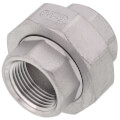
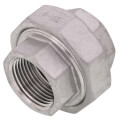
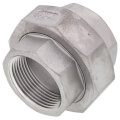
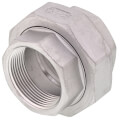
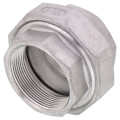

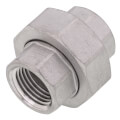
T304 stainless steel unions are threaded pipe fittings that let a contractor join, disconnect, and reconnect a run of stainless steel pipe without cutting or re-threading it. Built from 304-grade stainless, they resist corrosion in water, steam, and many chemical applications where black iron or standard steel fittings would eventually rust or pit. A union's three-piece design (nut, male end, female end) is what sets it apart from a coupling: loosen the center nut and the two pipe ends separate cleanly, which matters anywhere a valve, pump, or piece of equipment needs to come out for service later.
That serviceability is why unions show up so often just upstream and downstream of equipment on a stainless piping run. For anyone specifying stainless for its corrosion resistance in the first place, a union at the right point in the line keeps future maintenance from turning into a full pipe replacement.
Subcategories
- Threaded Unions: Standard NPT-threaded stainless unions for joining pipe on threaded stainless or dual-rated piping systems. Common on process water and compressed air lines where a section may need to come apart for cleaning or component swaps.
- Ground Joint Unions: Unions with a metal-to-metal ground seat instead of a separate gasket, giving a tight seal without a wearable part between the mating faces. Useful on lines that see frequent disassembly.
- Dielectric-Style Unions: Configurations that isolate dissimilar metals at a transition point, reducing galvanic corrosion risk where stainless pipe ties into copper or steel elsewhere in a system.
Buying Guide
Start with thread size and type. Stainless unions are sized to match the pipe they're joining, and confirming NPT thread size and count against the existing run avoids a mismatch that only shows up after installation. Pressure rating matters just as much: process piping, compressed air, and potable water lines each carry different working pressures, and a union rated below the system's operating pressure is a leak (or worse) waiting to happen.
Grade matters too. T304 stainless steel unions cover most general corrosion-resistance needs, including exposure to moisture, mild chemicals, and outdoor conditions. Applications with higher chloride exposure, like coastal installations or certain washdown environments, may call for a higher-grade stainless instead, so it's worth checking the specific service conditions before ordering.
Gasket or seat material is the other variable worth confirming. A union's sealing surface needs to be compatible with whatever's running through the pipe, whether that's potable water, compressed air, or a mild chemical solution, since the wrong seat material can degrade faster than the metal body around it.
Finally, think about where the union sits in the run. Placing one on each side of a valve or piece of equipment, rather than just one, makes future component swaps far easier since both connections can be broken without cutting into the pipe.
Buying in the size and thread configuration that matches the rest of the run, rather than mixing types, keeps future repairs simpler and reduces the number of spare parts a shop needs to stock.
Frequently Asked Questions
What's the difference between a union and a coupling?
A coupling permanently joins two pipe ends and can't be taken apart without cutting the pipe. A union has a center nut that lets the connection be separated and rejoined without any cutting, which is why unions go in front of valves and equipment that need future service.
Is T304 stainless steel suitable for outdoor use?
Yes, T304 handles general outdoor exposure and moisture well. In coastal areas or high-chloride environments, a contractor may want to confirm whether a higher stainless grade is a better fit for that specific site.
Can a stainless union connect to copper or steel pipe?
Direct metal-to-metal contact between dissimilar metals can cause galvanic corrosion over time. A dielectric-style union or fitting designed for that transition is the safer choice when stainless ties into a different pipe material.
Do these unions need a gasket?
It depends on the style. Ground joint unions seal metal-to-metal without a separate gasket, while other union styles use a gasket or O-ring at the sealing face. Check the specific union's construction before assuming one way or the other.
What thread type do these unions use?
Most stainless unions in this category use standard NPT threads sized to match common stainless and dual-rated pipe. Confirming the exact thread size and count against the existing pipe run before ordering avoids a mismatch.
