




Filters
SORT
Product Availability –
Application –
Options –
Review Score –
 --%3E %3Csvg version='1.1' id='Fill' xmlns='http://www.w3.org/2000/svg' xmlns:xlink='http://www.w3.org/1999/xlink' x='0px' y='0px' viewBox='0 0 100 100' enable-background='new 0 0 100 100' xml:space='preserve'%3E %3Cpath fill='%23F15C02' d='M79.44,0.95H20.56C9.78,0.95,0.95,9.78,0.95,20.56v58.87c0,10.79,8.82,19.61,19.61,19.61h58.87 c10.79,0,19.61-8.83,19.61-19.61V20.56C99.05,9.78,90.22,0.95,79.44,0.95z M65.38,58.24l9.38,29.58L49.69,69.78L24.5,87.82 l9.34-29.6L8.8,39.6l30.73-0.17c0,0,6.98-19.61,10-28.93c0.54,1.36,9.88,29.1,9.88,29.1H91.2L65.38,58.24z'/%3E %3C/svg%3E)
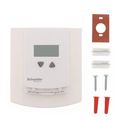
T200 Series Low Voltage Digital Thermostats



 --%3E %3Csvg version='1.1' id='No-RB' xmlns='http://www.w3.org/2000/svg' xmlns:xlink='http://www.w3.org/1999/xlink' x='0px' y='0px' viewBox='0 0 100 100' enable-background='new 0 0 100 100' xml:space='preserve'%3E %3Cpath fill='%23CECECE' d='M79.44,0.95H20.56C9.78,0.95,0.95,9.78,0.95,20.56v58.87c0,10.79,8.82,19.61,19.61,19.61h58.87 c10.79,0,19.61-8.83,19.61-19.61V20.56C99.05,9.78,90.22,0.95,79.44,0.95z M65.38,58.24l9.38,29.58L49.69,69.78L24.5,87.82 l9.34-29.6L8.8,39.6l30.73-0.17c0,0,6.98-19.61,10-28.93c0.54,1.36,9.88,29.1,9.88,29.1H91.2L65.38,58.24z'/%3E %3C/svg%3E)


T200 Series low voltage digital thermostats control fan coil units, heat pumps, and other zoned HVAC equipment that runs on low voltage control wiring rather than line voltage. A digital display and buttons replace the mechanical dial of older low voltage thermostats, giving building occupants or facility staff a clearer readout of setpoint and current temperature. Commercial buildings like offices, hotels, and multi-tenant properties commonly rely on this thermostat style, since each zone or room typically needs independent temperature control from a shared central plant. Wiring generally follows standard low voltage terminal conventions, so a replacement unit can usually swap into an existing thermostat wiring setup without rerunning wire. Facility technicians favor a straightforward digital replacement when an aging mechanical thermostat starts drifting out of calibration or occupants report inconsistent temperatures.
Subcategories
- Heating-Only Digital Thermostats: Heating-only digital thermostats in this series control a single heating stage, commonly a fan coil or baseboard zone valve, without any cooling output. Facility technicians choose this style for perimeter zones on a four-pipe system where cooling is handled by a separate device or not needed at all. A simple digital display shows setpoint and room temperature without the added menu complexity of a heating and cooling combination unit. Wiring stays minimal since only one output needs a low voltage connection back to the equipment.
- Heating and Cooling Digital Thermostats: Heating and cooling digital thermostats switch between two output stages depending on room demand, suiting fan coil units or heat pumps that need both functions from one control point. Facility staff in office buildings and hotels rely on this style most often, since a single zone frequently swings between needing heat in the morning and cooling by afternoon. A changeover input, either automatic or manual depending on the model, tells the thermostat which mode to serve at a given time. Wiring includes separate low voltage runs for the heating and cooling outputs back to the fan coil or unit.
- Fan Coil Thermostats with Fan Speed Control: Fan coil thermostats with fan speed control add a manual or automatic fan speed selection on top of standard heating and cooling switching, matching common two-pipe and four-pipe fan coil configurations. Hotel and multi-tenant building staff use this style where occupants expect direct control over airflow noise and intensity in their own space. Low, medium, and high fan speed settings typically wire back to separate terminals on the fan coil's motor. Replacing an older fan speed thermostat with a digital equivalent usually keeps the same terminal layout, simplifying the swap.
- Tamper-Resistant Digital Thermostats: Tamper-resistant digital thermostats add a locking cover or restricted setpoint range to standard heating and cooling control, aimed at spaces where facility management wants to limit occupant adjustment. Multi-tenant buildings, common areas, and public-facing spaces commonly specify this style to prevent setpoint changes that drive up energy costs or create comfort complaints from other occupants sharing the same zone. A key or code typically unlocks the cover for authorized adjustment. Facility staff turn to this style when repeated occupant tampering has already caused a comfort or cost problem on a specific zone.
Buying Guide
Matching output configuration to the equipment being controlled comes before anything else on a T200 Series replacement. Confirming whether the fan coil or heat pump zone needs heating only, heating and cooling, or heating and cooling with fan speed control determines which model in the lineup fits, and installing the wrong configuration means a return trip to swap it.
Wiring compatibility with the existing low voltage terminals matters just as much as the thermostat's feature set. Checking the number and function of wires already landed at the old thermostat before ordering a replacement avoids discovering a mismatch after the old unit is already off the wall. Most facility replacements in commercial buildings can reuse existing wiring, since T200 Series Low Voltage Digital Thermostats generally follow standard low voltage terminal conventions across the lineup.
Tamper resistance is worth considering on any zone with a history of occupant complaints tied to setpoint drift, particularly in common areas, hallways, or multi-tenant spaces where several occupants share one thermostat's decisions. A locking cover adds a small amount of upfront cost but often saves repeat service calls compared to a standard unit on a problem zone.
Fan speed control only matters where the connected fan coil actually offers multiple speeds; specifying it on equipment that only runs one fan speed adds a feature nobody can use.
Frequently Asked Questions
Can a T200 Series thermostat replace an older mechanical low voltage thermostat?
Most replacements reuse the existing low voltage wiring, since terminal conventions have stayed consistent across mechanical and digital low voltage thermostats for this equipment type. Confirming the number of wires and their function at the old thermostat before removing it avoids a surprise mismatch. Matching heating-only, heating and cooling, or fan speed control to what the old unit provided keeps the swap straightforward.
What's the difference between a two-pipe and four-pipe fan coil thermostat?
A two-pipe system shares one set of pipes for both heating and cooling, so the thermostat needs a changeover input to know which mode the building's central plant is currently providing. A four-pipe system runs separate heating and cooling piping, letting the thermostat switch modes independently without waiting on a central changeover signal. Confirming which piping configuration a building uses is necessary before ordering the correct thermostat type.
Why would a facility choose a tamper-resistant thermostat?
Common areas, hallways, and multi-tenant spaces where several occupants share one thermostat often see setpoint drift from repeated adjustment, driving up energy costs and generating comfort complaints. A locking cover or restricted setpoint range limits how far occupants can push the setpoint away from a facility-set baseline. Facility managers usually add tamper resistance after a specific zone has already caused a repeated problem.
Does fan speed control need extra wiring compared to a standard thermostat?
Fan speed control needs separate low voltage terminals for each fan speed the fan coil offers, typically low, medium, and high, in addition to the standard heating and cooling wiring. A fan coil that only supports one fan speed does not need this extra wiring at all. Checking the fan coil's own wiring diagram confirms how many speed terminals are actually available before ordering a thermostat with fan speed control.
How does a facility technician know which changeover method a thermostat uses?
Automatic changeover thermostats sense the water temperature in a two-pipe system and switch modes on their own, while manual changeover units need someone to flip a switch or setting when the building's central plant switches seasons. Checking the model's specification sheet or existing wiring diagram before replacement clarifies which method is in use. Matching changeover method to the building's own central plant switching schedule avoids a thermostat that fights the system instead of following it.
