




Filters
SORT
Product Availability –
Review Score –
 --%3E %3Csvg version='1.1' id='Fill' xmlns='http://www.w3.org/2000/svg' xmlns:xlink='http://www.w3.org/1999/xlink' x='0px' y='0px' viewBox='0 0 100 100' enable-background='new 0 0 100 100' xml:space='preserve'%3E %3Cpath fill='%23F15C02' d='M79.44,0.95H20.56C9.78,0.95,0.95,9.78,0.95,20.56v58.87c0,10.79,8.82,19.61,19.61,19.61h58.87 c10.79,0,19.61-8.83,19.61-19.61V20.56C99.05,9.78,90.22,0.95,79.44,0.95z M65.38,58.24l9.38,29.58L49.69,69.78L24.5,87.82 l9.34-29.6L8.8,39.6l30.73-0.17c0,0,6.98-19.61,10-28.93c0.54,1.36,9.88,29.1,9.88,29.1H91.2L65.38,58.24z'/%3E %3C/svg%3E)
 --%3E %3Csvg version='1.1' id='With-RB' xmlns='http://www.w3.org/2000/svg' xmlns:xlink='http://www.w3.org/1999/xlink' x='0px' y='0px' viewBox='0 0 100 100' enable-background='new 0 0 100 100' xml:space='preserve'%3E %3Cpath fill='%23FBC8B4' d='M79.44,0.95H20.56C9.78,0.95,0.95,9.78,0.95,20.56v58.87c0,10.79,8.82,19.61,19.61,19.61h58.87 c10.79,0,19.61-8.83,19.61-19.61V20.56C99.05,9.78,90.22,0.95,79.44,0.95z M65.38,58.24l9.38,29.58L49.69,69.78L24.5,87.82 l9.34-29.6L8.8,39.6l30.73-0.17c0,0,6.98-19.61,10-28.93c0.54,1.36,9.88,29.1,9.88,29.1H91.2L65.38,58.24z'/%3E %3C/svg%3E)
Through-The-Wall Ventilation Fans

 --%3E %3Csvg version='1.1' id='Half' xmlns='http://www.w3.org/2000/svg' xmlns:xlink='http://www.w3.org/1999/xlink' x='0px' y='0px' viewBox='0 0 100 100' enable-background='new 0 0 100 100' xml:space='preserve'%3E %3Cg%3E %3Cpath fill='%23F15C02' d='M30.05,70.23l3.79-12.01L8.8,39.6l30.73-0.17c0,0,6.98-19.61,10-28.93c0.54,1.36,9.88,29.1,9.88,29.1h1.58 L93.71,7.18c-3.58-3.82-8.66-6.23-14.28-6.23H20.56C9.78,0.95,0.95,9.78,0.95,20.56v58.87c0,5.41,2.22,10.32,5.79,13.88 L30.05,70.23z'/%3E %3C/g%3E %3Cpath fill='%23FBC8B4' d='M93.71,7.18L60.98,39.6H91.2L65.38,58.24l9.38,29.58L49.69,69.78L24.5,87.82l5.55-17.59L6.75,93.32 c3.55,3.54,8.44,5.73,13.82,5.73h58.87c10.79,0,19.61-8.83,19.61-19.61V20.56C99.05,15.4,97.01,10.69,93.71,7.18z'/%3E %3C/svg%3E)



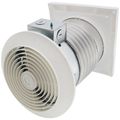
Through the wall ventilation fans are exhaust units built to mount directly in an exterior wall rather than through a ceiling or roof, making them a common fit for bathrooms, laundry rooms, and utility spaces without attic access above. Contractors reach for this style when a ceiling run is not practical, such as in a slab on grade home or a room directly under a floor with no attic path. The fan pulls air through a wall sleeve and exhausts it outside through a wall cap, which keeps ductwork short and reduces the chance of condensation building up inside a long duct run. Because the entire unit lives in the wall cavity, sizing the housing to the available stud depth matters before ordering. Contractors also confirm airflow capacity against the room's square footage so the fan actually clears moisture and odors rather than just running. Getting the housing depth and airflow rating right the first time avoids a return trip to swap a unit that does not fit or does not perform.
Subcategories
- Standard Through Wall Exhaust Fans: Standard units handle everyday bathroom and utility room exhaust duty, pulling moist or stale air straight out through the wall cap. Contractors favor them in additions and remodels where a ceiling fan run is not an option. Housing depth needs to match the wall cavity, so measuring before ordering saves a second trip. These fans typically mount between studs on standard residential framing centers.
- High Capacity Through Wall Fans: High capacity models move more air per minute, which suits larger bathrooms, shared laundry rooms, or spaces with heavy moisture loads. Property managers in multi-family buildings often specify these where a single fan serves more square footage than a typical residential bath. Higher airflow usually means a larger housing and wall cap, so contractors verify clearance before cutting the wall opening. Sound rating becomes a bigger factor at this capacity, so installers check it against where the fan will run.
- Through Wall Fans with Built-In Louvers: Louvered units combine the fan and exterior louver in one assembly, which cuts down on separate parts to source and install. Remodelers like the simpler installation since the backdraft damper and exterior grille come pre-fitted to the housing. That single assembly design also reduces the number of places air can leak back in during cold weather. Contractors still confirm the louver's exterior finish works with the building's siding or trim.
- Replacement Through Wall Fan Motors and Grilles: Replacement parts let a contractor service an existing through wall fan without tearing out the wall sleeve or housing. Property maintenance teams keep these on hand for older buildings where swapping just the motor or grille is faster than a full unit replacement. Matching the replacement part to the existing housing dimensions is the main thing to verify before ordering. Reusing the sleeve also avoids patching the wall a second time.
Buying Guide
Start with wall cavity depth, since a through the wall fan lives entirely inside the wall rather than above a ceiling. Measure the stud depth before ordering, because a housing that is too deep will not fit flush and one that is too shallow leaves the fan sitting loose in the cavity. Airflow capacity comes next. Match the fan's rated airflow to the room's square footage and typical moisture load, since an undersized fan will run constantly without ever really clearing the air. Sound rating matters more in this fan style than many contractors expect, since the housing sits closer to occupants than a ceiling mounted unit tucked into an attic.
Exterior wall cap style is worth checking against the building's siding and trim before the wall opening gets cut, since swapping a cap after installation means patching the exterior a second time. When comparing options across the lineup of Through-The-Wall Ventilation Fans, look at whether the backdraft damper is built into the housing or the exterior louver, since that affects how well the fan keeps outside air from leaking back in during cold months. Finally, decide whether replacement parts are readily available for the model chosen, since a fan that only comes as a full assembly costs more to service down the road than one with a stocked replacement motor or grille.
Frequently Asked Questions
Can a through the wall fan replace a ceiling exhaust fan?
In most cases, yes, especially in rooms without attic access above. Confirm the exterior wall has room for the wall cap and that the interior wall cavity is deep enough for the housing.
How is wall cavity depth measured for these fans?
Measure from the interior wall surface to the exterior sheathing at the stud bay where the fan will sit. Compare that measurement to the housing depth listed for the fan before ordering.
Do these fans need a backdraft damper?
A backdraft damper keeps outside air and pests from entering when the fan is off, so it is standard on most through the wall models. Confirm whether it is built into the housing or the exterior wall cap.
What size fan does a small bathroom need?
Airflow needs depend on the room's square footage and ceiling height, so check the fan's rated airflow against those numbers rather than guessing by room type alone. Local code may also set a minimum airflow requirement.
Can the motor be replaced without removing the wall sleeve?
Many through the wall fans are designed so the motor and grille can be serviced from inside the room without disturbing the sleeve or exterior cap. Confirm compatibility between the replacement part and the existing housing before ordering.
