



'/%3E%3C/svg%3E)
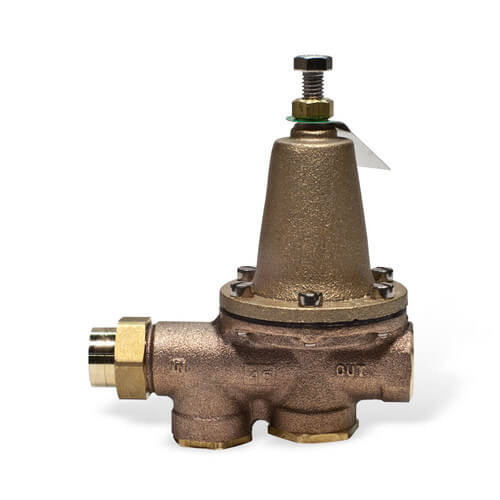
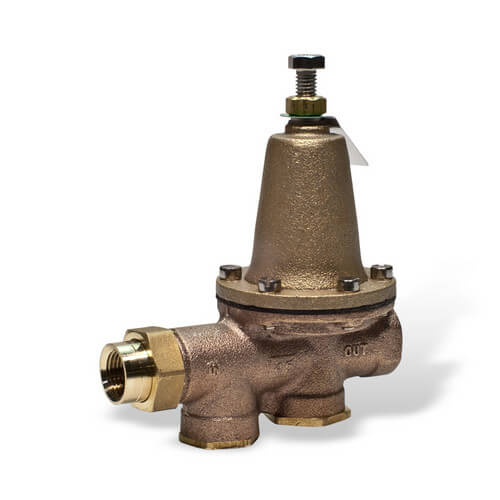
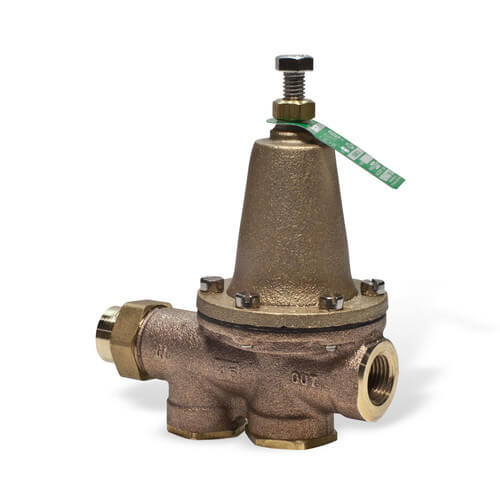
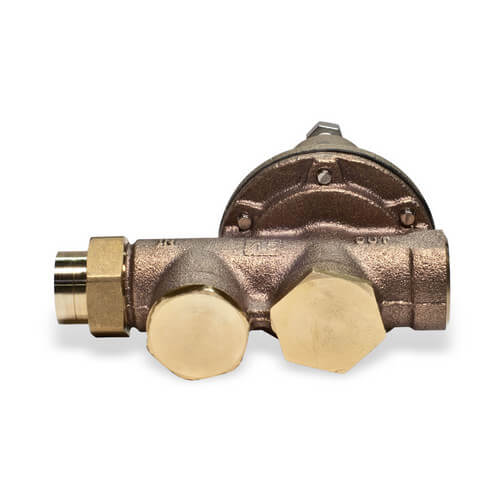
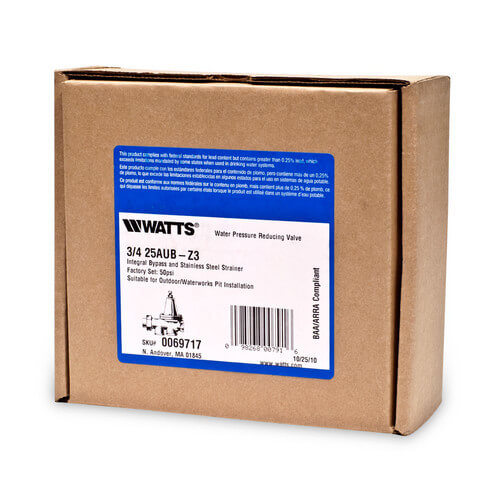
3/4" 25AUB-Z3 Pressure Reducing Valve (Threaded F Union Inlet x NPT Threaded F Outlet)
 --%3E %3Csvg version='1.1' id='Fill' xmlns='http://www.w3.org/2000/svg' xmlns:xlink='http://www.w3.org/1999/xlink' x='0px' y='0px' viewBox='0 0 100 100' enable-background='new 0 0 100 100' xml:space='preserve'%3E %3Cpath fill='%23F15C02' d='M79.44,0.95H20.56C9.78,0.95,0.95,9.78,0.95,20.56v58.87c0,10.79,8.82,19.61,19.61,19.61h58.87 c10.79,0,19.61-8.83,19.61-19.61V20.56C99.05,9.78,90.22,0.95,79.44,0.95z M65.38,58.24l9.38,29.58L49.69,69.78L24.5,87.82 l9.34-29.6L8.8,39.6l30.73-0.17c0,0,6.98-19.61,10-28.93c0.54,1.36,9.88,29.1,9.88,29.1H91.2L65.38,58.24z'/%3E %3C/svg%3E)
' fill='%23F15C02' d='M49 0C21.938 0 0 21.938 0 49s21.938 49 49 49 49-21.938 49-49S76.062 0 49 0m0 82.709a7.54 7.54 0 1 1 0-15.08 7.54 7.54 0 0 1 0 15.08m7.54-28.412a7.541 7.541 0 0 1-15.08 0V22.831a7.54 7.54 0 0 1 15.08 0v31.466z'/%3E%3C/svg%3E)
MANUALS (2)
Non-Potable Water Applications

Product Highlights


Description
Series 25AUB-Z3 Water Pressure Reducing Valves are used in commercial and residential applications to reduce incoming water pressure for protection of plumbing system components and to reduce water consumption. It consists of a bronze body construction, union inlet connection, integral stainless steel strainer and high temperature resistant reinforced diaphragm for hot water.
The Series 25AUB-Z3 is available with a variety of end connections including: threaded, solder, PEX and CPVC with both union and double union connections.
Series 25AUB-Z3 has an adjustable pressure range and is serviceable in-line. Maximum Working Pressure: 300psi (21 bars), Adjustable Reduced Pressure Range: 25 to 75psi (172 to 517 kPa), Standard Pressure Setting: 50psi (344kPa).
Specs
| Size: | 3/4" |
|---|---|
| Pressure Range: | 25 to 75 psi |
| Max Pressure (PSI): | 75 |
| Min Pressure (PSI): | 25 |
| Max Inlet Pressure: | 300 PSI |
| Temperature Range (F): | 33°F to 160°F |
| Connection Type: | Threaded |


Questions?
Product Reviews
Most Liked Positive Review
Watts 1-1/4" Pressure Reducing Valve
Most Liked Negative Review
 --%3E %3Csvg version='1.1' id='With-RB' xmlns='http://www.w3.org/2000/svg' xmlns:xlink='http://www.w3.org/1999/xlink' x='0px' y='0px' viewBox='0 0 100 100' enable-background='new 0 0 100 100' xml:space='preserve'%3E %3Cpath fill='%23FBC8B4' d='M79.44,0.95H20.56C9.78,0.95,0.95,9.78,0.95,20.56v58.87c0,10.79,8.82,19.61,19.61,19.61h58.87 c10.79,0,19.61-8.83,19.61-19.61V20.56C99.05,9.78,90.22,0.95,79.44,0.95z M65.38,58.24l9.38,29.58L49.69,69.78L24.5,87.82 l9.34-29.6L8.8,39.6l30.73-0.17c0,0,6.98-19.61,10-28.93c0.54,1.36,9.88,29.1,9.88,29.1H91.2L65.38,58.24z'/%3E %3C/svg%3E)
Has some construction issues
Fantastic

I would buy this product again
Fast delivery!
Excellent Product - Easy Install, Great Performance
I would recommend this to a friend
Good product, easy install.
I would buy again
Would buy again, but only from SupplyHouse.com
The 25 AUB is the better choice
Would have been nice if order wasn't missing anything!!
Product Q&A
22 QuestionsQ: Do you recommend pipe dope and/or Teflon tape for best results on threaded fittings?
Asked by coalcracker 12 years ago
Add your answer
I've had the best success with pipe dope.
I recommend Teflon tape.
Always use Teflon tape, 3 wraps around is enough Sent from my iPhone
Locate 567 is what I prefer, never a leak.. Sent from my Verizon Wireless 4G LTE smartphone
Sorry auto correct changed my answer.. Loctite 567. Sent from my Verizon Wireless 4G LTE smartphone
I only use Teflon tape and three wraps is plenty Sent from my iPhone
Q: Does the o-ring for the union fitting come included with the valve?
Asked by J 12 years ago
Add your answer
Everything you need is included.
Yes it should be supplied. Sometimes there isn't much grease on it and it can fall out in shipping. Good luck Sent from my iPhone
Q: what is the maximum flow rate?
Asked by doc 12 years ago
Add your answer
Verified Reply- SupplyHouse StaffThe maximum flow rate is approximately 30 gallons per minute when operating at the reduced pressure drop of 25 PSI.
Q: Can this valve be installed in the vertical position?
Asked by Mucks 12 years ago
Add your answer
Verified Reply- PexSupplyStaffYes, this line of Pressure Reducing Valves can be installed in the vertical position.
Q: i have a 1/2" LF25AUB-Z3 Pressure Reducing Valve (Threaded F Union Inlet x NPT Threaded F Outlet). i would like to know how to increase the pressure in my home. i believe to do so you would loosen the nut on the top and turn the screw on the top counter clock wise. am i correct.? should i turn off the house main?
Asked by don 13 years ago
Add your answer
Verified Reply- PexSupply StaffThe instruction manual states "To adjust pressure setting, loosen the lock nut and turn the adjusting bolt clockwise to increase pressure, counterclockwise to decrease pressure." The manual can be found here on our site : http://s3.pexsupply.com/product_files/es-lf25aub-inst.pdf
Q: I am concerned about getting the right valve... this model vs. the high/low pressure versions. My city supply fluctuates a lot. I recall pressures as high as 95psi, sometimes higher. I currently have a similar Watts PRV on my system and regardless of where I set the valve the max pressure I am pulling is 40 psi. So my question is four part... 1. Is my current PRV working properly? 2. Which version of this PRV would work best for my situation: this model, low or high models? 3. Is there any benefit to running two of these or a combination of models in series? 4. If I install a back-flow preventer, should I install it up or downstream of the PRV(s)?
Asked by Brandon 14 years ago
Add your answer
Yes. This Model would work fine. 95psi is well within the range of a single prv. Watts offers a great diagram in their product manual to describe the parallel and in series concept. I wouldn't worry about installing a backflow preventer unless required by code. The PRV will essentially create a closed system so you need to consider a thermal expansion tank for your water heater. A great resource is Water Heater Rescue. -Rob
Q: Highrise building with a 3" hot water line, max temp is 140 degrees F. The cold feeding the domestic boiler is 50 lbs. When the circulating pump is on (24/7) the presure is increased to 65lb. I need to lower the presure from 65 lbs to 50 lbs. Should I use a u5b-z3 or a 25aub-z3. Also what and why is there a thermal bypass? Thanks
Asked by Chuck 14 years ago
Add your answer
Not sure about the u5b-z3, or the 25aub-z3, but I'd guess the u5b since it's made for commercial applications. But neither have a 3" inlet/outlet pressure. Both max out at 2". The thermal bypass function is to compensate for water heater caused pressure on the outlet side. Since water heaters increase the pressure of the water (by heating it), that water pressure can push back on the outlet side of the pressure valve, which can increase to the point of causing knocking in pipes, or bad bursts of pressure when you turn on cold water. In your case, it shouldn't be an issue, since this issue is, as far as I know, only going to be seen when the valve is used on cold water supply, or if the water was going to be heated further on the outlet side of the valve. From their standards section (https://www.wattspremier.com/products.php?product=Watts-107001-U5B%252dZ3-Whole-House-Water-Pressure-Regulator): standard Specifications: A Water Pressure Reducing Valve with integral strainer shall be installed in the water service pipe near its entrance to the building where supply main pressure exceeds 60psi (413 kPa) to reduce it to 50psi (345 kPa) or lower. The valve shall feature a bronze body suitable for water supply pressures up to 300psi (20.7 bar). Provision shall be made to permit the bypass flow of water back through the valve into the main when pressures, due to thermal expansion on the outlet side of the valve, exceed the pressure in the main supply. Water Pressure Reducing Valve with built-in bypass check valves will be acceptable. Approved valve shall be listed to ASSE 1003 and IAPMO and certified to CSA B356. Valve shall be a Watts Regulator Company Series U5B-Z3. Good luck!
Q: What size expansion tank do I need with it and is it a special expansion tank? I have 135# on the street side and have the reducing valve set on 50#. What should the air pressure in the tank be?
Asked by Farmer John 15 years ago
Add your answer
Verified Reply- PexSupply StaffThe air pressure in an expansion tank must match the pressure of the system. Most expansion tanks are pre-charged to 12psi. They must be sized by the BTU load of the system. You may find our Expansion Tank Calculator (see link below) to be useful. http://www.pexsupply.com/pex/control/ExpansionTankSizeCalculator?intcmp=calc;extrol-rc
Q: What is the part # for the male NPT to Sweat adapter I need to connect this PRV to a 3/4" copper line.
Asked by 15 years ago
Add your answer
Verified Reply- PexSupply StaffYou would need part WP4-12.
Q: What is the overall length of this valve without the inlet fitting attached?
Asked by 15 years ago
Add your answer
Verified Reply- PexSupply StaffPlease refer to page 2 of the following specifications for dimensional information: http://s3.pexsupply.com/manuals/1305216392729/56103_PROD_FILE.pdf