




'/%3E%3C/svg%3E)
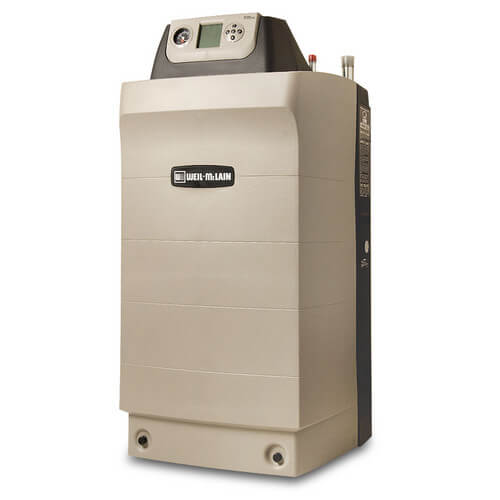
Ultra 105 - 81,000 BTU Output High Efficiency Boiler (Nat Gas or LP)
 --%3E %3Csvg version='1.1' id='Fill' xmlns='http://www.w3.org/2000/svg' xmlns:xlink='http://www.w3.org/1999/xlink' x='0px' y='0px' viewBox='0 0 100 100' enable-background='new 0 0 100 100' xml:space='preserve'%3E %3Cpath fill='%23F15C02' d='M79.44,0.95H20.56C9.78,0.95,0.95,9.78,0.95,20.56v58.87c0,10.79,8.82,19.61,19.61,19.61h58.87 c10.79,0,19.61-8.83,19.61-19.61V20.56C99.05,9.78,90.22,0.95,79.44,0.95z M65.38,58.24l9.38,29.58L49.69,69.78L24.5,87.82 l9.34-29.6L8.8,39.6l30.73-0.17c0,0,6.98-19.61,10-28.93c0.54,1.36,9.88,29.1,9.88,29.1H91.2L65.38,58.24z'/%3E %3C/svg%3E)
 --%3E %3Csvg version='1.1' id='With-RB' xmlns='http://www.w3.org/2000/svg' xmlns:xlink='http://www.w3.org/1999/xlink' x='0px' y='0px' viewBox='0 0 100 100' enable-background='new 0 0 100 100' xml:space='preserve'%3E %3Cpath fill='%23FBC8B4' d='M79.44,0.95H20.56C9.78,0.95,0.95,9.78,0.95,20.56v58.87c0,10.79,8.82,19.61,19.61,19.61h58.87 c10.79,0,19.61-8.83,19.61-19.61V20.56C99.05,9.78,90.22,0.95,79.44,0.95z M65.38,58.24l9.38,29.58L49.69,69.78L24.5,87.82 l9.34-29.6L8.8,39.6l30.73-0.17c0,0,6.98-19.61,10-28.93c0.54,1.36,9.88,29.1,9.88,29.1H91.2L65.38,58.24z'/%3E %3C/svg%3E)
' fill='%23F15C02' d='M49 0C21.938 0 0 21.938 0 49s21.938 49 49 49 49-21.938 49-49S76.062 0 49 0m0 82.709a7.54 7.54 0 1 1 0-15.08 7.54 7.54 0 0 1 0 15.08m7.54-28.412a7.541 7.541 0 0 1-15.08 0V22.831a7.54 7.54 0 0 1 15.08 0v31.466z'/%3E%3C/svg%3E)
MANUALS (8)

Replacement Parts

Product Highlights


Description
**Series 3 Ultra Boiler
Key Features
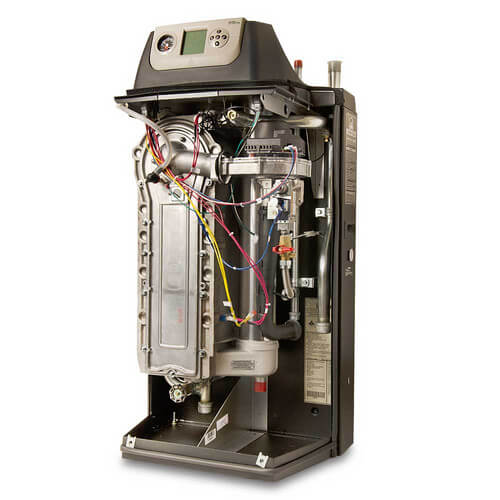
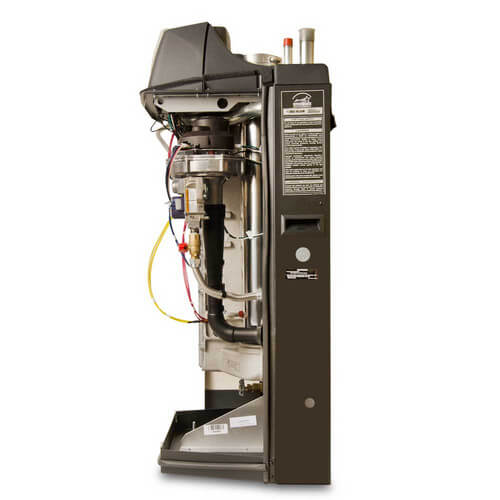
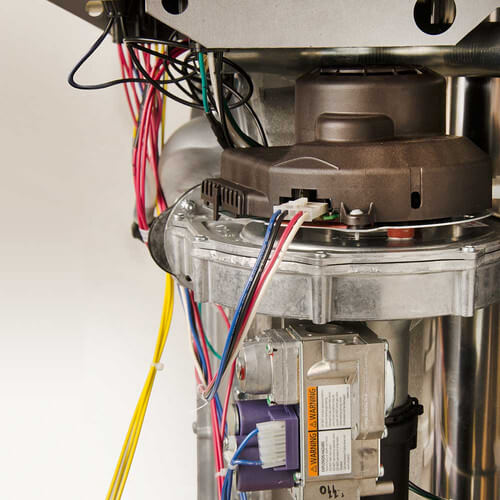
- Gas fired water boiler with cast aluminum heat exchanger
- Venturi mixing body mixes air and gas providing higher efficiency
- Designed to operate in low temperature condensing applications
- Outdoor reset and domestic hot water priority standard
- Negative regulated gas valve precisely delivers gas to the boiler
- Electronic control module automatically adjusts blower speed and gas flow rate in response to environment
- Modulates with 5 to 1 turndown ratio
- Variable speed motor matches combustion output to heating needs
- High grade stainless steel burner features quiet operation, high efficiency, and cleaner combustion for low NOx applications.
Hydro-Core Near Boiler Installation Options::
- FT-144 1" Ultra Component Kit
Specs
| Width (Inches): | 22-13/16" |
|---|---|
| Fuel Type: | Natural Gas Propane |
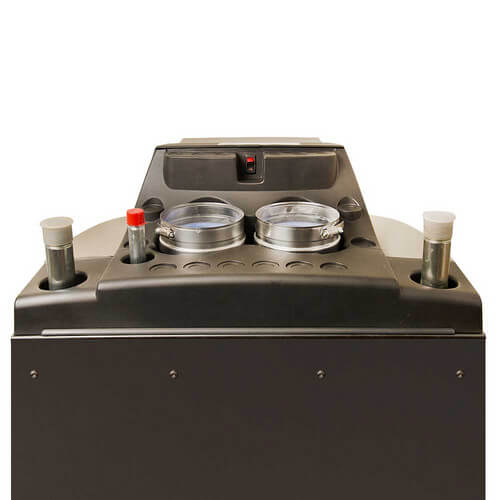
| Vent Type: | Direct Vent PVC AL29-4C |
| Boiler Type: | High Efficiency |
| Color: | Slate Gray |
| Efficiency: | 95.3% |
| System Type: | Hydronic (Water) |
| Features: | Direct Vent Condensing EI/Spark Ignition |
| Vent Size: | 3" |
| Water Connection: | 1" |
| Gas Connection: | 1/2" |
| BTU Input: | 105000 |
| BTU Output: | 81000 |
| Warranty: | 15 Year Limited (Heat Exchanger), 1 Year (Parts) |

Questions?

Ultra 105 (S3)
Replacement Parts
SKU: 383-500-702
Brand: Weil-McLain
 --%3E %3Csvg version='1.1' id='No-RB' xmlns='http://www.w3.org/2000/svg' xmlns:xlink='http://www.w3.org/1999/xlink' x='0px' y='0px' viewBox='0 0 100 100' enable-background='new 0 0 100 100' xml:space='preserve'%3E %3Cpath fill='%23CECECE' d='M79.44,0.95H20.56C9.78,0.95,0.95,9.78,0.95,20.56v58.87c0,10.79,8.82,19.61,19.61,19.61h58.87 c10.79,0,19.61-8.83,19.61-19.61V20.56C99.05,9.78,90.22,0.95,79.44,0.95z M65.38,58.24l9.38,29.58L49.69,69.78L24.5,87.82 l9.34-29.6L8.8,39.6l30.73-0.17c0,0,6.98-19.61,10-28.93c0.54,1.36,9.88,29.1,9.88,29.1H91.2L65.38,58.24z'/%3E %3C/svg%3E)

Need help finding a replacement part?
Product Reviews
Most Liked Positive Review
great product
Most Liked Negative Review
WeilMcLane 105 Gas Boiler
Quality Boiler

Expensive, lots of maintance, does not light when cold.
Ultra 105 S3
I would recommend this boiler
Great product, happy customer
Ultra 105 Boiler
I would recommend this boiler
Nice Boiler for the price.
Boiler purchased was a fantastic bargain
This something you won't regreat
Product Q&A
16 QuestionsQ: I have 4 zone valves will need a larger tranformer or other control
Asked by Dennis 12 years ago
Add your answer
Verified Reply- Supplyhouse StaffThere are a couple of variables that will need to be considered, as it depends on how much power the valves draw, and if your powering anything else off the transformer.
Q: want to convert from lp to natural gas what parts do i need
Asked by glen pudenz 12 years ago
Add your answer
Verified Reply- SupplyHouse StaffThis conversion is not supported by the manufacturer. There is no conversion kit available to convert from LP to Natural Gas for the Ultra 105.
Q: CAN YOU ADD DOMESTIC HOT WATER SUPPLY
Asked by BRUCE 14 years ago
Add your answer
Verified Reply- PexSupply StaffYou can, but only if you connect the boiler to an indirect water heater.
Bruce, I used a boilermate for hot water. indirect fired water heater is definitely the way to go.
Yes, you need an indirect water heater. Directions are with the boiler Sent from my iPhone
Q: will you get 95% efficiency if you do not have cast iron baseboards.
Asked by io 14 years ago
Add your answer
Verified Reply- PexSupply StaffYou can achieve 95% efficiency with this boiler using any type of radiators as long as you operate the boiler at return temperatures that are low enough to allow flue gases to condense and you use an outdoor reset control.
My house has copper with aluminum fin baseboards. I have no idea how to measure efficiency but I went from spending $400+ a month for heating oil to about $40 a month for my gas bill.
Q: Too many circulators? Ref: Application Guide,#8,pg 24-25. This shows 3 circulators - DWH, System & Boiler. I agree 1 for the system but why 2 additional? My existing separate gas water heater doesn't require a circulator - hot water out is replaced by cold water in. Pressure moves it. The GV90+ boiler,pg 16 says, the internal circulator can be used for multi-zone systems. If the Ultra 105 is is a high efficiency boiler, using 3 circulators doesn't seam too efficient to me. Can you explain this to me please. Thanks, cm
Asked by cm 14 years ago
Add your answer
Verified Reply- PexSupply StaffCondensing boilers like this one require primary/secondary piping. Since they do not hold as much water as standard boilers, there is a large pressure drop. A circulator that solely moves water through the boiler is needed to overcome this drop. The extra circulator will make your electric bill go up, but this increase should be minor when compared to the savings on your gas bill that the boiler will create. The third circulator is only necessary if you have an indirect water heater. The purpose of this circulator is not to move domestic water into and out of the tank (water pressure moves it), but to cycle fluid from the heating system through the coil in the indirect tank in order to heat the domestic water.
The Ultra has 1 pump for the boiler alone. This pump circulates a "small" amount of water through its heat exchanger and can not be used for anything else, It has no tank of its own. "IF" you decide to install a domestic hot water tank with a coil in it (not gas fed), then you would need 1 pump off the ultra to heat it. If you choose to install a gas hot water heater, you do not need a pump on the ultra for it. Note (1) > You "may" need a circulation pump on a standard gas fired hot water heater to keep the water hot in areas located far away from the domestic hot water heater. This would basically keep the* domestic hot water hot at the tap at all times*. It is a loop back to the gas fired hot water heater and has nothing to do with the ultra. Note (2) > If you were to install a coil type domestic hot water tank for the ultra and you had a situation as explained in Note (1) above, you would also need a small domestic hot water circulator to keep the water in those remote areas hot. In this instance, you would need a minimum of 3 pumps. 1 for the ultra heat exchanger, 1 for the domestic hot water tank & 1 to circulate the domestic hot water to and from remote locations. It is possible to use a "prioritized" zone valve on the coil type domestic hot water tank pump from the Ultra to also feed 1 or 2 heat zones (with zone valves) in your home depending upon your domestic hot water use. While heating water, your home would not be heated in this instance but depending upon your hot water use you may not need it to be as it would only be on a short time to produce hot water & would switch back to your baseboard zones when the domestic hot water demand was met. Part of the savings in the ultra is not having a large stagnate water storage capacity in the boiler itself. The more water/baseboard you have to heat, the more it costs. Therefor he most efficient hot water heaters are the at location, on demand type with no storage at all. Unfortunately, there is no savings if you need 5 or 6 of these for a large home.
Q: On a typical boiler, the supply and return lines are seperate. I noticed there is a connection piece between the two, allowing the return flow to mix with the supply flow. Would it not run more efficient if the cool return flow didn't mix with the supply? or is there a specific reason for the connection?
Asked by RGR 14 years ago
Add your answer
Verified Reply- PexSupply StaffThis boiler, like most condensing boilers, requires primary/secondary piping to handle the large pressure drop through the unit.
Boilers connected in this way are using a so-called 'primary/secondary' piping design. In this design style, there is a single piping loop (as opposed to two parallel pipes). A system pump runs fluid through the main loop, then it is up to each 'loop participant' to use their own pump to withdraw/return fluid into the loop. The boiler is just another loop participant, extracting cooler fluid, and returning warmer. Radiators loops do the opposite. There are some advantages to this design style, as I've understood. One big pipe is often cheaper than two. Also, on some boilers the return water must not be too cold, which the single pipe design can help prevent.
I tried plumbing the way suggested but it would not function properly. The water took the path of least resistance and traveled in the very small loop instead of feeding the baseboards. I installed a valve in the section between the inlet and outlet pipe and have it about 90-95% closed. Has been running like this for 2 years with no problems. Gas bill is about $20 a month compared to the $400+ a month I was spending on oil. Heater is well worth it.
I am not sure why the engineer designed it that way but that is how you get the most efficency. I connected mine up the way it showed in the manual and absolutely love it. Works great. Had to adjust the settings for my floor application but was easy. Hope this helps.
If you are talking about the pre formed easy-up manifold kit, from the way it was explained to me, the connection between the supply and return was to solve a balancing issue with the water pressure. It also means that you would have to install 2 pumps, one on the return side and one on the supply side. I chose not to install the manifold kit and just installed one pump on the return side.
These types of boilers are usually piped in a configuration called "primary-secondary" where there are two loops, one for circulating through the radiation and the other for circulating through the boiler. They join up at two closely-spaced tees. The reason behind this is that it keeps the flow rate through the loops separate. These boilers have a very restrictive heat exchanger, and the supplied circulator is designed to circulate water through the exchanger at the appropriate rate. If you put the boiler in the same loop as the radiation it would be difficult to size the circulators properly to maintain flow in the entire system. In primary-secondary, you size the circulator(s) for the radiator/convector loops so that they circulate at the appropriate flow rate given the design temperature and type of radiation. There is the added benefit that when the boiler cycles off and the main circulators are still running that no water is circulated through the boiler, so you don't lose any heat through the boiler.
Q: Does the unit come with a hot water coil for domestic water. My current oil burner has a coil.
Asked by 15 years ago
Add your answer
Verified Reply- PexSupply StaffThis boiler does not come with a coil. You may want to consider Weil-McLain's CGt (NG or LP) or WTGO (oil). These units have an option for a tankless coil.
Q: I am unsure whether the 105 will produce enough heat for my house. I used the BTU calculator but the answer varies from 119,000 to 134,000 btu's if I select or don't select whether the house has had remodeling. What does this mean? My house is 2800 sq ft, is 90 yrs old but very solid full wood construction, has had a few rooms remodeled, has 3 inches of insulation in walls and attic, and has 17 large radiators, and is located in Trenton, NJ. My plumber thinks it's big enough but I am unsure. What is the downside to going to the next larger size boiler? Thanks
Asked by Bob 15 years ago
Add your answer
Verified Reply- PexSupply StaffThe biggest downside to selecting a boiler that's oversized is that you will use more fuel than is necessary to heat your house. If you want to size the boiler accurately, a heat loss calculation (AKA manual J) would be necessary. Our calculator is only meant to provide an estimate.
The downside is that you might be using more fuel than you need. You should use a heat loss calculator to know exactly how large of a boiler you will need.
Q: Is there a relationship with nat. gas btu to oil btu?
Asked by jake 15 years ago
Add your answer
Verified Reply- PexSupply StaffNatural Gas - 100,000 BTU per 1 CCF (1 therm). #2 Oil 139,000 BTU per Gallon.
Q: Does the boiler need to be programed by a Weil Mclain tech or can I do it myself?
Asked by Bamma 15 years ago
Add your answer
Verified Reply- PexSupply StaffWe always recommend having a professional installer to install your equipment. However the boiler manual will give detailed directions on boiler control setup.