




Filters
SORT
Product Availability –
Product Type –
Length (Inches) –
Review Score –
 --%3E %3Csvg version='1.1' id='Fill' xmlns='http://www.w3.org/2000/svg' xmlns:xlink='http://www.w3.org/1999/xlink' x='0px' y='0px' viewBox='0 0 100 100' enable-background='new 0 0 100 100' xml:space='preserve'%3E %3Cpath fill='%23F15C02' d='M79.44,0.95H20.56C9.78,0.95,0.95,9.78,0.95,20.56v58.87c0,10.79,8.82,19.61,19.61,19.61h58.87 c10.79,0,19.61-8.83,19.61-19.61V20.56C99.05,9.78,90.22,0.95,79.44,0.95z M65.38,58.24l9.38,29.58L49.69,69.78L24.5,87.82 l9.34-29.6L8.8,39.6l30.73-0.17c0,0,6.98-19.61,10-28.93c0.54,1.36,9.88,29.1,9.88,29.1H91.2L65.38,58.24z'/%3E %3C/svg%3E)
 --%3E %3Csvg version='1.1' id='With-RB' xmlns='http://www.w3.org/2000/svg' xmlns:xlink='http://www.w3.org/1999/xlink' x='0px' y='0px' viewBox='0 0 100 100' enable-background='new 0 0 100 100' xml:space='preserve'%3E %3Cpath fill='%23FBC8B4' d='M79.44,0.95H20.56C9.78,0.95,0.95,9.78,0.95,20.56v58.87c0,10.79,8.82,19.61,19.61,19.61h58.87 c10.79,0,19.61-8.83,19.61-19.61V20.56C99.05,9.78,90.22,0.95,79.44,0.95z M65.38,58.24l9.38,29.58L49.69,69.78L24.5,87.82 l9.34-29.6L8.8,39.6l30.73-0.17c0,0,6.98-19.61,10-28.93c0.54,1.36,9.88,29.1,9.88,29.1H91.2L65.38,58.24z'/%3E %3C/svg%3E)
Price Range –
Westwood Electrodes & Insulators





 --%3E %3Csvg version='1.1' id='Half' xmlns='http://www.w3.org/2000/svg' xmlns:xlink='http://www.w3.org/1999/xlink' x='0px' y='0px' viewBox='0 0 100 100' enable-background='new 0 0 100 100' xml:space='preserve'%3E %3Cg%3E %3Cpath fill='%23F15C02' d='M30.05,70.23l3.79-12.01L8.8,39.6l30.73-0.17c0,0,6.98-19.61,10-28.93c0.54,1.36,9.88,29.1,9.88,29.1h1.58 L93.71,7.18c-3.58-3.82-8.66-6.23-14.28-6.23H20.56C9.78,0.95,0.95,9.78,0.95,20.56v58.87c0,5.41,2.22,10.32,5.79,13.88 L30.05,70.23z'/%3E %3C/g%3E %3Cpath fill='%23FBC8B4' d='M93.71,7.18L60.98,39.6H91.2L65.38,58.24l9.38,29.58L49.69,69.78L24.5,87.82l5.55-17.59L6.75,93.32 c3.55,3.54,8.44,5.73,13.82,5.73h58.87c10.79,0,19.61-8.83,19.61-19.61V20.56C99.05,15.4,97.01,10.69,93.71,7.18z'/%3E %3C/svg%3E)


 --%3E %3Csvg version='1.1' id='No-RB' xmlns='http://www.w3.org/2000/svg' xmlns:xlink='http://www.w3.org/1999/xlink' x='0px' y='0px' viewBox='0 0 100 100' enable-background='new 0 0 100 100' xml:space='preserve'%3E %3Cpath fill='%23CECECE' d='M79.44,0.95H20.56C9.78,0.95,0.95,9.78,0.95,20.56v58.87c0,10.79,8.82,19.61,19.61,19.61h58.87 c10.79,0,19.61-8.83,19.61-19.61V20.56C99.05,9.78,90.22,0.95,79.44,0.95z M65.38,58.24l9.38,29.58L49.69,69.78L24.5,87.82 l9.34-29.6L8.8,39.6l30.73-0.17c0,0,6.98-19.61,10-28.93c0.54,1.36,9.88,29.1,9.88,29.1H91.2L65.38,58.24z'/%3E %3C/svg%3E)


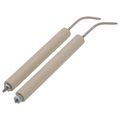





Westwood electrodes and insulators are the ignition components that generate and direct the spark inside an oil burner's combustion chamber, positioning the arc so the burner lights reliably on every call for heat. Beckett acquired the Westwood product line in 2021 and now manufactures the electrodes, flame rods, and insulators under the Westwood by Beckett name, continuing a line that technicians have specified for oil heat service for decades. Electrode sets are matched to a specific burner model, since gap width, tip angle, and insulator length all affect spark quality and flame detection. Replacing worn ceramic insulators along with the electrode tips at the same service call prevents a cracked insulator from causing a misfire on the next startup.
Subcategories
- Electrode Assemblies: Electrode assemblies pair two electrodes on an insulated mounting bracket that positions the spark gap in front of the burner nozzle. Gap width and tip position are set to the burner manufacturer's specification, since a gap that's too wide or too narrow affects ignition reliability. Technicians typically replace the full assembly rather than individual electrodes when the ceramic insulator shows any cracking. Matching the assembly to the exact burner model keeps flame shape and ignition timing consistent with the original equipment.
- Ceramic Insulators: Ceramic insulators hold the electrode rod in place while isolating it electrically from the burner housing, preventing the high-voltage ignition spark from arcing to ground. Heat cycling and combustion byproducts gradually cause hairline cracks in the ceramic, which is one of the more common causes of an intermittent ignition failure. Insulators are sized to match the electrode rod diameter and the specific burner's mounting bracket. Replacing a cracked insulator at the first sign of carbon tracking avoids a callback for a burner that won't light.
- Flame Rods: Flame rods use the electrical conductivity of a flame to signal the primary control that ignition was successful, allowing the burner to continue its firing sequence. A rod coated in soot or corrosion can send a false signal and trip the burner into lockout even when the flame is present. Cleaning or replacing the flame rod is a routine step during annual burner service. Flame rods are matched to the specific primary control and burner model in use.
Buying Guide
Matching Westwood electrodes and insulators to the exact burner model is the starting point for any repair, since gap width, tip angle, and insulator length are specific to each burner manufacturer's design. Pulling the burner's model and serial number before ordering avoids the trial-and-error of testing multiple electrode kits against one unit. A service call that already shows a cracked insulator or a soot-coated flame rod is a good opportunity to replace both components together, since they wear on a similar schedule and a second callback for a related failure is easy to avoid with one extra part on the truck. Technicians who service older oil-fired systems should also confirm whether the original Westwood electrodes and insulators are still in production or have been consolidated into an updated Beckett-manufactured equivalent, since some legacy configurations have changed since the 2021 acquisition. Gap and tip position should be verified against the burner manufacturer's specification after installation, not just set by eye, because a spark gap that drifts even slightly out of range shows up later as an intermittent ignition failure rather than an immediate one. Keeping a small stock of common electrode and insulator sizes on the truck cuts down on return trips for straightforward ignition failures, which make up a large share of oil burner service calls.
Frequently Asked Questions
How is the correct electrode kit identified for a given burner?
Matching starts with the burner's model and serial number, since gap width, tip angle, and mounting style are specific to each manufacturer's design. Westwood, now manufactured under Beckett, covers many of the same replacement configurations used across common residential and commercial oil burners. Checking the burner manufacturer's spec sheet before ordering avoids installing a kit with the wrong gap setting.
What causes a ceramic insulator to fail?
Repeated heat cycling and exposure to combustion byproducts gradually create hairline cracks in the ceramic. A cracked insulator lets the ignition spark arc toward the housing instead of the electrode tip, which shows up as an intermittent or failed ignition. Replacing the insulator at the first sign of carbon tracking around the crack prevents a repeat service call.
Why would a burner lock out even though the flame is lit?
A soot-coated or corroded flame rod can fail to conduct the signal the primary control needs to confirm ignition, even with a visible flame present. The control then reads a false no-flame condition and locks the burner out as a safety response. Cleaning or replacing the flame rod during routine service resolves most of these false lockouts.
Should the electrode and insulator be replaced together?
Both wear on a similar schedule since they're exposed to the same heat and combustion conditions, so replacing them together during a service call is common practice. It also avoids a second callback if the older component fails shortly after the other is replaced. Technicians carrying both parts on the truck can complete most ignition repairs in a single visit.
Are older Westwood electrode styles still available?
Many legacy configurations remain available, now manufactured under the Beckett brand following its 2021 acquisition of the Westwood product line. Some older styles have been consolidated into a current equivalent that fits the same burner mounting. Confirming the cross-reference against the burner's original part number avoids ordering a kit that doesn't fit.
