




Filters
SORT
Product Availability –
Category –
Intended Household –
Fuel Type –
Capacity (Gallons) –
BTU Input –
Energy Factor –
Energy Star Rated –
Diameter (Inches) –
Review Score –
 --%3E %3Csvg version='1.1' id='Fill' xmlns='http://www.w3.org/2000/svg' xmlns:xlink='http://www.w3.org/1999/xlink' x='0px' y='0px' viewBox='0 0 100 100' enable-background='new 0 0 100 100' xml:space='preserve'%3E %3Cpath fill='%23F15C02' d='M79.44,0.95H20.56C9.78,0.95,0.95,9.78,0.95,20.56v58.87c0,10.79,8.82,19.61,19.61,19.61h58.87 c10.79,0,19.61-8.83,19.61-19.61V20.56C99.05,9.78,90.22,0.95,79.44,0.95z M65.38,58.24l9.38,29.58L49.69,69.78L24.5,87.82 l9.34-29.6L8.8,39.6l30.73-0.17c0,0,6.98-19.61,10-28.93c0.54,1.36,9.88,29.1,9.88,29.1H91.2L65.38,58.24z'/%3E %3C/svg%3E)
 --%3E %3Csvg version='1.1' id='With-RB' xmlns='http://www.w3.org/2000/svg' xmlns:xlink='http://www.w3.org/1999/xlink' x='0px' y='0px' viewBox='0 0 100 100' enable-background='new 0 0 100 100' xml:space='preserve'%3E %3Cpath fill='%23FBC8B4' d='M79.44,0.95H20.56C9.78,0.95,0.95,9.78,0.95,20.56v58.87c0,10.79,8.82,19.61,19.61,19.61h58.87 c10.79,0,19.61-8.83,19.61-19.61V20.56C99.05,9.78,90.22,0.95,79.44,0.95z M65.38,58.24l9.38,29.58L49.69,69.78L24.5,87.82 l9.34-29.6L8.8,39.6l30.73-0.17c0,0,6.98-19.61,10-28.93c0.54,1.36,9.88,29.1,9.88,29.1H91.2L65.38,58.24z'/%3E %3C/svg%3E)
Price Range –
Bradford White Residential Gas Water Heaters

 --%3E %3Csvg version='1.1' id='No-RB' xmlns='http://www.w3.org/2000/svg' xmlns:xlink='http://www.w3.org/1999/xlink' x='0px' y='0px' viewBox='0 0 100 100' enable-background='new 0 0 100 100' xml:space='preserve'%3E %3Cpath fill='%23CECECE' d='M79.44,0.95H20.56C9.78,0.95,0.95,9.78,0.95,20.56v58.87c0,10.79,8.82,19.61,19.61,19.61h58.87 c10.79,0,19.61-8.83,19.61-19.61V20.56C99.05,9.78,90.22,0.95,79.44,0.95z M65.38,58.24l9.38,29.58L49.69,69.78L24.5,87.82 l9.34-29.6L8.8,39.6l30.73-0.17c0,0,6.98-19.61,10-28.93c0.54,1.36,9.88,29.1,9.88,29.1H91.2L65.38,58.24z'/%3E %3C/svg%3E)


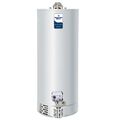
Bradford White Residential Gas Water Heaters are storage tank units built for single-family homes and light residential applications, spanning atmospheric vent, power vent, and direct vent configurations. Every model in the lineup incorporates the Defender Safety System, a flammable vapor ignition resistance design intended to reduce the risk of ignition from external vapors during operation. Bradford White manufactures its water heaters in the United States, which supports consistent parts availability and predictable lead times for contractors managing service calls or new installs. Tank capacities range from compact units suited to smaller households up to larger recovery models for homes with higher simultaneous hot water demand. Recovery rate, vent type, and gas input all affect which model fits a given job, so plumbers typically match these specs against the existing venting path and the home's peak draw before ordering a replacement. Choosing the right configuration up front avoids a second trip mid-installation.
Subcategories
- Atmospheric Vent Gas Water Heaters: Atmospheric vent models draft exhaust naturally through a vertical chimney or B-vent, making them a common choice for replacement jobs where existing venting is already in place. They include the Defender Safety System for flammable vapor resistance and are typically the lowest first-cost option in the lineup. Contractors favor them for straightforward swap-outs in basements and utility closets with adequate vertical clearance.
- Power Vent Gas Water Heaters: Power vent units use an integral blower to push exhaust horizontally through PVC or similar venting, opening up installation locations that lack a usable chimney. The blower allows longer vent runs than atmospheric models support, useful in additions or homes without existing masonry venting. Power vent tanks draw a small amount of electrical power to run the fan during operation.
- Direct Vent Gas Water Heaters: Direct vent models draw combustion air from outside through a sealed intake pipe rather than pulling it from the surrounding room, suiting tighter mechanical closets and homes with combustion air concerns. Both intake and exhaust run through concentric or two-pipe venting to the exterior. The sealed-combustion design keeps indoor air separate from the burner, a common requirement in modern tight-envelope construction.
- High Efficiency Condensing Gas Water Heaters: Condensing models capture additional heat from flue gases before venting, pushing efficiency well above standard atmospheric or power vent units. They vent with PVC or CPVC piping thanks to lower exhaust temperatures, and installers need a condensate drain line to handle the acidic byproduct. Higher upfront complexity is offset by lower operating costs over the tank's service life.
Buying Guide
Selecting a Bradford White residential gas water heater starts with venting. Confirm whether the installation site already has a usable chimney or B-vent, since that determines whether an atmospheric model is workable or whether a power vent or direct vent unit is needed instead. Next, size the tank to household demand: a two-bathroom home with a family of four typically needs a larger first-hour rating than a one-bathroom unit occupied by a couple, so match recovery rate and tank capacity to peak simultaneous draw rather than tank size alone.
Gas input and vent diameter must match the manufacturer's specifications for the chosen configuration; undersized venting on a power vent or direct vent replacement can cause nuisance shutdowns even when the tank itself is correctly sized. Contractors replacing an older unit should also check whether the gas line, shutoff valve, and drain pan meet current code, since a straightforward tank swap can turn into a larger job if those components need updating too.
For homes prioritizing lower operating costs over years of use, a condensing model within the Bradford White Residential Gas Water Heaters lineup offsets its higher installed cost with reduced fuel consumption, provided a condensate drain is available nearby. Standard efficiency atmospheric and power vent models remain the more common choice for straightforward replacements where the existing venting and gas supply are already sized correctly for the new unit.
Frequently Asked Questions
What's the difference between power vent and direct vent Bradford White water heaters?
Power vent models pull combustion air from the surrounding room and exhaust mechanically through PVC venting, while direct vent models draw combustion air from outside through a sealed intake. Direct vent is the better fit for tight mechanical rooms or homes with combustion air restrictions. Power vent installations are usually simpler where room air is already unrestricted.
Can an atmospheric vent water heater be replaced with a power vent model without changing the venting?
No, the vent type has to change along with the tank in most cases. Atmospheric vent tanks rely on a vertical chimney or B-vent that a power vent unit does not use, so switching configurations means installing new PVC venting to the point of termination.
How long is the warranty on Bradford White residential gas water heaters?
Warranty terms vary by model and tank type within the lineup. Contractors should confirm the exact term for the model number being installed and check whether the buyer plans to register the unit, since registration requirements can affect coverage.
Do these water heaters need a dedicated gas line size?
Gas line and meter capacity have to support the water heater's BTU input along with every other gas appliance running in the home at the same time. Undersized gas lines cause reduced firing rates and slow recovery even on a correctly chosen tank, so verifying total connected load before installation avoids callbacks.
What maintenance keeps a Bradford White gas water heater running longer?
Annual flushing of the tank removes sediment buildup that reduces efficiency and shortens tank life, especially in areas with hard water. Checking the anode rod every couple of years and replacing it before it's fully consumed protects the tank from corrosion. Venting and combustion air openings should be inspected periodically to confirm nothing is blocked or disconnected.
