



'/%3E%3C/svg%3E)
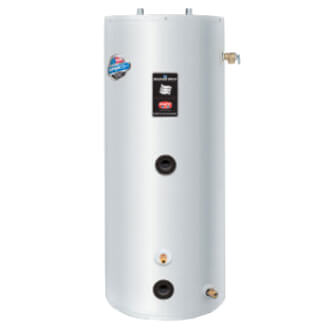
75 Gallon - Residential PowerStor Series Single Wall Indirect Water Heater
 --%3E %3Csvg version='1.1' id='Fill' xmlns='http://www.w3.org/2000/svg' xmlns:xlink='http://www.w3.org/1999/xlink' x='0px' y='0px' viewBox='0 0 100 100' enable-background='new 0 0 100 100' xml:space='preserve'%3E %3Cpath fill='%23F15C02' d='M79.44,0.95H20.56C9.78,0.95,0.95,9.78,0.95,20.56v58.87c0,10.79,8.82,19.61,19.61,19.61h58.87 c10.79,0,19.61-8.83,19.61-19.61V20.56C99.05,9.78,90.22,0.95,79.44,0.95z M65.38,58.24l9.38,29.58L49.69,69.78L24.5,87.82 l9.34-29.6L8.8,39.6l30.73-0.17c0,0,6.98-19.61,10-28.93c0.54,1.36,9.88,29.1,9.88,29.1H91.2L65.38,58.24z'/%3E %3C/svg%3E)
'/%3E%3C/svg%3E)
Lift Gate
Product Highlights


Specs
| BTU Input: | 157000 |
|---|---|
| Capacity (Gallons): | 75 |
| Connection Type: | Threaded |
| Height (Inches): | 59" |
| Water Connection: | 3/4" |
| Diameter (Inches): | 24" |
| Test Pressure (PSI): | 300 psi |
| Weight (lbs): | 224 lbs |
| Working Pressure (PSI): | 150 psi |
| Warranty: | Limited Lifetime Tank & Heat Exchanger/ 6 Year Limited on Component Parts |
| Application: | Plumbing |

Questions?
10 Replacement Parts

Need help finding a replacement part?
Product Reviews
Solar Hot Water Storage

Easy install, excellent performance
Product Q&A
1 QuestionQ: what is the efficiency of the water heater
Asked by MG 12 years ago
Add your answer
This water heater heats water by circulating a hot liquid through an internal “heat exchanger”. In our home we circulate an antifreeze solution, heated by solar panels, through the heat exchanger. On a sunny day the tank reaches temperatures approaching 190°F. It is difficult to define the “efficiency” of a hot water tank. It would be easier to think in terms of heat loss through the walls of the tank. At sunset, for example, the tank reaches a certain temperature. How much does that temperature drop during the night? This tank is well insulated, and the overnight temperature drop is modest. It is larger when the initial temperature is very high, dropping possibly seven or eight Fahrenheit degrees. It is much more modest for lower initial temperatures. If, at sunset, for example, the tank had reached only 130°F, then by morning it might have dropped by only two or three degrees. Such heat loss is a function of the insulation, which appears to be very good for this tank. An additional fiberglass insulating jacket would probably reduce the heat loss even more, but it's quite acceptable as is. Now if the hot, circulating fluid were produced by a gas furnace, for example, then it would be easier to talk about “efficiency”. For every joule of energy provided by the fuel, what fraction of that joule would actually end up in the circulating heating fluid and how much of it would ultimately show up in the hot water tank. Instinctively, I would guess, no more than 70%, if that much. In this case we would be looking at the efficiency of the entire system, including the tank. Looking at the tank in isolation, however, and if there were no heat heat leakage through the walls, its efficiency would be 100%. Hope this isn’t confusing. I would add that we have been very happy with this tank. We consider ourselves fortunate to have found it.