




CPVC Pipe Fittings

PVC Fittings








| PRODUCT | SIZE | SINGLE UNIT | BOX UP & SAVE | STOCK STATUS | LIST | COMPARE |
|---|

CPVC fittings are plumbing components manufactured to connect CPVC pipe in hot and cold water distribution lines for residential and light commercial buildings. Plumbers reach for CPVC fittings when a job calls for a corrosion-resistant material that costs less than copper while still handling sustained hot water service without scale buildup or pitting. The fittings join together with solvent cement rather than soldering or crimping, which speeds up rough-in work and avoids an open flame on the job site. Common types include elbows, tees, couplings, reducers, and threaded adapters, covering nearly every transition a plumbing or HVAC technician runs into on a repair or remodel. Because CPVC systems pair with copper, PEX, and threaded metal pipe through transition fittings, a well-stocked assortment of CPVC fittings keeps a service truck ready for most water heater and supply line jobs without an extra trip to the supply house.
Subcategories
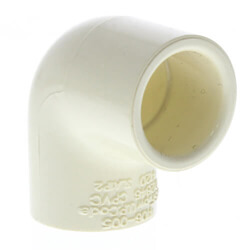
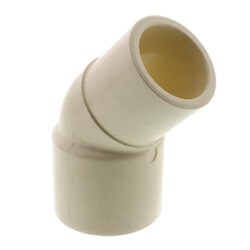
- CPVC Elbows: CPVC elbows redirect a pipe run at a 90 degree or 45 degree angle without cutting into the straight pipe itself. Plumbers use them at wall penetrations, ceiling transitions, and anywhere a water line needs to change direction around framing or other trades' work. Slip and threaded versions are both common, letting a fitting either solvent weld directly to pipe or thread onto a valve or fixture connection. Stocking both angles in a few common sizes covers most residential rough-in work.
- CPVC Tees and Wyes: Tees and wyes create a branch off a main CPVC line, splitting flow to feed a fixture, water heater, or secondary run. A standard tee branches at 90 degrees while a wye branches at a shallower angle, which some installers prefer for smoother flow and easier support in tight spaces. Reducing tees step down to a smaller branch size without needing a separate reducer fitting. These are among the most frequently used CPVC fittings on any multi-fixture job.
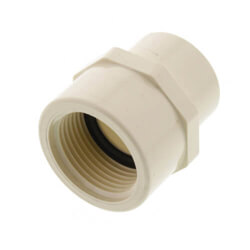
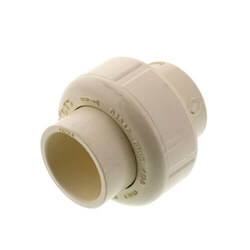
- CPVC Couplings and Adapters: Couplings join two straight lengths of CPVC pipe of the same diameter, while adapters transition CPVC to another pipe material or connection type such as threaded metal, copper, or PEX. Slip couplings are used for straight repairs, and repair couplings without a center stop allow a technician to slide the fitting over an existing pipe when there is no room to swing a new section into place. Adapters with female or male threads let a CPVC line terminate at a valve, water heater, or fixture supply.
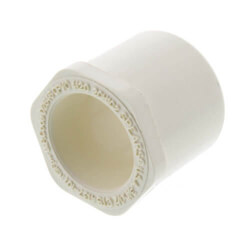
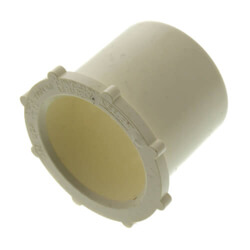
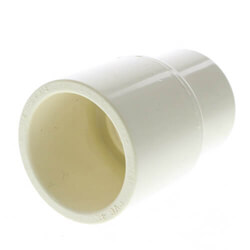
- CPVC Reducing Fittings: Reducing fittings step a CPVC line down from a larger diameter to a smaller one, commonly where a main line feeds individual fixture branches. Reducer bushings fit inside a larger fitting to accept smaller pipe, while reducing couplings and tees combine the transition with a straight or branch connection in a single part. Choosing the correct reducer avoids adding an extra joint, cutting down the number of solvent-welded connections that could eventually need service.
Buying Guide
Choosing the right fittings for a CPVC installation starts with confirming pipe size and wall thickness, since fittings are sized to match schedule 40 or CTS (copper tube size) dimensions and are not interchangeable across systems. Matching the fitting schedule to the pipe already installed avoids a leak point at the joint. Next, consider the connection style needed at each transition: slip fittings for permanent solvent-welded joints, and threaded fittings where a valve, fixture, or future service disconnect is required. CPVC fittings rated for both hot and cold water service handle the temperature swings common in residential supply lines, so verifying a temperature rating that matches the application prevents premature failure on hot water branches. For repair work, keeping a stock of repair couplings and slip fittings on hand pays off, since many callbacks involve replacing a single cracked or corroded section rather than a full re-pipe. Primer and solvent cement compatible with CPVC (not standard PVC cement) is required for a proper joint, and using the wrong cement is one of the most common causes of a failed connection. Buying fittings in bulk multi-packs for the most frequently used sizes and angles, elbows, tees, and couplings, cuts down on truck stock trips for common repair calls. Checking local plumbing code for approved CPVC applications before bidding a job also avoids rework if an inspector flags an installation.
Frequently Asked Questions
What is the difference between CPVC and PVC fittings?
CPVC is rated for higher temperatures than standard PVC, making it suitable for hot water lines where PVC would soften or fail. The two materials also require different solvent cements, so a technician cannot substitute PVC cement on a CPVC joint. Visually, CPVC fittings are typically a cream or tan color compared to the white or gray common with PVC.
Can CPVC fittings connect to copper pipe?
Yes, transition adapters allow a CPVC line to connect to copper pipe, typically using a threaded or push-to-connect fitting rather than a direct solvent weld. Direct contact between CPVC cement and copper is avoided, so the adapter provides a mechanical seal instead. This is common where an older copper system is being extended or repaired with CPVC.
What sizes do CPVC fittings come in?
CPVC fittings are commonly available in half-inch through two-inch diameters for residential and light commercial supply lines, matching the CTS sizing used for CPVC pipe. Larger diameters exist for commercial applications but are less common on typical service trucks. Matching fitting size exactly to the pipe diameter already installed is necessary since CPVC fittings are not interchangeable between schedules.
Do CPVC fittings need primer before cementing?
Many plumbing codes require a primer application before solvent cement on CPVC joints, particularly for schedule 40 systems, though some cement formulations are approved for primerless installation. Checking local code requirements before starting a job avoids a failed inspection. Even where primer is optional, cleaning the joint surfaces before cementing helps produce a stronger bond.
How long do CPVC fittings last in a hot water system?
CPVC fittings are built for long-term service in continuous hot water applications without the scale buildup or pitting that can affect metal fittings over time. Actual service life depends on water chemistry, installation quality, and system pressure, but a properly solvent-welded CPVC joint is a permanent connection rather than a serviceable one. Failures are more often traced to a bad cement joint than to the fitting material itself.
