




Filters
SORT
Product Availability –
Size –
Review Score –
 --%3E %3Csvg version='1.1' id='Fill' xmlns='http://www.w3.org/2000/svg' xmlns:xlink='http://www.w3.org/1999/xlink' x='0px' y='0px' viewBox='0 0 100 100' enable-background='new 0 0 100 100' xml:space='preserve'%3E %3Cpath fill='%23F15C02' d='M79.44,0.95H20.56C9.78,0.95,0.95,9.78,0.95,20.56v58.87c0,10.79,8.82,19.61,19.61,19.61h58.87 c10.79,0,19.61-8.83,19.61-19.61V20.56C99.05,9.78,90.22,0.95,79.44,0.95z M65.38,58.24l9.38,29.58L49.69,69.78L24.5,87.82 l9.34-29.6L8.8,39.6l30.73-0.17c0,0,6.98-19.61,10-28.93c0.54,1.36,9.88,29.1,9.88,29.1H91.2L65.38,58.24z'/%3E %3C/svg%3E)
Price Range –
CPVC Unions

 --%3E %3Csvg version='1.1' id='No-RB' xmlns='http://www.w3.org/2000/svg' xmlns:xlink='http://www.w3.org/1999/xlink' x='0px' y='0px' viewBox='0 0 100 100' enable-background='new 0 0 100 100' xml:space='preserve'%3E %3Cpath fill='%23CECECE' d='M79.44,0.95H20.56C9.78,0.95,0.95,9.78,0.95,20.56v58.87c0,10.79,8.82,19.61,19.61,19.61h58.87 c10.79,0,19.61-8.83,19.61-19.61V20.56C99.05,9.78,90.22,0.95,79.44,0.95z M65.38,58.24l9.38,29.58L49.69,69.78L24.5,87.82 l9.34-29.6L8.8,39.6l30.73-0.17c0,0,6.98-19.61,10-28.93c0.54,1.36,9.88,29.1,9.88,29.1H91.2L65.38,58.24z'/%3E %3C/svg%3E)
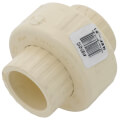
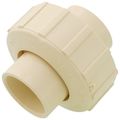
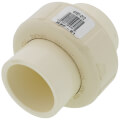
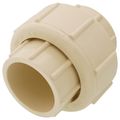
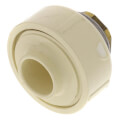
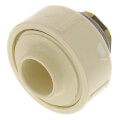
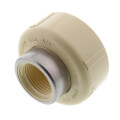
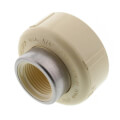

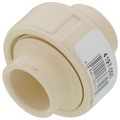
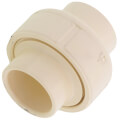
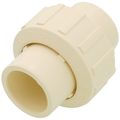
CPVC Unions in this category are CTS-sized Spears fittings that let a plumber disconnect and reconnect a CPVC line without cutting pipe or rebuilding a solvent-welded joint. Each union uses a socket by socket connection with an EPDM O-ring seal, and CTS CPVC pipe and fittings carry a continuous working pressure rating of 100 psi at 180 degrees Fahrenheit. Sizes in the line run from 1/2 inch up through 1-1/4 inch, covering typical branch lines up to larger mainline or equipment connections. Plumbers use these fittings anywhere a future water heater, pump, or fixture swap is likely, since the union lets that section come apart for service without forcing a full pipe replacement. Having a union joint built into the run ahead of time turns a repair job that would otherwise require cutting and re-gluing pipe into a quick disconnect and reconnect.
Subcategories
- 1/2 Inch CTS CPVC Unions: The 1/2 inch union (4197-005) uses a socket by socket connection with an EPDM O-ring seal, matching standard CTS pipe dimensions. Smaller branch lines and individual fixture connections are the most common application for this size. Plumbers often place this union just ahead of a fixture shutoff or small appliance connection where future service is likely.
- 3/4 Inch CTS CPVC Unions: The 3/4 inch union (4197-007) shares the same socket connection and EPDM O-ring seal design as the smaller size, sized for CTS 3/4 inch pipe. Main domestic hot and cold water branch lines in residential and light commercial systems commonly use this size. Installing this union ahead of a water heater gives a disconnect point for future replacement.
- 1-1/4 Inch CTS CPVC Unions: The 1-1/4 inch union (4197-012) carries the same EPDM O-ring socket design in a larger bore for higher flow mainline runs or equipment connections. Larger residential systems or light commercial installations with higher demand typically step up to this size. The larger bore accommodates equipment such as recirculation pumps or larger fixture groups without restricting flow.
Buying Guide
Start by confirming pipe size matches the existing CPVC run rather than assuming a standard size fits every job. CTS CPVC Unions in this category come in 1/2 inch, 3/4 inch, and 1-1/4 inch sizes, and mixing up CTS sizing with Schedule 40 or Schedule 80 iron pipe sizing leads to a union that won't thread onto the existing pipe. Pressure rating matters next: CTS CPVC carries a continuous working pressure of 100 psi at 180 degrees Fahrenheit, which covers standard domestic hot and cold water service but leaves less headroom than Schedule 80 CPVC on higher-pressure or higher-temperature applications. Placement in the system deserves some planning too, since CPVC Unions work best installed just ahead of a water heater, pump, or any fixture that's likely to need future service, rather than buried in the middle of a long straight run where they add no practical benefit. The EPDM O-ring seal design lets the joint separate and reconnect without solvent cement, so confirm the O-ring material is compatible with the system's fluid and temperature before specifying it on a job with anything other than typical potable water. Socket connections on both ends still require proper primer and cement on the pipe side of the joint, so a union doesn't eliminate standard CPVC solvent-weld procedure for the rest of the run, only at the union body itself.
Frequently Asked Questions
What's the difference between a CPVC union and a standard coupling?
A union allows a section of CPVC pipe to be disconnected and reconnected without cutting the pipe or rebuilding a solvent-welded joint. A standard coupling only joins two pipe ends permanently with solvent cement and offers no way to take the joint apart later. Installing a union ahead of a water heater or pump makes future service much simpler than relying on couplings alone.
What sizes are available in this CTS CPVC union line?
CPVC Unions in this size range include 1/2 inch, 3/4 inch, and 1-1/4 inch options, all using CTS, or copper tube size, dimensions. Confirming CTS sizing against the existing pipe matters, since Schedule 40 and Schedule 80 iron pipe size fittings won't thread onto CTS pipe. Matching size correctly avoids an awkward adapter fitting on the job.
What pressure rating do these unions carry?
CTS CPVC carries a continuous working pressure rating of 100 psi at 180 degrees Fahrenheit, with higher short-term pressure capacity at lower temperatures. Standard domestic hot and cold water service falls well within that rating on most residential and light commercial jobs. Higher-pressure or higher-temperature applications may call for Schedule 80 CPVC fittings instead.
How does the EPDM O-ring seal work compared to a standard solvent weld?
The EPDM O-ring seal lets the two halves of the union separate and reconnect without solvent cement at that specific joint. Socket connections on the pipe side of the union still require standard primer and cement, so the O-ring only affects the union body itself. Confirming O-ring compatibility with the system's fluid matters before specifying the fitting on anything other than typical potable water.
Where should a union be placed in a CPVC run?
Installing a union just ahead of a water heater, pump, or fixture that's likely to need future service gives a quick disconnect point for that component. Burying a union in the middle of a long straight run with no planned service point adds cost without a practical benefit. Planning union placement during rough-in saves cutting and re-gluing pipe during a later repair.
