



Filters
SORT
Product Availability –
Brand –
Application –
Diameter (Inches) –
Drilling Depth –
Review Score –
 --%3E %3Csvg version='1.1' id='Fill' xmlns='http://www.w3.org/2000/svg' xmlns:xlink='http://www.w3.org/1999/xlink' x='0px' y='0px' viewBox='0 0 100 100' enable-background='new 0 0 100 100' xml:space='preserve'%3E %3Cpath fill='%23F15C02' d='M79.44,0.95H20.56C9.78,0.95,0.95,9.78,0.95,20.56v58.87c0,10.79,8.82,19.61,19.61,19.61h58.87 c10.79,0,19.61-8.83,19.61-19.61V20.56C99.05,9.78,90.22,0.95,79.44,0.95z M65.38,58.24l9.38,29.58L49.69,69.78L24.5,87.82 l9.34-29.6L8.8,39.6l30.73-0.17c0,0,6.98-19.61,10-28.93c0.54,1.36,9.88,29.1,9.88,29.1H91.2L65.38,58.24z'/%3E %3C/svg%3E)
 --%3E %3Csvg version='1.1' id='With-RB' xmlns='http://www.w3.org/2000/svg' xmlns:xlink='http://www.w3.org/1999/xlink' x='0px' y='0px' viewBox='0 0 100 100' enable-background='new 0 0 100 100' xml:space='preserve'%3E %3Cpath fill='%23FBC8B4' d='M79.44,0.95H20.56C9.78,0.95,0.95,9.78,0.95,20.56v58.87c0,10.79,8.82,19.61,19.61,19.61h58.87 c10.79,0,19.61-8.83,19.61-19.61V20.56C99.05,9.78,90.22,0.95,79.44,0.95z M65.38,58.24l9.38,29.58L49.69,69.78L24.5,87.82 l9.34-29.6L8.8,39.6l30.73-0.17c0,0,6.98-19.61,10-28.93c0.54,1.36,9.88,29.1,9.88,29.1H91.2L65.38,58.24z'/%3E %3C/svg%3E)
Price Range –
Carbide Tipped Hole Saws

 --%3E %3Csvg version='1.1' id='No-RB' xmlns='http://www.w3.org/2000/svg' xmlns:xlink='http://www.w3.org/1999/xlink' x='0px' y='0px' viewBox='0 0 100 100' enable-background='new 0 0 100 100' xml:space='preserve'%3E %3Cpath fill='%23CECECE' d='M79.44,0.95H20.56C9.78,0.95,0.95,9.78,0.95,20.56v58.87c0,10.79,8.82,19.61,19.61,19.61h58.87 c10.79,0,19.61-8.83,19.61-19.61V20.56C99.05,9.78,90.22,0.95,79.44,0.95z M65.38,58.24l9.38,29.58L49.69,69.78L24.5,87.82 l9.34-29.6L8.8,39.6l30.73-0.17c0,0,6.98-19.61,10-28.93c0.54,1.36,9.88,29.1,9.88,29.1H91.2L65.38,58.24z'/%3E %3C/svg%3E)

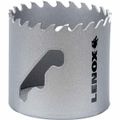
Carbide Tipped Hole Saws are cutting accessories designed to bore clean, round holes through tough or abrasive materials that wear out standard bi-metal blades quickly. Carbide teeth hold an edge far longer than bi-metal construction, with some models offering a cutting depth of 1-15/16 inches for a wide variety of materials. Trade professionals use them on jobs involving fastener-embedded wood, stainless steel, tile backer board, fiberglass, and other abrasive surfaces where a standard hole saw would dull fast or bind. They install with a standard 1/4-inch arbor system, matching the same drive setup used across most hole saw lines, so techs don't need separate arbors for each material type. Because carbide teeth resist wear better than bi-metal, a single blade can complete significantly more cuts before replacement, which matters on large jobs like whole-house electrical or plumbing rough-in. Keeping a set on the truck means fewer blade changes and less downtime when the material changes mid-job.
Subcategories
- Small-Diameter Carbide Hole Saws: Small-diameter carbide hole saws cover openings roughly under 1-1/2 inches, sized for electrical box knockouts, low-voltage cable runs, and small conduit penetrations. Electricians and low-voltage techs use this range most often on daily service calls. Carbide-tipped versions in this range are available down to about 11/16 inch. The smaller size still carries the same carbide edge durability as larger blades in the same line.
- Mid-Diameter Carbide Hole Saws: Mid-diameter carbide hole saws generally range from about 1-1/2 to 3 inches and cover common plumbing and HVAC penetrations like pipe stub-outs and small duct fittings. Plumbers and HVAC installers reach for this range most frequently on rough-in day. This size range is available in the same 21-size lineup that spans from 11/16 inch up to 6 inches. Carbide teeth in this range hold up well against fastener-embedded framing lumber.
- Large-Diameter Carbide Hole Saws: Large-diameter carbide hole saws cover openings up to 6 inches, used for larger duct penetrations, recessed fixture cutouts, and bigger pipe runs. Contractors cutting through tile backer, fiberglass, or stainless steel panels rely on the larger sizes to avoid multiple overlapping cuts. Cutting depth on these models can reach 1-15/16 inches, enough to punch through most standard wall assemblies in a single pass. The larger blades still use the same 1/4-inch arbor drive system as smaller sizes in the line.
- Hole Saw Arbors: Hole saw arbors are the drive component that connects a carbide-tipped hole saw to a drill or driver, and they're typically sold separately from the blade itself. A standard 1/4-inch chuck connection is common across most carbide hole saw lines, letting one arbor drive multiple blade sizes. Techs carrying a range of hole saw diameters only need one or two arbors to cover the full set. Replacing a worn or bent arbor is far cheaper than replacing an entire hole saw.
Buying Guide
Match the blade to the material first. Carbide Tipped Hole Saws are built for abrasive and fastener-embedded materials like stainless steel, tile backer, fiberglass, and wood that may contain hidden nails or screws, situations where a standard bi-metal blade wears out fast or binds. For clean wood, drywall, or plastic without embedded fasteners, a bi-metal hole saw is usually the more cost-effective choice since carbide construction costs more upfront. Next, confirm the diameter matches the fixture, fitting, or conduit being installed, since carbide hole saw lines typically span a wide range of sizes from under an inch up to six inches. Check cutting depth against the wall or panel thickness on the job; a blade with a cutting depth under two inches may require cutting from both sides on thicker assemblies. Confirm arbor compatibility before buying loose blades, since arbors are often sold separately and not every blade size uses the same arbor thread or connection. For techs running mixed material jobs, a multi-piece set with several diameters and a shared arbor cuts down on truck stock while still covering most common hole sizes. Higher upfront cost for carbide construction typically pays off on jobs with heavy material abuse, where a bi-metal blade would need frequent replacement.
Frequently Asked Questions
What's the difference between carbide tipped and bi-metal hole saws?
Carbide tipped hole saws use carbide teeth that hold an edge much longer than bi-metal construction, especially on abrasive or fastener-embedded materials. Bi-metal blades cost less but wear out faster on tough materials like stainless steel or nail-embedded wood. The choice generally comes down to material type and how much use the blade will see before replacement.
What materials can carbide tipped hole saws cut?
Carbide tipped hole saws are designed for materials like fastener-embedded wood, stainless steel, tile backer board, and fiberglass. They handle abrasive surfaces that dull standard bi-metal blades quickly. Checking the specific blade's rated materials before cutting helps avoid premature wear.
What size arbor do carbide hole saws use?
Most carbide tipped hole saw lines use a standard 1/4-inch arbor connection, which is often sold separately from the blade itself. One arbor typically drives multiple blade diameters within the same product line. Confirming arbor compatibility before purchase avoids ending up with a blade that doesn't fit existing equipment.
How deep can a carbide tipped hole saw cut?
Cutting depth varies by model, with some carbide tipped hole saws offering up to 1-15/16 inches of depth. That depth needs to be checked against the thickness of the material being cut, since thicker panels or walls may require cutting from both sides. Matching cutting depth to the job avoids getting stuck partway through a cut.
Can carbide tipped hole saws cut pipe?
Carbide tipped hole saws are generally not recommended for pipe cutting, since they're designed for boring holes through flat panels, framing, and sheet materials rather than cutting through round stock. A dedicated pipe cutting tool is typically a better fit for that task. Checking manufacturer guidance for the specific blade confirms its intended use.
