




Commercial ERV Series

 --%3E %3Csvg version='1.1' id='No-RB' xmlns='http://www.w3.org/2000/svg' xmlns:xlink='http://www.w3.org/1999/xlink' x='0px' y='0px' viewBox='0 0 100 100' enable-background='new 0 0 100 100' xml:space='preserve'%3E %3Cpath fill='%23CECECE' d='M79.44,0.95H20.56C9.78,0.95,0.95,9.78,0.95,20.56v58.87c0,10.79,8.82,19.61,19.61,19.61h58.87 c10.79,0,19.61-8.83,19.61-19.61V20.56C99.05,9.78,90.22,0.95,79.44,0.95z M65.38,58.24l9.38,29.58L49.69,69.78L24.5,87.82 l9.34-29.6L8.8,39.6l30.73-0.17c0,0,6.98-19.61,10-28.93c0.54,1.36,9.88,29.1,9.88,29.1H91.2L65.38,58.24z'/%3E %3C/svg%3E)
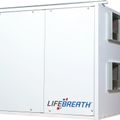
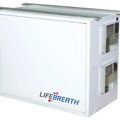
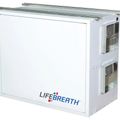

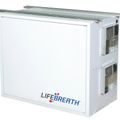
Commercial ERV Series units are energy recovery ventilators built by Lifebreath for bringing fresh outdoor air into commercial and light-commercial buildings while recovering heat and moisture from the air being exhausted. The 330ERV moves 270 CFM through a single energy recovery core, while the larger 730ERV uses a double core rated at 680 CFM, giving contractors a range of capacities to match different building sizes without changing the product family. Both units include a fan defrost cycle that protects the core from icing during cold-weather operation, which matters in climates where outdoor intake air runs well below freezing for extended stretches. Facility managers specify this series when code requires mechanical ventilation in a tightly sealed commercial space but conditioning all of that incoming outdoor air directly would drive up energy costs. Because the units share a common installation approach across capacities, contractors familiar with one model in the series can generally service or install another without relearning the platform.
Subcategories
- 330ERV & Smaller-Capacity Units: The 330ERV is built around a single energy recovery core and moves 270 CFM, which suits smaller commercial spaces or zoned ventilation setups. Its fan defrost cycle keeps the core from icing over during cold outdoor air intake. It's a common starting point for buildings adding mechanical ventilation to meet code without a major capacity jump.
- 730ERV & Larger-Capacity Units: The 730ERV steps up to a double energy recovery core rated at 680 CFM, roughly double the airflow of the 330ERV. It shares the same fan defrost approach as the smaller unit, so cold-climate performance carries over across the lineup. Contractors serving larger commercial buildings typically default to this tier when a single 330ERV can't cover the required air changes.
- Replacement Cores & Filters: Energy recovery cores and intake filters need periodic replacement to keep a unit performing at its rated CFM. Airflow drops off gradually as a core loads with dust, so a maintenance schedule matters more than a reactive fix once occupants start complaining about stuffiness. Keeping a spare core on hand shortens downtime on service calls.
- Controls & Accessories: Wall controls, dampers, and ducting accessories round out a Commercial ERV installation. Some buildings pair the ERV with a dedicated control sequence tied to occupancy schedules rather than running it continuously. Contractors should confirm control compatibility with the building's existing automation system before specifying accessories.
Buying Guide
Sizing a unit from the Commercial ERV Series starts with the building's required air changes per hour, which depends on occupancy, square footage, and what local code calls for in that occupancy class. Contractors specifying a 330ERV versus a 730ERV are really choosing between roughly 270 CFM and 680 CFM of rated airflow, so undersizing the unit means the space won't hit its required ventilation rate no matter how well the rest of the system is installed. Climate matters as much as capacity: buildings in cold regions benefit from the fan defrost cycle built into these units, since a core that ices over stops recovering heat and can restrict airflow until it thaws. Ducting layout affects performance too, since long duct runs or excessive fittings between the ERV and its intake or exhaust points reduce the effective CFM delivered to the space, even when the unit itself is rated correctly. Maintenance access is worth planning during design, not after installation, because the energy recovery core needs periodic cleaning or replacement to hold its rated performance over time. For buildings with existing building automation, confirming that a chosen ERV's controls integrate with that system avoids running a separate, unmonitored control loop for ventilation alone.
Frequently Asked Questions
How much airflow does the 330ERV move compared to the 730ERV?
The 330ERV is rated at 270 CFM through a single energy recovery core, while the 730ERV moves 680 CFM through a double core. Both include a fan defrost cycle for cold-climate operation, so the choice between them mostly comes down to the building's required ventilation rate.
Why does a commercial ERV need a fan defrost cycle?
In cold climates, incoming outdoor air can cause moisture in the energy recovery core to freeze, which restricts airflow and reduces heat recovery. The fan defrost cycle periodically adjusts operation to clear ice from the core so the unit keeps performing through winter months.
How often does the energy recovery core need to be replaced?
Core replacement intervals depend on how dusty the intake air is and how consistently filters are serviced, since a loaded core restricts airflow below its rated CFM. Checking airflow periodically and replacing the core when it drops off, rather than waiting for a complaint, keeps the system running at its designed capacity.
Can a Commercial ERV Series unit be tied into an existing building automation system?
Many buildings run these units on a dedicated control sequence tied to occupancy schedules instead of continuous operation, and how well it connects depends on the specific automation system in place. Confirming control compatibility before ordering the unit avoids adding a separate, unmonitored control loop.
What determines whether a building needs a 330ERV or a 730ERV?
The right size depends on the building's required air changes per hour, which is based on occupancy, square footage, and local code for that occupancy class. A 330ERV covers smaller spaces or zoned setups, while a 730ERV suits larger buildings needing roughly double the airflow.
