




LifeBreath Energy Recovery Ventilators


 --%3E %3Csvg version='1.1' id='No-RB' xmlns='http://www.w3.org/2000/svg' xmlns:xlink='http://www.w3.org/1999/xlink' x='0px' y='0px' viewBox='0 0 100 100' enable-background='new 0 0 100 100' xml:space='preserve'%3E %3Cpath fill='%23CECECE' d='M79.44,0.95H20.56C9.78,0.95,0.95,9.78,0.95,20.56v58.87c0,10.79,8.82,19.61,19.61,19.61h58.87 c10.79,0,19.61-8.83,19.61-19.61V20.56C99.05,9.78,90.22,0.95,79.44,0.95z M65.38,58.24l9.38,29.58L49.69,69.78L24.5,87.82 l9.34-29.6L8.8,39.6l30.73-0.17c0,0,6.98-19.61,10-28.93c0.54,1.36,9.88,29.1,9.88,29.1H91.2L65.38,58.24z'/%3E %3C/svg%3E)



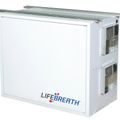
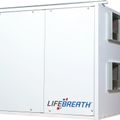
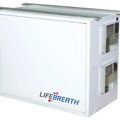
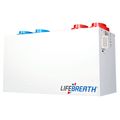
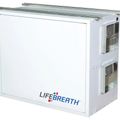
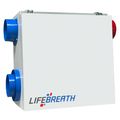
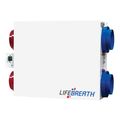
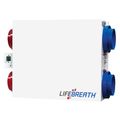
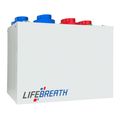
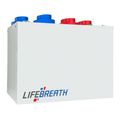
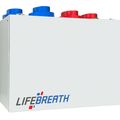

LifeBreath energy recovery ventilators bring continuous fresh outdoor air into a home while exhausting stale indoor air, transferring heat and moisture between the two air streams so the incoming air arrives closer to the home's existing indoor temperature and humidity. Builders and HVAC contractors install these units most often in newer, tightly sealed homes where reduced air leakage improves energy efficiency but also traps stale air, excess humidity, and indoor pollutants that would otherwise escape through natural infiltration. An energy recovery ventilator keeps a continuous air exchange running year-round without the heating or cooling penalty that simply opening a window or running an exhaust fan alone would cause.
Sizing a unit to the home's total living area and expected occupancy determines how much air needs to move through the system on a continuous basis. HVAC contractors typically integrate the ventilator with the home's existing ductwork or run dedicated fresh-air and exhaust lines depending on the retrofit or new-construction scope of the project.
Subcategories
- Whole-Home ERV Units: Whole-home ERV units are sized to handle the continuous ventilation needs of an entire house, typically tying into or working alongside the main HVAC ductwork to distribute fresh air to multiple rooms. Contractors select unit capacity based on total square footage, occupancy, and the home's airtightness rating. These units run continuously at a low speed with the option to boost airflow during high-humidity or high-occupancy periods. Balanced intake and exhaust airflow is central to how the units maintain neutral pressure throughout the house.
- Control Panels & Wall Controls: Control panels and wall controls let homeowners and technicians adjust ventilation speed, switch between continuous and intermittent operation, and view basic system status without accessing the unit itself. Some controls integrate with a home's existing thermostat system, while others operate as a standalone wall-mounted switch. Multi-speed controls allow a boost setting for periods of higher humidity, such as during cooking or showering. Technicians typically mount the control in a central, accessible location like a hallway or utility area.
- Core Replacement & Filters: Core replacement and filters address the two components inside an ERV that need periodic service: the energy recovery core that transfers heat and moisture between air streams, and the filters that keep dust and debris out of both the core and the home's air supply. Filters typically need more frequent replacement than the core itself, depending on local air quality and household dust levels. A neglected filter reduces airflow efficiency and can eventually strain the unit's fan motor. Cores are designed for a much longer service life but should be inspected periodically for buildup.
- Ducting & Installation Accessories: Ducting and installation accessories include the intake hoods, exhaust terminations, insulated flex duct, and mounting hardware needed to connect an ERV to both the outdoors and the home's interior air distribution. Correct duct sizing between the unit and its termination points affects overall system airflow and efficiency. Insulated ducting is generally required on runs through unconditioned spaces to prevent condensation inside the duct. Exterior hoods and terminations need to be positioned to avoid short-circuiting, where exhaust air gets pulled directly back into the intake.
Buying Guide
Selecting the right LifeBreath ERV starts with calculating the home's required ventilation rate based on square footage, number of bedrooms, and occupancy, since an undersized unit won't adequately clear excess humidity and stale air while an oversized unit runs less efficiently and can increase energy use without added benefit. Climate also plays a role in unit selection, since energy recovery ventilators are generally better suited to climates with both a heating and cooling season, where the moisture-transfer function helps balance humidity levels indoors year-round. Contractors should confirm whether the installation is new construction, where ductwork can be planned around the ERV, or a retrofit, where existing duct routing and available space may limit unit placement.
Duct design has a direct effect on unit performance, since undersized ductwork or excessive duct length reduces the actual airflow delivered compared to the unit's rated capacity. Positioning the exterior intake and exhaust terminations far enough apart prevents short-circuiting, which otherwise undermines the whole point of bringing in genuinely fresh outdoor air. Ongoing filter maintenance access should factor into placement decisions as well, since a unit installed in a hard-to-reach attic or crawlspace location makes routine filter changes more likely to get skipped, reducing both air quality and system efficiency over time.
Frequently Asked Questions
What's the difference between an ERV and an HRV?
An energy recovery ventilator transfers both heat and moisture between the incoming and outgoing air streams, while a heat recovery ventilator transfers only heat. ERVs are generally better suited to climates with humid summers, since they help manage moisture along with temperature.
How often does the filter need to be changed on an ERV?
Filter replacement frequency depends on local air quality and household dust levels, but most manufacturers recommend checking filters every few months and replacing them at least a couple of times a year. A neglected filter reduces airflow and can put extra strain on the fan motor over time.
Can an ERV be added to a home that already has central HVAC?
Yes, an ERV can often tie into existing ductwork or run independent fresh-air and exhaust lines alongside a home's central HVAC system. The best approach depends on existing duct layout, available space, and whether the project is new construction or a retrofit.
Do ERVs run continuously or only when triggered?
Most ERVs run continuously at a low, steady airflow rate to provide consistent fresh-air exchange, with a boost mode available for higher-demand periods like cooking or showering. Continuous low-speed operation is generally more effective at maintaining consistent indoor air quality than intermittent cycling.
What causes reduced airflow in an installed ERV system?
Reduced airflow is most often caused by a dirty filter, undersized or excessively long ductwork, or a partially blocked exterior intake or exhaust hood. Checking the filter first is the simplest troubleshooting step before inspecting the ductwork or terminations.
