




Filters
SORT
Product Availability –
Category –
Brand –
Number Of Outlets –
Loop Size –
Supply Size –
Review Score –
 --%3E %3Csvg version='1.1' id='Fill' xmlns='http://www.w3.org/2000/svg' xmlns:xlink='http://www.w3.org/1999/xlink' x='0px' y='0px' viewBox='0 0 100 100' enable-background='new 0 0 100 100' xml:space='preserve'%3E %3Cpath fill='%23F15C02' d='M79.44,0.95H20.56C9.78,0.95,0.95,9.78,0.95,20.56v58.87c0,10.79,8.82,19.61,19.61,19.61h58.87 c10.79,0,19.61-8.83,19.61-19.61V20.56C99.05,9.78,90.22,0.95,79.44,0.95z M65.38,58.24l9.38,29.58L49.69,69.78L24.5,87.82 l9.34-29.6L8.8,39.6l30.73-0.17c0,0,6.98-19.61,10-28.93c0.54,1.36,9.88,29.1,9.88,29.1H91.2L65.38,58.24z'/%3E %3C/svg%3E)
 --%3E %3Csvg version='1.1' id='With-RB' xmlns='http://www.w3.org/2000/svg' xmlns:xlink='http://www.w3.org/1999/xlink' x='0px' y='0px' viewBox='0 0 100 100' enable-background='new 0 0 100 100' xml:space='preserve'%3E %3Cpath fill='%23FBC8B4' d='M79.44,0.95H20.56C9.78,0.95,0.95,9.78,0.95,20.56v58.87c0,10.79,8.82,19.61,19.61,19.61h58.87 c10.79,0,19.61-8.83,19.61-19.61V20.56C99.05,9.78,90.22,0.95,79.44,0.95z M65.38,58.24l9.38,29.58L49.69,69.78L24.5,87.82 l9.34-29.6L8.8,39.6l30.73-0.17c0,0,6.98-19.61,10-28.93c0.54,1.36,9.88,29.1,9.88,29.1H91.2L65.38,58.24z'/%3E %3C/svg%3E)
Price Range –
Copper Manifolds

 --%3E %3Csvg version='1.1' id='No-RB' xmlns='http://www.w3.org/2000/svg' xmlns:xlink='http://www.w3.org/1999/xlink' x='0px' y='0px' viewBox='0 0 100 100' enable-background='new 0 0 100 100' xml:space='preserve'%3E %3Cpath fill='%23CECECE' d='M79.44,0.95H20.56C9.78,0.95,0.95,9.78,0.95,20.56v58.87c0,10.79,8.82,19.61,19.61,19.61h58.87 c10.79,0,19.61-8.83,19.61-19.61V20.56C99.05,9.78,90.22,0.95,79.44,0.95z M65.38,58.24l9.38,29.58L49.69,69.78L24.5,87.82 l9.34-29.6L8.8,39.6l30.73-0.17c0,0,6.98-19.61,10-28.93c0.54,1.36,9.88,29.1,9.88,29.1H91.2L65.38,58.24z'/%3E %3C/svg%3E)


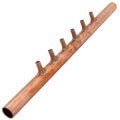
Copper manifolds are distribution assemblies that split a single hydronic supply and return line into multiple individually controlled loops for radiant floor heating, snow melt systems, and multi-zone hot water baseboard installs. Built from soldered or brazed copper tubing with threaded outlets, a manifold lets an installer feed several PEX or PEX-AL-PEX loops from one boiler or heat source while keeping each loop isolated for balancing, shutoff, and future service. Hydronic contractors choose copper manifolds over plastic alternatives on jobs where higher operating temperatures, mechanical durability, or a preference for sweat and press fittings makes copper construction the more practical choice. A manifold typically mounts inside a wall cavity or utility closet with each outlet feeding a separate radiant zone, and many models accept add-on valves or flow meters directly on the manifold body. Choosing the correct number of outlets and port spacing up front avoids costly modifications once tubing runs are already in place.
Subcategories
- Supply Manifolds: Supply manifolds distribute heated water from the boiler or heat source out to each individual radiant or baseboard loop. Each outlet on the manifold body accepts a shutoff or balancing valve so an installer can isolate a single loop for service without draining the entire system. Copper construction lets these manifolds handle sweat, press, or threaded connections depending on the rest of the piping system. Contractors size the supply manifold by the number of zones the job requires, not by the boiler's output alone.
- Return Manifolds: Return manifolds collect water flowing back from each radiant or baseboard loop and route it back to the boiler or heat source for reheating. They mount alongside the matching supply manifold, typically on the same wall bracket, so both halves of each loop stay accessible for service in one location. Many return manifolds include ports for flow-setting valves so each loop can be balanced against the others. Isolation at the return side matters as much as at the supply side when troubleshooting an underperforming zone.
- Manifold Valves and Accessories: Ball valves, balancing valves, and flow meters thread directly onto manifold outlets to give an installer control over each individual loop without adding separate fittings elsewhere in the system. Isolation valves let a single zone be shut down for repair while the rest of the system stays in operation. Flow-indicating accessories help balance multi-zone systems so loops with different lengths still deliver even heat output. Mounting brackets and insulated boxes are commonly paired with the manifold to protect it inside a wall cavity.
Buying Guide
Selecting a copper manifold starts with counting the number of zones or loops the job requires, since manifolds are sold with a fixed number of outlets and adding capacity later usually means replacing the whole assembly. Contractors should account for any future zones the customer might add during a renovation, since a manifold with a couple of spare, capped outlets costs far less trouble than retrofitting a second manifold into a tight mechanical space. Port spacing and overall manifold length also matter when the install target is a shallow wall cavity or a crowded utility closet.
Connection type is the next decision: sweat, press, and threaded outlet options all exist, and matching the manifold's connection style to the rest of the piping system on the job saves a step at rough-in. Copper Manifolds paired with balancing valves at each outlet make it far easier to true up flow between loops of different lengths, which matters most on radiant floor jobs where uneven heat output shows up as cold spots. Contractors doing repeat hydronic work often standardize on one manifold connection type across jobs so valve stock and adapters stay interchangeable. Insulated wall boxes are worth adding to the order when the manifold will sit inside an exterior wall, since an uninsulated cavity around copper piping is a common source of condensation and heat loss.
Frequently Asked Questions
How many outlets does a radiant heat manifold need?
The outlet count should match the number of individual loops the radiant or baseboard system requires, with each loop connected to its own port for isolation and balancing. Adding one or two spare, capped outlets is common practice when a future zone addition is likely. Manifolds are not field-expandable, so undersizing at purchase usually means installing a second manifold later rather than modifying the first.
Can a copper manifold be used with PEX tubing?
Yes, copper manifolds are commonly paired with PEX or PEX-AL-PEX tubing in radiant floor and snow melt systems, with the tubing connecting to the manifold outlets through a threaded adapter fitting. The copper body handles the higher temperatures some hydronic systems run at better than an all-plastic manifold. Matching the adapter fitting to both the manifold thread and the tubing type keeps the connection leak-free.
What is the difference between a supply manifold and a return manifold?
A supply manifold sends heated water out to each individual loop, while a return manifold collects water coming back from those loops and routes it to the boiler for reheating. Both halves typically mount together on the same bracket so each loop's supply and return connections are accessible in one spot. Balancing valves are more commonly installed on the supply side, though some systems use them on both.
Why choose copper over a plastic manifold?
Copper manifolds hold up well under higher operating temperatures and give installers the option of sweat, press, or threaded connections that match the rest of a copper-based piping system. Plastic manifolds are lighter and often less expensive, but some contractors prefer copper for its mechanical durability in systems that see frequent service or higher heat loads. The choice often comes down to matching the manifold material to the piping already specified for the job.
How is a multi-zone radiant system balanced at the manifold?
Flow-setting or balancing valves installed at each manifold outlet let an installer adjust flow rate loop by loop so zones with different lengths or heat loads deliver even output. Balancing typically happens after the system is filled and running, using a flow meter or the valve's built-in indicator to compare each loop. Rechecking balance after any zone is added or modified keeps the whole system performing evenly.
