




Radiant Floor Heat Manifolds
Radiant floor heat manifolds distribute supply and return water to the individual PEX loops that make up a radiant heating system. The category covers stainless steel and brass manifold bodies from Bluefin, Caleffi, Viega, and Uponor, including electronically balanced models that read temperature and flow per loop.
Manifold material affects both cost and corrosion resistance, with stainless steel construction generally offering the longest service life in a radiant system. Electronically balanced manifolds like Uponor's TruFLOW line simplify commissioning by automatically adjusting flow to each loop rather than requiring manual balancing valves.
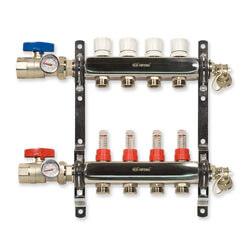

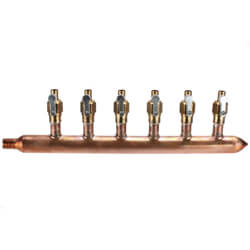


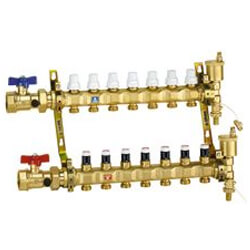
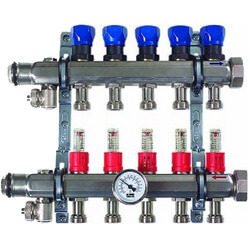
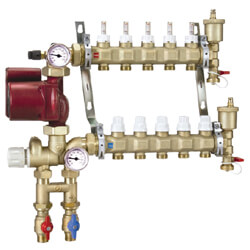
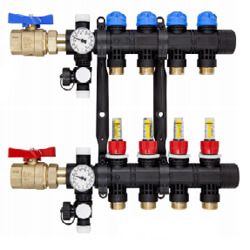
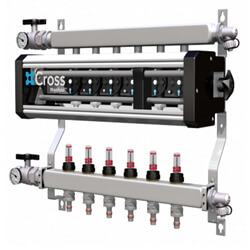
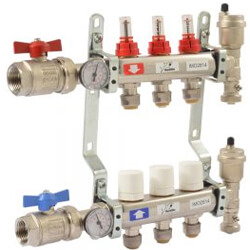
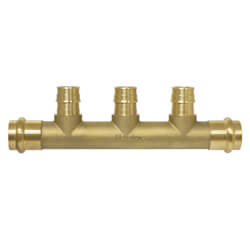
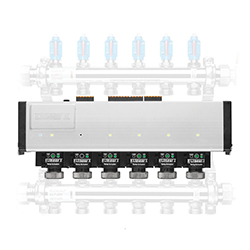
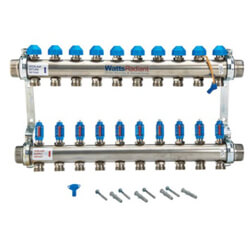


Bluefin Radiant Heat Manifolds are stainless steel manifold systems designed for long service life in radiant heating applications. Bluefin manifolds include a supply manifold with balancing valves and a temperature well, and a return manifold with actuator-compatible valves for zone control. The balancing valves on the supply side allow individual circuit flow rates to be adjusted independently for a balanced system. Bluefin manifolds are available in multiple circuit counts and are compatible with standard PEX connection adapters.
Uponor (Wirsbo) TruFLOW Manifolds use an electronic balancing system that reads temperature and flow rate on each circuit and adjusts accordingly, providing precise loop-by-loop control without manual balancing. The supply manifold contains electronic balancing valves and flow and temperature nipples; the return manifold holds actuator-ready valves and a fill and drain valve. Fittings for connecting loops and supply lines are purchased separately. TruFLOW manifolds are designed for use with Uponor ProPEX fittings and tubing.
Mr. PEX Manifolds are available in brass and stainless steel construction in standard packages that include a supply manifold with balancing valves and flow meters, a return manifold with actuator-ready valves, mounting brackets, fill and drain valves, end caps, and PEX adapters. The all-in-one package format reduces the number of separate components to source and simplifies installation. Mr. PEX manifolds are available in configurations from two to twelve circuits.
Caleffi Manifolds & Accessories include stainless steel and brass manifold bodies with a range of accessories for customizing system configuration. Caleffi manifolds are compatible with actuators for thermostatic zone control and are available in both supply and return sections with options for flow meters, balancing valves, and temperature gauges. Caleffi accessories allow the manifold to be expanded or adapted for specific piping configurations and system layouts.
Viega ProRadiant Stainless Steel Manifolds are manufactured from 304 stainless steel for corrosion resistance in hydronic applications. Viega ProRadiant manifolds use the Viega press connection system on the supply and return inlets. The manifold circuits connect to PEX tubing through Viega fittings, and the system is compatible with Viega actuators for zone control. Circuit counts range from two to twelve loops.
Uponor (Wirsbo) EP Radiant Heat Manifolds are constructed from high-performance engineered thermoplastic that resists corrosion, pitting, scaling, and high chlorine levels. The EP manifold is a cost-effective alternative to brass, copper, and stainless steel options without sacrificing resistance to heat and moisture. Uponor EP manifolds are compatible with ProPEX expansion fittings and are available with or without flow meter assemblies.
Circuit count is the primary selection factor for a radiant heat manifold. Count the number of independent floor loops in the system and match it to the manifold's loop capacity. Installing a manifold with too few circuits requires a second manifold and additional piping; oversizing the manifold leaves unused ports that must be capped.
PEX connection type must align with the tubing and fittings used in the rest of the system. Uponor ProPEX manifolds require the expansion tool and ProPEX rings. Crimp-style manifolds use standard crimp rings and the crimp tool. Push-fit manifolds are compatible with multiple PEX types but carry a higher per-connection cost. Mixing connection systems within a single installation creates compatibility problems.
Manifold material selection depends on water quality and system type. Stainless steel and brass are appropriate for most residential hydronic applications. Engineered plastic manifolds offer corrosion resistance at a lower cost but are typically rated for lower maximum operating pressures than metal bodies.
Balancing valves on the supply manifold allow each loop's flow rate to be adjusted independently. Systems with loops of unequal length require balancing to prevent short loops from drawing more flow than longer ones. Integrated flow meters make balancing visible without requiring separate measurement equipment.
Actuator compatibility on the return manifold enables thermostatic zone control. Verify that the actuator thread size and voltage match the manifold's valve bodies before purchasing. Most radiant manifolds use 24VAC actuators compatible with standard zone controllers.
How do I determine how many circuits I need on a radiant heat manifold?
The number of circuits equals the number of independent floor loops in the system. Each room or zone controlled separately requires at least one dedicated circuit. Large areas may have multiple loops running parallel circuits from the same manifold port. It is acceptable to use a manifold with one or two extra circuits, as unused ports can be capped, but significantly oversizing adds cost without benefit.
What's the difference between a supply manifold and a return manifold?
The supply manifold distributes heated water from the heat source to individual floor loops. The return manifold collects water after it has circulated through each loop and returns it to the heat source. The supply manifold has balancing valves and flow meters to control output per circuit; the return manifold has valves designed for actuator installation to enable thermostatic zone control.
Do I need balancing valves and flow meters on my radiant manifold?
Balancing valves and flow meters are strongly recommended for systems with loops of unequal length or rooms with different heat load requirements. Without balancing, short loops draw more flow than long ones, resulting in uneven floor temperatures. Flow meters make the balancing process visible and repeatable. For simple systems with equal-length loops, valveless manifolds are an option, but most professional installations use valved manifolds.
Can I add circuits to an existing radiant heat manifold?
Most radiant heat manifolds are sold in fixed circuit counts and cannot be extended by adding ports to an existing body. If additional circuits are needed, a second manifold must be added to the system and connected to the supply and return headers. Some manufacturers offer accessories that allow two manifold bodies to be joined into a single assembly. Confirm compatibility with the specific manifold brand before attempting to join sections.
What actuator voltage do radiant heat manifold valves require?
Most residential radiant heat manifold valves are designed for 24VAC actuators, compatible with standard zone controllers used in North American hydronic systems. Some European-origin manifolds use a different thread size or 230VAC actuators. Before purchasing actuators, confirm the thread size (typically M30x1.5 for most brands) and the operating voltage specified by the manifold manufacturer.
Resources

 --%3E %3C!DOCTYPE svg PUBLIC '-//W3C//DTD SVG 1.1//EN' 'http://www.w3.org/Graphics/SVG/1.1/DTD/svg11.dtd'%3E %3Csvg version='1.1' id='Layer_1' xmlns='http://www.w3.org/2000/svg' xmlns:xlink='http://www.w3.org/1999/xlink' x='0px' y='0px' width='90px' height='90px' viewBox='0 0 90 90' enable-background='new 0 0 90 90' xml:space='preserve'%3E %3Crect x='27' y='23' fill='%23FFFFFF' width='43' height='44'/%3E %3Cg%3E %3Cdefs%3E %3Crect id='SVGID_1_' width='90' height='90'/%3E %3C/defs%3E %3CclipPath id='SVGID_2_'%3E %3Cuse xlink:href='%23SVGID_1_' overflow='visible'/%3E %3C/clipPath%3E %3Cpath clip-path='url(%23SVGID_2_)' fill='%234186AD' d='M45,0C20.1,0,0,20.1,0,45c0,24.9,20.1,45,45,45c24.9,0,45-20.1,45-45 C90,20.1,69.9,0,45,0'/%3E %3C/g%3E %3Cpath fill='%23FFFFFF' d='M60.6,47.4l-22.5,14c-0.5,0.3-1,0.399-1.5,0.399s-0.9-0.1-1.4-0.399c-0.9-0.5-1.4-1.4-1.4-2.5v-28 c0-1,0.6-2,1.4-2.5c0.9-0.5,2-0.5,2.9,0.1l22.5,14.1C61.4,43.1,61.9,44,61.9,45S61.4,46.9,60.6,47.4'/%3E %3C/svg%3E)


Bluefin Radiant Heat Manifolds are stainless steel manifold systems designed for long service life in radiant heating applications. Bluefin manifolds include a supply manifold with balancing valves and a temperature well, and a return manifold with actuator-compatible valves for zone control. The balancing valves on the supply side allow individual circuit flow rates to be adjusted independently for a balanced system. Bluefin manifolds are available in multiple circuit counts and are compatible with standard PEX connection adapters.
Uponor (Wirsbo) TruFLOW Manifolds use an electronic balancing system that reads temperature and flow rate on each circuit and adjusts accordingly, providing precise loop-by-loop control without manual balancing. The supply manifold contains electronic balancing valves and flow and temperature nipples; the return manifold holds actuator-ready valves and a fill and drain valve. Fittings for connecting loops and supply lines are purchased separately. TruFLOW manifolds are designed for use with Uponor ProPEX fittings and tubing.
Mr. PEX Manifolds are available in brass and stainless steel construction in standard packages that include a supply manifold with balancing valves and flow meters, a return manifold with actuator-ready valves, mounting brackets, fill and drain valves, end caps, and PEX adapters. The all-in-one package format reduces the number of separate components to source and simplifies installation. Mr. PEX manifolds are available in configurations from two to twelve circuits.
Caleffi Manifolds & Accessories include stainless steel and brass manifold bodies with a range of accessories for customizing system configuration. Caleffi manifolds are compatible with actuators for thermostatic zone control and are available in both supply and return sections with options for flow meters, balancing valves, and temperature gauges. Caleffi accessories allow the manifold to be expanded or adapted for specific piping configurations and system layouts.
Viega ProRadiant Stainless Steel Manifolds are manufactured from 304 stainless steel for corrosion resistance in hydronic applications. Viega ProRadiant manifolds use the Viega press connection system on the supply and return inlets. The manifold circuits connect to PEX tubing through Viega fittings, and the system is compatible with Viega actuators for zone control. Circuit counts range from two to twelve loops.
Uponor (Wirsbo) EP Radiant Heat Manifolds are constructed from high-performance engineered thermoplastic that resists corrosion, pitting, scaling, and high chlorine levels. The EP manifold is a cost-effective alternative to brass, copper, and stainless steel options without sacrificing resistance to heat and moisture. Uponor EP manifolds are compatible with ProPEX expansion fittings and are available with or without flow meter assemblies.
Circuit count is the primary selection factor for a radiant heat manifold. Count the number of independent floor loops in the system and match it to the manifold's loop capacity. Installing a manifold with too few circuits requires a second manifold and additional piping; oversizing the manifold leaves unused ports that must be capped.
PEX connection type must align with the tubing and fittings used in the rest of the system. Uponor ProPEX manifolds require the expansion tool and ProPEX rings. Crimp-style manifolds use standard crimp rings and the crimp tool. Push-fit manifolds are compatible with multiple PEX types but carry a higher per-connection cost. Mixing connection systems within a single installation creates compatibility problems.
Manifold material selection depends on water quality and system type. Stainless steel and brass are appropriate for most residential hydronic applications. Engineered plastic manifolds offer corrosion resistance at a lower cost but are typically rated for lower maximum operating pressures than metal bodies.
Balancing valves on the supply manifold allow each loop's flow rate to be adjusted independently. Systems with loops of unequal length require balancing to prevent short loops from drawing more flow than longer ones. Integrated flow meters make balancing visible without requiring separate measurement equipment.
Actuator compatibility on the return manifold enables thermostatic zone control. Verify that the actuator thread size and voltage match the manifold's valve bodies before purchasing. Most radiant manifolds use 24VAC actuators compatible with standard zone controllers.
How do I determine how many circuits I need on a radiant heat manifold?
The number of circuits equals the number of independent floor loops in the system. Each room or zone controlled separately requires at least one dedicated circuit. Large areas may have multiple loops running parallel circuits from the same manifold port. It is acceptable to use a manifold with one or two extra circuits, as unused ports can be capped, but significantly oversizing adds cost without benefit.
What's the difference between a supply manifold and a return manifold?
The supply manifold distributes heated water from the heat source to individual floor loops. The return manifold collects water after it has circulated through each loop and returns it to the heat source. The supply manifold has balancing valves and flow meters to control output per circuit; the return manifold has valves designed for actuator installation to enable thermostatic zone control.
Do I need balancing valves and flow meters on my radiant manifold?
Balancing valves and flow meters are strongly recommended for systems with loops of unequal length or rooms with different heat load requirements. Without balancing, short loops draw more flow than long ones, resulting in uneven floor temperatures. Flow meters make the balancing process visible and repeatable. For simple systems with equal-length loops, valveless manifolds are an option, but most professional installations use valved manifolds.
Can I add circuits to an existing radiant heat manifold?
Most radiant heat manifolds are sold in fixed circuit counts and cannot be extended by adding ports to an existing body. If additional circuits are needed, a second manifold must be added to the system and connected to the supply and return headers. Some manufacturers offer accessories that allow two manifold bodies to be joined into a single assembly. Confirm compatibility with the specific manifold brand before attempting to join sections.
What actuator voltage do radiant heat manifold valves require?
Most residential radiant heat manifold valves are designed for 24VAC actuators, compatible with standard zone controllers used in North American hydronic systems. Some European-origin manifolds use a different thread size or 230VAC actuators. Before purchasing actuators, confirm the thread size (typically M30x1.5 for most brands) and the operating voltage specified by the manifold manufacturer.