



Drain Cleaners
Drain cleaners cover the manual and mechanical tools plumbers use to clear clogs from sinks, tubs, toilets, and larger drain lines. The category ranges from hand-crank augers for fixture-level clogs to cables and machines built for clearing longer branch and main lines.
Choosing the right tool depends on the drain size and how far into the line the clog sits, since a fixture auger will not reach or clear a blockage in a main line. Keeping a range of cable sizes and head attachments on hand covers most residential and light commercial drain calls.






Subcategories
- Air Guns: Air guns use a blast of compressed air or CO2 to push through a stubborn clog in a toilet, tub, or drum trap without running a cable at all. Plumbers reach for one on a quick service call where the clog sits close to the fixture and a cable would take longer to rig than the job is worth.
- Augers: Augers are hand-crank or hand-fed cable tools built for sink, tub, and toilet lines rather than mains. A closet auger with a protective sleeve clears toilet trapways without scratching porcelain, while a smaller hand auger handles sink and tub branch clogs a plunger can't move.
- Drain Bladders & Suction Guns: Drain bladders connect to a garden hose and expand inside the pipe to seal against the wall before releasing pulses of water pressure that break up a clog, a method suited to laundry and floor drain lines. Suction guns work the opposite direction, pulling a clog back toward the fixture opening in a toilet or tub where pushing it further down isn't an option.
- Drain Cable Head Attachments: Head attachments thread onto the end of a drain cleaning cable and get chosen by clog type rather than cable size alone: a spear or auger head for grease and soft stoppages, a retrieving head for pulling out debris, and a cutting or saw-tooth head for roots. Matching the attachment thread and cable diameter to the machine keeps the connection from stripping mid-job.
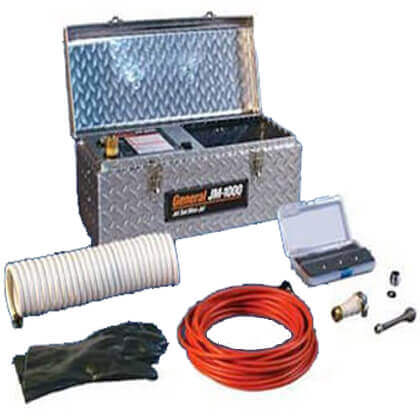
- Drain Cleaning Accessories: Cable oil and lubricant, cable connectors and couplings, carrying cases, gloves rated for cable work, and leader hose for hydro units make up the support gear that keeps a cable machine running. None of it clears a clog directly, but a machine missing the right connector or lubricant stalls a job just as fast as a dull cutting head.
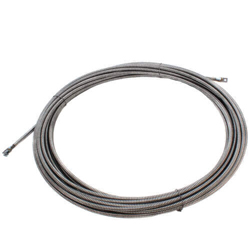
- Drain Cleaning Cables: Drain cleaning cables come in inner-core and standard wound-wire construction, with common diameters of 1/4 inch, 5/16 inch, and 3/8 inch and lengths running from about 25 feet up to 100 feet depending on the drum machine they're built for. Inner-core cable resists kinking and holds up better under torque than standard cable, which matters on longer runs where the cable takes more twisting force before it reaches the clog.
Buying Guide
Cable diameter should match both the drain size and the machine it's fed through, since a cable too large for the line won't turn corners and one too small won't clear a bigger main. Most manufacturers publish a diameter-to-pipe-size chart that lines up with their specific machines.
Length matters as much as diameter. A cable long enough to reach the clog with slack left on the drum makes the job faster, but a cable that's too long for the machine's drum capacity becomes harder to feed and retrieve cleanly.
Head attachment choice depends on what's causing the stoppage. Grease and soap buildup respond to a spear or spiral head, roots need a cutting or saw-tooth head, and a solid object lodged in the line calls for a retrieving head rather than one built to grind through debris.
Hand tools cover most fixture-level clogs, while a drum or sectional machine earns its keep on repeat main line calls where a hand auger simply doesn't have the reach or torque. Crews doing frequent main line work typically carry both so the smaller tool doesn't get used past its limit.
Accessories like cable oil, spare connectors, and cable-rated gloves aren't optional extras once a machine is in regular rotation. Skipping lubrication or letting a cable rust between jobs shortens its life and increases the odds it kinks mid-job.
Frequently Asked Questions
What size drain cleaning cable is needed for a main line?
Main lines typically call for a larger cable diameter than fixture branch lines, with the exact size depending on the machine and pipe diameter involved. Checking the machine manufacturer's chart for cable-to-pipe-size pairing avoids running a cable that's too light for the line.
Can a hand auger clear a toilet clog?
A closet auger, which is a specific hand auger with a protective sleeve, is built for toilet trapways and clears most standard clogs without scratching the bowl. A standard hand auger without that sleeve risks damaging porcelain and works better on sink or tub lines instead.
What's the difference between inner-core and standard drain cable?
Inner-core cable has a center wire running through the coil that adds torque resistance and cuts down on kinking, which extends cable life on tougher jobs. Standard wound cable costs less upfront but tends to kink and wear faster under heavy or frequent use.
When should a drain bladder be used instead of a cable machine?
Drain bladders work well on laundry, floor drain, and other lines with straightforward soft stoppages where a hose-fed water pulse can break the clog loose without pulling out a cable machine. Roots, solid objects, and long runs still call for a cable, since a bladder relies on water pressure that alone can't cut through that kind of blockage.
How often does drain cleaning cable need to be replaced?
Cable life depends on use frequency and maintenance, but any cable showing kinks, flat spots, or exposed inner wire needs replacing before the next job rather than after it fails mid-run. Routine oiling and drying the cable after each use extends the interval between replacements.
Resources
Subcategories
- Air Guns: Air guns use a blast of compressed air or CO2 to push through a stubborn clog in a toilet, tub, or drum trap without running a cable at all. Plumbers reach for one on a quick service call where the clog sits close to the fixture and a cable would take longer to rig than the job is worth.
- Augers: Augers are hand-crank or hand-fed cable tools built for sink, tub, and toilet lines rather than mains. A closet auger with a protective sleeve clears toilet trapways without scratching porcelain, while a smaller hand auger handles sink and tub branch clogs a plunger can't move.
- Drain Bladders & Suction Guns: Drain bladders connect to a garden hose and expand inside the pipe to seal against the wall before releasing pulses of water pressure that break up a clog, a method suited to laundry and floor drain lines. Suction guns work the opposite direction, pulling a clog back toward the fixture opening in a toilet or tub where pushing it further down isn't an option.
- Drain Cable Head Attachments: Head attachments thread onto the end of a drain cleaning cable and get chosen by clog type rather than cable size alone: a spear or auger head for grease and soft stoppages, a retrieving head for pulling out debris, and a cutting or saw-tooth head for roots. Matching the attachment thread and cable diameter to the machine keeps the connection from stripping mid-job.
- Drain Cleaning Accessories: Cable oil and lubricant, cable connectors and couplings, carrying cases, gloves rated for cable work, and leader hose for hydro units make up the support gear that keeps a cable machine running. None of it clears a clog directly, but a machine missing the right connector or lubricant stalls a job just as fast as a dull cutting head.
- Drain Cleaning Cables: Drain cleaning cables come in inner-core and standard wound-wire construction, with common diameters of 1/4 inch, 5/16 inch, and 3/8 inch and lengths running from about 25 feet up to 100 feet depending on the drum machine they're built for. Inner-core cable resists kinking and holds up better under torque than standard cable, which matters on longer runs where the cable takes more twisting force before it reaches the clog.
Buying Guide
Cable diameter should match both the drain size and the machine it's fed through, since a cable too large for the line won't turn corners and one too small won't clear a bigger main. Most manufacturers publish a diameter-to-pipe-size chart that lines up with their specific machines.
Length matters as much as diameter. A cable long enough to reach the clog with slack left on the drum makes the job faster, but a cable that's too long for the machine's drum capacity becomes harder to feed and retrieve cleanly.
Head attachment choice depends on what's causing the stoppage. Grease and soap buildup respond to a spear or spiral head, roots need a cutting or saw-tooth head, and a solid object lodged in the line calls for a retrieving head rather than one built to grind through debris.
Hand tools cover most fixture-level clogs, while a drum or sectional machine earns its keep on repeat main line calls where a hand auger simply doesn't have the reach or torque. Crews doing frequent main line work typically carry both so the smaller tool doesn't get used past its limit.
Accessories like cable oil, spare connectors, and cable-rated gloves aren't optional extras once a machine is in regular rotation. Skipping lubrication or letting a cable rust between jobs shortens its life and increases the odds it kinks mid-job.
Frequently Asked Questions
What size drain cleaning cable is needed for a main line?
Main lines typically call for a larger cable diameter than fixture branch lines, with the exact size depending on the machine and pipe diameter involved. Checking the machine manufacturer's chart for cable-to-pipe-size pairing avoids running a cable that's too light for the line.
Can a hand auger clear a toilet clog?
A closet auger, which is a specific hand auger with a protective sleeve, is built for toilet trapways and clears most standard clogs without scratching the bowl. A standard hand auger without that sleeve risks damaging porcelain and works better on sink or tub lines instead.
What's the difference between inner-core and standard drain cable?
Inner-core cable has a center wire running through the coil that adds torque resistance and cuts down on kinking, which extends cable life on tougher jobs. Standard wound cable costs less upfront but tends to kink and wear faster under heavy or frequent use.
When should a drain bladder be used instead of a cable machine?
Drain bladders work well on laundry, floor drain, and other lines with straightforward soft stoppages where a hose-fed water pulse can break the clog loose without pulling out a cable machine. Roots, solid objects, and long runs still call for a cable, since a bladder relies on water pressure that alone can't cut through that kind of blockage.
How often does drain cleaning cable need to be replaced?
Cable life depends on use frequency and maintenance, but any cable showing kinks, flat spots, or exposed inner wire needs replacing before the next job rather than after it fails mid-run. Routine oiling and drying the cable after each use extends the interval between replacements.