




Filters
SORT
Product Availability –
Brand –
Size –
Review Score –
 --%3E %3Csvg version='1.1' id='Fill' xmlns='http://www.w3.org/2000/svg' xmlns:xlink='http://www.w3.org/1999/xlink' x='0px' y='0px' viewBox='0 0 100 100' enable-background='new 0 0 100 100' xml:space='preserve'%3E %3Cpath fill='%23F15C02' d='M79.44,0.95H20.56C9.78,0.95,0.95,9.78,0.95,20.56v58.87c0,10.79,8.82,19.61,19.61,19.61h58.87 c10.79,0,19.61-8.83,19.61-19.61V20.56C99.05,9.78,90.22,0.95,79.44,0.95z M65.38,58.24l9.38,29.58L49.69,69.78L24.5,87.82 l9.34-29.6L8.8,39.6l30.73-0.17c0,0,6.98-19.61,10-28.93c0.54,1.36,9.88,29.1,9.88,29.1H91.2L65.38,58.24z'/%3E %3C/svg%3E)
 --%3E %3Csvg version='1.1' id='With-RB' xmlns='http://www.w3.org/2000/svg' xmlns:xlink='http://www.w3.org/1999/xlink' x='0px' y='0px' viewBox='0 0 100 100' enable-background='new 0 0 100 100' xml:space='preserve'%3E %3Cpath fill='%23FBC8B4' d='M79.44,0.95H20.56C9.78,0.95,0.95,9.78,0.95,20.56v58.87c0,10.79,8.82,19.61,19.61,19.61h58.87 c10.79,0,19.61-8.83,19.61-19.61V20.56C99.05,9.78,90.22,0.95,79.44,0.95z M65.38,58.24l9.38,29.58L49.69,69.78L24.5,87.82 l9.34-29.6L8.8,39.6l30.73-0.17c0,0,6.98-19.61,10-28.93c0.54,1.36,9.88,29.1,9.88,29.1H91.2L65.38,58.24z'/%3E %3C/svg%3E)
Price Range –
EMT Raintight Compression Couplings


 --%3E %3Csvg version='1.1' id='No-RB' xmlns='http://www.w3.org/2000/svg' xmlns:xlink='http://www.w3.org/1999/xlink' x='0px' y='0px' viewBox='0 0 100 100' enable-background='new 0 0 100 100' xml:space='preserve'%3E %3Cpath fill='%23CECECE' d='M79.44,0.95H20.56C9.78,0.95,0.95,9.78,0.95,20.56v58.87c0,10.79,8.82,19.61,19.61,19.61h58.87 c10.79,0,19.61-8.83,19.61-19.61V20.56C99.05,9.78,90.22,0.95,79.44,0.95z M65.38,58.24l9.38,29.58L49.69,69.78L24.5,87.82 l9.34-29.6L8.8,39.6l30.73-0.17c0,0,6.98-19.61,10-28.93c0.54,1.36,9.88,29.1,9.88,29.1H91.2L65.38,58.24z'/%3E %3C/svg%3E)



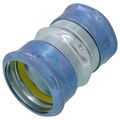


EMT Raintight Compression Couplings join two lengths of EMT conduit together in wet or outdoor locations, sealing out moisture at the joint instead of relying on a standard set-screw fitting. The coupling body uses zinc-plated steel to resist corrosion during long-term outdoor exposure, and the fitting meets NEC 358.42 requirements for wet location conduit fittings while carrying a cULus listing. Electricians reach for the raintight version anywhere EMT runs outside a building or through an unconditioned wet space, since a standard indoor-rated coupling won't keep water out of the conduit run. Sizes span 1/2 inch through 4 inch to match common EMT diameters used on residential and commercial jobs. Choosing the correct raintight coupling at the design stage keeps an outdoor conduit run code-compliant and protected from moisture that would otherwise corrode conductors or trip ground-fault protection over time.
Subcategories
- Compression Couplings: Compression couplings join two straight lengths of EMT conduit together at a single joint, sealing the connection with a compression ring instead of a set screw. Electricians use this style anywhere two conduit runs need to connect in a wet or outdoor location, such as a run continuing along an exterior wall. The zinc-plated steel body resists corrosion at exposed outdoor joints over years of weather exposure.
- Compression Connectors: Compression connectors join a length of EMT conduit to a box, panel, or enclosure rather than connecting two lengths of conduit to each other. Electricians terminate an outdoor or wet-location conduit run into a panel or junction box using this fitting to keep the connection sealed against moisture. Like couplings, connectors carry a cULus listing and meet NEC 358.42 requirements for wet locations.
- Small-Diameter Fittings (1/2 Inch to 1 Inch): Small-diameter raintight fittings cover the 1/2 inch through 1 inch range most common on residential branch circuits and lighter commercial wiring. Electricians use this size range for most outdoor receptacle, fixture, and equipment feeds run in EMT. These smaller fittings still carry the same zinc-plated steel construction and wet-location rating as the larger sizes.
- Large-Diameter Fittings (1-1/4 Inch to 4 Inch): Large-diameter raintight fittings cover conduit from 1-1/4 inch through 4 inch, sized for feeder runs and larger service conductors on commercial and industrial projects. Electricians specify this size range on outdoor feeder runs supplying panels, transformers, or large equipment loads. The larger fittings meet the same NEC 358.42 wet-location requirements as the smaller sizes in the lineup.
Buying Guide
Confirm the location first. Any EMT run installed outdoors, in a wet location, or in an area exposed to washdown needs a raintight fitting rather than a standard indoor-rated set-screw coupling, since code requires wet-location listed fittings in those spots under NEC 358.42. EMT Raintight Compression Couplings differ from raintight compression connectors in one key way: couplings join two lengths of conduit together, while connectors terminate a conduit run into a box, panel, or enclosure, so the choice between the two depends on what's on each end of the run. Matching conduit diameter comes next, since a coupling or connector sized for the wrong EMT diameter won't seat or compress properly at the joint. Zinc-plated steel construction handles most outdoor exposure without issue, though electricians working in coastal or heavily corrosive environments should ask a supplier about additional corrosion protection beyond standard zinc plating. Checking for a cULus listing on the fitting confirms it's been tested for the wet-location application rather than repurposed from an indoor product line. Installers running larger feeder conduit should verify the fitting size covers the full diameter range needed, since large-diameter fittings see less frequent use than the 1/2 inch through 1 inch sizes common on most branch circuit work. Getting the coupling or connector type, size, and listing right at rough-in avoids reworking an outdoor conduit run after it's already in the wall or ground.
Frequently Asked Questions
What's the difference between a raintight coupling and a raintight connector?
A raintight coupling joins two lengths of EMT conduit together at a single joint. A raintight connector terminates a conduit run into a box, panel, or enclosure instead of joining two conduit ends. Electricians choose between the two based on what's on each end of the conduit run being installed.
Do raintight compression couplings meet code for outdoor conduit runs?
Raintight compression couplings meet NEC 358.42 requirements for wet-location conduit fittings and carry a cULus listing confirming they've been tested for that application. Electricians use this style anywhere EMT runs outside a building or through another wet or unconditioned space. A standard indoor-rated coupling doesn't meet this requirement and shouldn't be used in those locations.
What sizes do EMT raintight compression couplings come in?
EMT raintight compression couplings are available from 1/2 inch through 4 inch to match common EMT conduit diameters. Smaller sizes in the 1/2 inch through 1 inch range cover most residential and light commercial branch circuit work. Larger sizes handle feeder runs and larger service conductors on commercial and industrial projects.
What material are these couplings made from?
EMT raintight compression couplings use a zinc-plated steel body designed to resist corrosion during long-term outdoor exposure. The compression design seals the joint against moisture rather than relying on a set screw. Electricians working in coastal or heavily corrosive environments should ask a supplier about additional corrosion protection beyond standard zinc plating.
Where should raintight compression couplings be used instead of standard couplings?
Raintight compression couplings belong anywhere EMT conduit runs outdoors, through a wet location, or through an area exposed to washdown or moisture. A standard set-screw coupling doesn't seal the joint against water the way a compression fitting does. Code requires wet-location listed fittings like these in those installation locations under NEC 358.42.
