




Eaton Contactors


 --%3E %3Csvg version='1.1' id='No-RB' xmlns='http://www.w3.org/2000/svg' xmlns:xlink='http://www.w3.org/1999/xlink' x='0px' y='0px' viewBox='0 0 100 100' enable-background='new 0 0 100 100' xml:space='preserve'%3E %3Cpath fill='%23CECECE' d='M79.44,0.95H20.56C9.78,0.95,0.95,9.78,0.95,20.56v58.87c0,10.79,8.82,19.61,19.61,19.61h58.87 c10.79,0,19.61-8.83,19.61-19.61V20.56C99.05,9.78,90.22,0.95,79.44,0.95z M65.38,58.24l9.38,29.58L49.69,69.78L24.5,87.82 l9.34-29.6L8.8,39.6l30.73-0.17c0,0,6.98-19.61,10-28.93c0.54,1.36,9.88,29.1,9.88,29.1H91.2L65.38,58.24z'/%3E %3C/svg%3E)


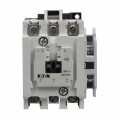




Eaton contactors are electromechanical switching devices used to control high-current electrical loads in HVAC and refrigeration equipment, such as compressors, condenser fans, and heating elements. A contactor uses a low-voltage control circuit, typically from a thermostat or control board, to energize a coil that pulls a set of contacts closed, allowing the higher-voltage load circuit to switch on and off without routing that current through the control components directly. HVAC technicians replace contactors regularly because the contacts wear from repeated arcing every time the load cycles on and off.
Selecting a replacement contactor means matching pole configuration, coil voltage, and current rating to the equipment being serviced, since an undersized contactor will overheat and fail prematurely under the connected load. Eaton contactors are commonly found in residential and light commercial condensing units, package units, and other equipment where a compressor or fan motor needs to be switched by a low-voltage control signal.
Subcategories
- Single-Pole Contactors: Single-pole contactors switch one line of the load circuit, typically used on smaller single-phase equipment such as a residential condenser fan motor. They are the simplest and most compact contactor style stocked for light residential service work. Coil voltage still needs to match the control circuit supplying it.
- Two-Pole Contactors: Two-pole contactors switch both lines of a single-phase 240-volt circuit simultaneously, which is the common configuration for residential air conditioning and heat pump compressors. Switching both lines helps fully de-energize the load when the contactor opens rather than leaving one leg live. This is the most commonly replaced contactor type in residential HVAC service.
- Three-Pole Contactors: Three-pole contactors switch all three lines of a three-phase circuit, used on commercial and light industrial equipment such as larger compressors, chillers, and rooftop units. Three-phase loads draw more current than typical residential equipment, so contact ratings and physical contactor size are correspondingly larger. Proper phase sequencing during replacement matters on three-pole applications.
- Definite Purpose Contactors: Definite purpose contactors are built specifically for HVAC and refrigeration duty rather than general industrial control, with a compact footprint suited to tight equipment enclosures. They are the standard replacement style stocked for residential and light commercial condensing units. Coil voltage, pole count, and current rating are the specs to match against the original part.
Buying Guide
Start by confirming the pole configuration on the failed or original contactor, since single-pole, two-pole, and three-pole units are not interchangeable without changing the wiring approach. Most residential condenser and heat pump replacements use a two-pole contactor.
Next, match the coil voltage to the control circuit that will energize the contactor, commonly 24 volts for residential thermostats but sometimes higher on commercial control systems. Eaton contactors are available across a range of coil voltages, so confirming this before ordering avoids a contactor that will not pull in reliably.
Check the current rating against the equipment's full load amperage, including the compressor's locked rotor amperage on startup, not just its running current. A contactor rated too close to the load's running amps can overheat and fail early, especially in equipment that cycles frequently.
Finally, confirm the physical mounting footprint and terminal layout fit the existing enclosure and wiring. A replacement contactor that matches electrical specs but has a different mounting pattern or terminal spacing can still complicate the swap, so checking physical dimensions alongside electrical ratings saves a second trip for a different part.
Frequently Asked Questions
How do I know how many poles a replacement contactor needs?
The pole count should match the original contactor and the equipment's wiring configuration. Residential single-phase compressors and condenser fans commonly use two-pole contactors, while three-phase commercial equipment requires a three-pole contactor.
What coil voltage do most residential HVAC contactors use?
24 volts is the most common coil voltage on residential HVAC systems, matching the low-voltage control circuit from the thermostat. Commercial systems sometimes use higher coil voltages, so the control circuit voltage should be confirmed before ordering.
Why does a contactor wear out over time?
The contacts arc slightly every time the load switches on and off, and repeated arcing gradually pits and erodes the contact surface. Equipment that cycles frequently, such as a compressor responding to short thermostat calls, wears its contactor faster than equipment with longer run cycles.
Can I use a contactor with a higher current rating than the original?
A contactor rated at or above the original's current rating is generally acceptable as long as the pole configuration, coil voltage, and physical mounting still match the application. Undersizing the current rating relative to the load is the more common cause of premature failure.
What is a definite purpose contactor?
A definite purpose contactor is built specifically for HVAC and refrigeration switching duty, with a compact size suited to equipment enclosures, as opposed to general industrial control contactors. Most residential and light commercial replacement parts are definite purpose contactors.
