




Fantech Inline Duct Fans
Fantech inline duct fans mount directly inside round or rectangular ductwork to move air for ventilation, exhaust, and fresh-air systems in homes and light commercial buildings. Unlike a fan mounted in a wall or ceiling grille, an inline fan sits within the duct run itself. This lets installers place it in an attic, mechanical closet, or other out-of-the-way spot away from the space being ventilated. The lineup spans centrifugal and mixed-flow designs in round and rectangular duct sizes. These match different airflow and static pressure needs.
Placing the fan inline instead of at the register keeps fan noise away from occupied rooms. This matters for bathroom exhaust, whole-house ventilation, and kitchen makeup air systems, where a loud fan right at the grille is a common complaint. Contractors also use inline fans to boost airflow on a duct run that's too long or has too many turns. A standard exhaust fan can't handle those runs on its own. Matching fan type, duct size, and airflow capacity to the job keeps a ventilation system quiet and effective.



Subcategories
- CVS Series Central Ventilation Multi-Port Exhaust Fans: CVS Series central ventilation multi-port exhaust fans serve several exhaust points, such as multiple bathrooms, from a single inline fan unit connected by branch ductwork. This layout centralizes the fan in one location instead of installing a separate fan at each register. It's a common choice on multi-family or larger residential projects where running one central fan is more practical than several small ones.
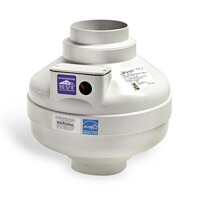
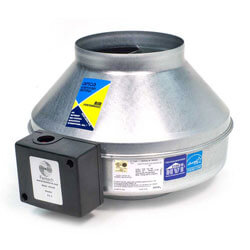
- FG Series Inline Round Centrifugal Exhaust Fans: FG Series inline round centrifugal exhaust fans use a centrifugal wheel design suited to duct runs with higher static pressure, such as longer runs or those with several elbows. They install in round ductwork and are commonly used for bathroom, utility, or general exhaust applications. Centrifugal designs generally hold their airflow better than axial fans as duct resistance increases.
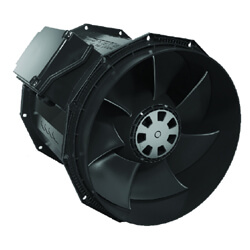
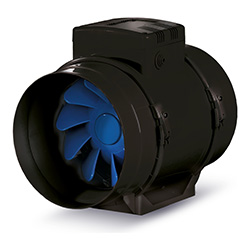
- FKD Series Inline Round Mixed Flow Centrifugal Fans: FKD Series inline round mixed flow centrifugal fans combine characteristics of axial and centrifugal designs to balance airflow and static pressure performance in a compact housing. They fit round ductwork and suit installations where space is tight but the run still has meaningful resistance to overcome. Mixed-flow designs are a middle option between straightforward axial fans and higher-pressure centrifugal units.
- FR Series Inline Round Centrifugal Exhaust Fans: FR Series inline round centrifugal exhaust fans are a round-duct centrifugal option built for general ventilation and exhaust duty. Installers use them in attic or crawlspace mounting locations where the fan needs to move air through a moderate length of ductwork. As with other centrifugal models, they hold up better under static pressure than a basic axial inline fan.
- FRD Series Inline Rectangular Low Profile Centrifugal Fans: FRD Series inline rectangular low profile centrifugal fans are built for rectangular ductwork and a shallow mounting depth. This suits installations where clearance above a ceiling or within a chase is limited. The low-profile housing lets installers fit the fan into tighter spaces than a standard round inline unit would allow. They're commonly specified for retrofit projects with existing rectangular duct runs.
- FSD Series Inline Mixed Flow Square Centrifugal Fans: FSD Series inline mixed flow square centrifugal fans pair a mixed-flow wheel with a square housing suited to square or rectangular duct transitions. They're used where the ductwork configuration favors a square inline unit over a round one. The mixed-flow design gives a balance of airflow and pressure capability similar to the round FKD Series.
Buying Guide
Selecting an inline duct fan starts with matching the fan to the duct shape already in place or planned for the job. Round and rectangular fans aren't interchangeable without a duct transition. Retrofitting into existing ductwork usually points toward whichever fan shape avoids adding a transition fitting.
Static pressure in the duct run is the next major factor. A short, straight run with few elbows can often be handled by a basic axial or lower-pressure centrifugal fan. A longer run, multiple elbows, or filters and grilles in the airflow path call for a higher-pressure centrifugal or mixed-flow model. This maintains adequate airflow at the register.
Mounting location affects both fan choice and installation method. An attic or crawlspace installation gives more flexibility for fan size and orientation. A tight ceiling chase or low-clearance space may require a low-profile rectangular fan instead of a standard round unit.
Multi-point systems, such as a central fan serving several bathroom exhaust points, must be sized for the combined airflow of all connected registers operating at once. Sizing for a single point is not enough. Undersizing a central fan leaves the connected rooms with weaker exhaust than a dedicated fan at each location would provide.
Noise is a common complaint with ventilation systems. Moving the fan inline, away from the occupied space, helps. Choosing a fan rated for quiet operation at the required airflow also keeps a bathroom or utility exhaust system from becoming a nuisance.
Frequently Asked Questions
What's the advantage of an inline duct fan over a fan mounted at the grille?
Mounting the fan inline, away from the register, moves fan noise out of the occupied space and lets installers place it in an attic, closet, or other accessible spot. It also makes future service easier since the fan isn't built into the ceiling or wall grille itself.
How is a centrifugal duct fan different from an axial one?
A centrifugal fan uses a wheel design that holds its airflow better as duct resistance from length, elbows, or filters increases. An axial fan is generally simpler and works well on short, low-resistance runs but loses performance faster as static pressure rises.
Can one inline fan serve multiple bathrooms?
Yes, a central multi-port fan can serve several exhaust points through branch ductwork, which is common on multi-family or larger residential projects. The fan needs to be sized for the combined airflow of all connected registers running at the same time.
When is a low-profile rectangular fan the better choice?
A low-profile rectangular fan fits installations with limited clearance, such as a shallow ceiling chase, where a standard round inline fan wouldn't fit. It's also a natural match for existing rectangular ductwork on a retrofit job.
Do round and rectangular inline fans require different ductwork?
Round fans connect to round ductwork and rectangular fans connect to rectangular ductwork, so switching fan shapes on an existing run generally requires a duct transition fitting. Matching the fan to the existing duct shape avoids that extra step.
Resources

 --%3E %3C!DOCTYPE svg PUBLIC '-//W3C//DTD SVG 1.1//EN' 'http://www.w3.org/Graphics/SVG/1.1/DTD/svg11.dtd'%3E %3Csvg version='1.1' id='Layer_1' xmlns='http://www.w3.org/2000/svg' xmlns:xlink='http://www.w3.org/1999/xlink' x='0px' y='0px' width='90px' height='90px' viewBox='0 0 90 90' enable-background='new 0 0 90 90' xml:space='preserve'%3E %3Crect x='27' y='23' fill='%23FFFFFF' width='43' height='44'/%3E %3Cg%3E %3Cdefs%3E %3Crect id='SVGID_1_' width='90' height='90'/%3E %3C/defs%3E %3CclipPath id='SVGID_2_'%3E %3Cuse xlink:href='%23SVGID_1_' overflow='visible'/%3E %3C/clipPath%3E %3Cpath clip-path='url(%23SVGID_2_)' fill='%234186AD' d='M45,0C20.1,0,0,20.1,0,45c0,24.9,20.1,45,45,45c24.9,0,45-20.1,45-45 C90,20.1,69.9,0,45,0'/%3E %3C/g%3E %3Cpath fill='%23FFFFFF' d='M60.6,47.4l-22.5,14c-0.5,0.3-1,0.399-1.5,0.399s-0.9-0.1-1.4-0.399c-0.9-0.5-1.4-1.4-1.4-2.5v-28 c0-1,0.6-2,1.4-2.5c0.9-0.5,2-0.5,2.9,0.1l22.5,14.1C61.4,43.1,61.9,44,61.9,45S61.4,46.9,60.6,47.4'/%3E %3C/svg%3E)
Subcategories
- CVS Series Central Ventilation Multi-Port Exhaust Fans: CVS Series central ventilation multi-port exhaust fans serve several exhaust points, such as multiple bathrooms, from a single inline fan unit connected by branch ductwork. This layout centralizes the fan in one location instead of installing a separate fan at each register. It's a common choice on multi-family or larger residential projects where running one central fan is more practical than several small ones.
- FG Series Inline Round Centrifugal Exhaust Fans: FG Series inline round centrifugal exhaust fans use a centrifugal wheel design suited to duct runs with higher static pressure, such as longer runs or those with several elbows. They install in round ductwork and are commonly used for bathroom, utility, or general exhaust applications. Centrifugal designs generally hold their airflow better than axial fans as duct resistance increases.
- FKD Series Inline Round Mixed Flow Centrifugal Fans: FKD Series inline round mixed flow centrifugal fans combine characteristics of axial and centrifugal designs to balance airflow and static pressure performance in a compact housing. They fit round ductwork and suit installations where space is tight but the run still has meaningful resistance to overcome. Mixed-flow designs are a middle option between straightforward axial fans and higher-pressure centrifugal units.
- FR Series Inline Round Centrifugal Exhaust Fans: FR Series inline round centrifugal exhaust fans are a round-duct centrifugal option built for general ventilation and exhaust duty. Installers use them in attic or crawlspace mounting locations where the fan needs to move air through a moderate length of ductwork. As with other centrifugal models, they hold up better under static pressure than a basic axial inline fan.
- FRD Series Inline Rectangular Low Profile Centrifugal Fans: FRD Series inline rectangular low profile centrifugal fans are built for rectangular ductwork and a shallow mounting depth. This suits installations where clearance above a ceiling or within a chase is limited. The low-profile housing lets installers fit the fan into tighter spaces than a standard round inline unit would allow. They're commonly specified for retrofit projects with existing rectangular duct runs.
- FSD Series Inline Mixed Flow Square Centrifugal Fans: FSD Series inline mixed flow square centrifugal fans pair a mixed-flow wheel with a square housing suited to square or rectangular duct transitions. They're used where the ductwork configuration favors a square inline unit over a round one. The mixed-flow design gives a balance of airflow and pressure capability similar to the round FKD Series.
Buying Guide
Selecting an inline duct fan starts with matching the fan to the duct shape already in place or planned for the job. Round and rectangular fans aren't interchangeable without a duct transition. Retrofitting into existing ductwork usually points toward whichever fan shape avoids adding a transition fitting.
Static pressure in the duct run is the next major factor. A short, straight run with few elbows can often be handled by a basic axial or lower-pressure centrifugal fan. A longer run, multiple elbows, or filters and grilles in the airflow path call for a higher-pressure centrifugal or mixed-flow model. This maintains adequate airflow at the register.
Mounting location affects both fan choice and installation method. An attic or crawlspace installation gives more flexibility for fan size and orientation. A tight ceiling chase or low-clearance space may require a low-profile rectangular fan instead of a standard round unit.
Multi-point systems, such as a central fan serving several bathroom exhaust points, must be sized for the combined airflow of all connected registers operating at once. Sizing for a single point is not enough. Undersizing a central fan leaves the connected rooms with weaker exhaust than a dedicated fan at each location would provide.
Noise is a common complaint with ventilation systems. Moving the fan inline, away from the occupied space, helps. Choosing a fan rated for quiet operation at the required airflow also keeps a bathroom or utility exhaust system from becoming a nuisance.
Frequently Asked Questions
What's the advantage of an inline duct fan over a fan mounted at the grille?
Mounting the fan inline, away from the register, moves fan noise out of the occupied space and lets installers place it in an attic, closet, or other accessible spot. It also makes future service easier since the fan isn't built into the ceiling or wall grille itself.
How is a centrifugal duct fan different from an axial one?
A centrifugal fan uses a wheel design that holds its airflow better as duct resistance from length, elbows, or filters increases. An axial fan is generally simpler and works well on short, low-resistance runs but loses performance faster as static pressure rises.
Can one inline fan serve multiple bathrooms?
Yes, a central multi-port fan can serve several exhaust points through branch ductwork, which is common on multi-family or larger residential projects. The fan needs to be sized for the combined airflow of all connected registers running at the same time.
When is a low-profile rectangular fan the better choice?
A low-profile rectangular fan fits installations with limited clearance, such as a shallow ceiling chase, where a standard round inline fan wouldn't fit. It's also a natural match for existing rectangular ductwork on a retrofit job.
Do round and rectangular inline fans require different ductwork?
Round fans connect to round ductwork and rectangular fans connect to rectangular ductwork, so switching fan shapes on an existing run generally requires a duct transition fitting. Matching the fan to the existing duct shape avoids that extra step.