




Filters
SORT
Product Availability –
Brand –
Size –
Review Score –
 --%3E %3Csvg version='1.1' id='Fill' xmlns='http://www.w3.org/2000/svg' xmlns:xlink='http://www.w3.org/1999/xlink' x='0px' y='0px' viewBox='0 0 100 100' enable-background='new 0 0 100 100' xml:space='preserve'%3E %3Cpath fill='%23F15C02' d='M79.44,0.95H20.56C9.78,0.95,0.95,9.78,0.95,20.56v58.87c0,10.79,8.82,19.61,19.61,19.61h58.87 c10.79,0,19.61-8.83,19.61-19.61V20.56C99.05,9.78,90.22,0.95,79.44,0.95z M65.38,58.24l9.38,29.58L49.69,69.78L24.5,87.82 l9.34-29.6L8.8,39.6l30.73-0.17c0,0,6.98-19.61,10-28.93c0.54,1.36,9.88,29.1,9.88,29.1H91.2L65.38,58.24z'/%3E %3C/svg%3E)
Price Range –
Flex/AC/MC Liquid Tight Straight Connectors (Non-Insulated)



 --%3E %3Csvg version='1.1' id='No-RB' xmlns='http://www.w3.org/2000/svg' xmlns:xlink='http://www.w3.org/1999/xlink' x='0px' y='0px' viewBox='0 0 100 100' enable-background='new 0 0 100 100' xml:space='preserve'%3E %3Cpath fill='%23CECECE' d='M79.44,0.95H20.56C9.78,0.95,0.95,9.78,0.95,20.56v58.87c0,10.79,8.82,19.61,19.61,19.61h58.87 c10.79,0,19.61-8.83,19.61-19.61V20.56C99.05,9.78,90.22,0.95,79.44,0.95z M65.38,58.24l9.38,29.58L49.69,69.78L24.5,87.82 l9.34-29.6L8.8,39.6l30.73-0.17c0,0,6.98-19.61,10-28.93c0.54,1.36,9.88,29.1,9.88,29.1H91.2L65.38,58.24z'/%3E %3C/svg%3E)
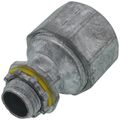

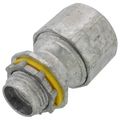
Flex/AC/MC Liquid Tight Straight Connectors (Non-Insulated) are fittings that join flexible metal conduit, armored cable, or metal clad cable to a box or enclosure while keeping moisture, oil, and coolant out of the raceway. Listed to UL 514B and CSA C22.2 No. 18F, these connectors come in trade sizes from 3/8 inch through 4 inches to match the flexible conduit or cable being terminated. A steel body threads onto the conduit, a sealing ring provides the liquid tight seal, and a locknut secures the fitting to the box on the opposite side. The non-insulated throat design skips the plastic bushing found on insulated versions, keeping the fitting shorter for installations where conductor insulation does not need extra protection at the termination point. Electricians reach for this connector whenever equipment sits in a wet, outdoor, or washdown location and the raceway needs to stay liquid tight at the termination.
Subcategories
- Flexible Metal Conduit (Flex) Connectors: Flex connectors terminate liquid tight flexible metal conduit, the corrugated steel raceway with a plastic jacket commonly run to motors, pumps, and outdoor equipment. Listed to UL 514B, they come in trade sizes from 3/8 inch through 4 inches to match the conduit being installed. A sealing ring compresses against the conduit jacket while a locknut draws the connector tight to the enclosure. Electricians pick the non-insulated version when the conductors inside do not need the extra insulated throat found on wet location or hazardous duty jobs.
- Armored Cable (AC) Connectors: AC connectors terminate armored cable, the interlocked metal jacketed cable used in dry indoor branch circuit wiring. The connector body still meets UL 514B and CSA C22.2 No. 18F even though AC cable itself carries a separate cable listing. A locknut on the box side and a sealing ring at the cable entry keep the termination liquid tight where the cable passes through a damp or washdown area. Electricians choose this connector style when a run transitions from armored cable into a wet or outdoor rated section.
- Metal Clad Cable (MC) Connectors: MC connectors terminate metal clad cable, which adds a grounding conductor inside the jacket compared to standard armored cable. Sizing follows the same 3/8 inch through 4 inch trade size range used across the connector line. The steel body and sealing ring construction match the flex and AC versions, so a single stock of locknuts and sealing rings can service all three cable types. Contractors specify MC connectors on commercial and industrial jobs where the cable itself is already rated for the required grounding path.
Buying Guide
Matching the connector to the raceway type comes first, since flexible metal conduit, armored cable, and metal clad cable all use the same body style but pair with different cable constructions. Trade size is the next check, since these connectors span 3/8 inch through 4 inches, and the fitting needs to match the conduit or cable diameter rather than the conductor count inside it. Non-insulated throat versions skip the plastic bushing found on insulated connectors, which works fine anywhere the conductors do not need extra abrasion protection at the termination point, but jobs with sharp conductor bends or higher voltage conductors often call for the insulated version instead. Every connector in this line carries a UL 514B and CSA C22.2 No. 18F listing, so code compliance is not a differentiator between brands, but confirming the listing on the box still matters for inspection. Locknut and sealing ring construction is standard across sizes, and both parts should stay with the fitting during installation since a missing sealing ring breaks the liquid tight rating. Location drives the decision as much as raceway type, since Flex/AC/MC Liquid Tight Straight Connectors (Non-Insulated) show up wherever equipment sits in a wet, outdoor, or washdown area and the raceway itself needs to stay sealed at the box. Reusable designs allow the connector to be removed and reinstalled during equipment service without buying a replacement fitting each time.
Frequently Asked Questions
What is the difference between an insulated and non-insulated liquid tight connector?
Insulated connectors add a plastic throat bushing that protects conductor insulation as it passes through the fitting, while Flex/AC/MC Liquid Tight Straight Connectors (Non-Insulated) skip that bushing for a shorter, simpler fitting. Both styles carry the same UL 514B and CSA C22.2 No. 18F listing and use the same locknut and sealing ring construction. Choosing between them comes down to whether the application needs extra abrasion protection at the termination point.
Can the same connector be used for flex conduit, AC cable, and MC cable?
Connector bodies across flex, AC, and MC applications share the same steel construction, trade size range, and UL listing, but each is sized and configured for its specific cable or conduit type. Matching the connector to the actual raceway or cable jacket being terminated keeps the fitting properly sealed. Mixing connector types across cable constructions can leave the termination loose or out of code compliance.
What trade sizes are available for these connectors?
Flex/AC/MC Liquid Tight Straight Connectors (Non-Insulated) are manufactured in trade sizes from 3/8 inch through 4 inches. Selecting the correct size means matching the connector to the outside diameter of the conduit or cable jacket, not the conductor count inside it. A size that is too large will not seal properly even if the locknut tightens down.
Are these connectors reusable?
Most non-insulated liquid tight straight connectors are built as reusable fittings, meaning they can be removed from the conduit and reinstalled during equipment service. Reusability depends on the connector holding its sealing ring and locknut without damage during removal. Replacing a worn sealing ring restores the liquid tight rating without replacing the entire fitting.
What UL standard applies to non-insulated liquid tight connectors?
Non-insulated liquid tight straight connectors are listed to UL 514B, the standard for conduit, tubing, and cable fittings, along with CSA C22.2 No. 18F for Canadian installations. The listing confirms the fitting meets the liquid tight and grounding requirements expected in wet or outdoor electrical installations. Checking for the UL mark on the fitting itself is the fastest way to confirm compliance before an inspection.
