



'/%3E%3C/svg%3E)
 --%3E %3Csvg version='1.1' id='Fill' xmlns='http://www.w3.org/2000/svg' xmlns:xlink='http://www.w3.org/1999/xlink' x='0px' y='0px' viewBox='0 0 100 100' enable-background='new 0 0 100 100' xml:space='preserve'%3E %3Cpath fill='%23F15C02' d='M79.44,0.95H20.56C9.78,0.95,0.95,9.78,0.95,20.56v58.87c0,10.79,8.82,19.61,19.61,19.61h58.87 c10.79,0,19.61-8.83,19.61-19.61V20.56C99.05,9.78,90.22,0.95,79.44,0.95z M65.38,58.24l9.38,29.58L49.69,69.78L24.5,87.82 l9.34-29.6L8.8,39.6l30.73-0.17c0,0,6.98-19.61,10-28.93c0.54,1.36,9.88,29.1,9.88,29.1H91.2L65.38,58.24z'/%3E %3C/svg%3E)
 --%3E %3Csvg version='1.1' id='Half' xmlns='http://www.w3.org/2000/svg' xmlns:xlink='http://www.w3.org/1999/xlink' x='0px' y='0px' viewBox='0 0 100 100' enable-background='new 0 0 100 100' xml:space='preserve'%3E %3Cg%3E %3Cpath fill='%23F15C02' d='M30.05,70.23l3.79-12.01L8.8,39.6l30.73-0.17c0,0,6.98-19.61,10-28.93c0.54,1.36,9.88,29.1,9.88,29.1h1.58 L93.71,7.18c-3.58-3.82-8.66-6.23-14.28-6.23H20.56C9.78,0.95,0.95,9.78,0.95,20.56v58.87c0,5.41,2.22,10.32,5.79,13.88 L30.05,70.23z'/%3E %3C/g%3E %3Cpath fill='%23FBC8B4' d='M93.71,7.18L60.98,39.6H91.2L65.38,58.24l9.38,29.58L49.69,69.78L24.5,87.82l5.55-17.59L6.75,93.32 c3.55,3.54,8.44,5.73,13.82,5.73h58.87c10.79,0,19.61-8.83,19.61-19.61V20.56C99.05,15.4,97.01,10.69,93.71,7.18z'/%3E %3C/svg%3E)


Description
Specs
| Frequency: | 60 Hz 60 Hz 60 Hz |
|---|---|
| Application: | Replacement Part |


Questions?
You May Also Need
Product Reviews
Most Liked Positive Review
Saves time, water
Most Liked Negative Review
 --%3E %3Csvg version='1.1' id='With-RB' xmlns='http://www.w3.org/2000/svg' xmlns:xlink='http://www.w3.org/1999/xlink' x='0px' y='0px' viewBox='0 0 100 100' enable-background='new 0 0 100 100' xml:space='preserve'%3E %3Cpath fill='%23FBC8B4' d='M79.44,0.95H20.56C9.78,0.95,0.95,9.78,0.95,20.56v58.87c0,10.79,8.82,19.61,19.61,19.61h58.87 c10.79,0,19.61-8.83,19.61-19.61V20.56C99.05,9.78,90.22,0.95,79.44,0.95z M65.38,58.24l9.38,29.58L49.69,69.78L24.5,87.82 l9.34-29.6L8.8,39.6l30.73-0.17c0,0,6.98-19.61,10-28.93c0.54,1.36,9.88,29.1,9.88,29.1H91.2L65.38,58.24z'/%3E %3C/svg%3E)
Warm cold water
Groundfos bypass
I would buy again , works perfectly
I would buy this product again.
Excellent product
Easy replacement purchase
This product was great
I would buy again
Comfort valve
I would buy again
Comfort Valve
Product Q&A
7 QuestionsQ: Comfort Valve SKU:595926 Brand: Grundfos Why do you have to use this valve? Can't two tees be used instead? Is there moving parts in this valve?
Asked by Dude 11 years ago
Add your answer
This is not simply two tees. It contains a special valve assembly that allows only a trickle of water to flow through it in one direction. Without it, the comfort system would not operate correctly. I find that in places with hard water, like in Arizona, these need to be replaced every 18 months or so as they get clogged up.
There are moving parts within valve. When water temperature reaches 95F, for example, the valve will shut off the cold water port.
Inside this fitting is a temperature controlled valve. It opens and allows circulation back thru the cold water inlet when it senses cold water on the hot inlet side. It closes once it senses warm water at the hot inlet side. A pump must be installed near the water heater in the hot supply line to force the circulation back thru the cold water supply line.
Since this valve is an integral part of the operation of the Grundfos pump I would have to surmise that you need to use it and not a substitute of any kind; it lasts quite a long time. Install it under the sink that is furthest from the water heater/pump. There are no moving parts to this valve. Hope this helps! SQ Sommer
This is a temperature control valve that allows hot water flow from the hot water side of a faucet into the cold water line in order to keep the water at the faucet warm. The valve stops the flow when the water at the faucet becomes warm. Without the valve, the water would continuously flow. This would fill the cold water recirculating loop with hot water. Sent from Chuck's iPhone
You must use this valve. There is a thermos valve in the cross pipe . The way the system works is that the hot water from the pump pushes the hot water through the cross pipe to push the cold water out of the hot side as the hot water reaches the valve the small thermos valve closes. You will have a small amount of warm water in the cold side.
Tease will not work and I do not know if there are moving parts inside the valve or if it is just a small orifice Sent from my iPhone
Q: Is the Comfort Valve brass or plastic?
Asked by Junior 11 years ago
Add your answer
Plastic
Plastic
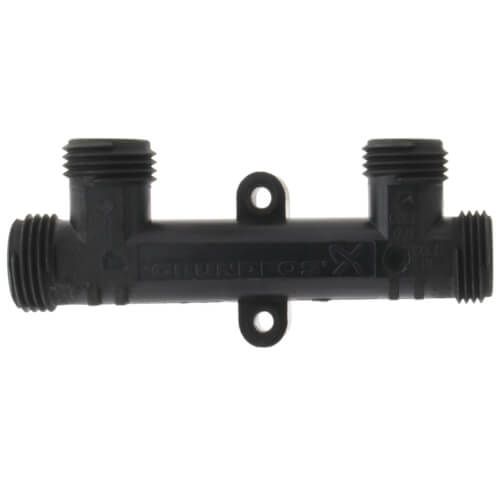
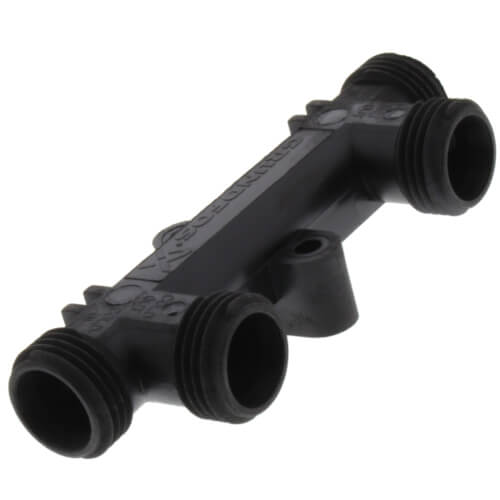
The valve is a very hard-feeling plastic; it's not brass.
The comfort valve is fiberglas reinforced plastic.
Q: If only this valve is installed, in other words, no circulating pump, is it still possible to get hot water quickly? If so, how is the water temperature maintained to be lower on the cold pipe?
Asked by Aash 12 years ago
Add your answer
Without the pump to force circulating the water, I doubt if you would get hot water. Sent from my iPhone
The circulating pump is required to force the eventual hot water through the valve into the cold water line until the valve senses that the water is hot. As a result, the cold water line will be a little warm until it is ran for a short time.
No, you need the circulating pump to keep moving the hot water through the pipes . You will find that the cold water side is not as cold as it used to be. Sent from my iPad
Q: After the Grundfos valve opens and pumps the hot water to the cold water side, and then is satisfied that you have hot water, does the pump keep pumping? Does the pump shut off and then start up again?
Asked by Wbb 12 years ago
Add your answer
On my unit there is a 24hr timer with on/off pins to set - I have the pump come on at 4:30AM and then off at 11PM
the pump is operated on a programmable timer, so it will pump constantly during the on cycle.
Yes, the pump keeps pumping during the timer period you set up for it. Whenever the valve starts sensing the water is cold it will open up allowing more hot water to arrive, as long as it is in the period the pump is operating. Doane
The pump turns on and off via a timer. The valve opens to allow hot water to stay at the hot water faucet. Sent from my iPhone
The Pump can be running all the time, or running on a timer, or in conjunction with an aquastat, running until the temperature in the piping reaches a certain limit, usually 85 to 95 degrees. Assuming the pump is running all the time, there is a temperature device within the crossover valve that when satisfied, shuts off the cold water supply, and limits the flow to the hot water supply only. Assume that it's 95 degrees. However, unless the pump is on a timer or controlled by an aquastat, the pump continues to run, it justs "dead heads" at the hot water shutoff. And yes, you could get up to 94 degrees HW in the cold water side. Want a product where the pump only runs when you ask for HW? Try the Taco OnCommand unit. More money, but you could might be able to save $30 or more on your monthly water bill, depending on your usage and number of family members. The DOE says that 8,000 - 14,000 gallons of water are lost each year waiting on water to get warm.
The pump keeps pumping.
I think the pump keeps on - it doesn't shut off at all unless you physically turn it off at the pump.
The pump is on a timer and runs when the timer is set to run. When the comfort valve shuts off the pump keeps running and continues to slightly pressurise the hot water line. The pump is a centrifugal pump which is designed to run in this deadheaded condition. It takes very little power when running anyway.
Answer: The pump has a 24 time clock on it. You elect to either set it to operate in a certain time range like 5AM to 9AM so a morning shower runs hot faster, or have it run continuously. I set mine to run continuously. Steve Pisarcik
There is no pump. Water pressure moves the hot water through the valve. There is a timer on the recirculater on the valve that will turn off and on depending on the times you set it at.
Q: Does this valve comes with Flexible tubing or thats extra?
Asked by whorewer 13 years ago
Add your answer
Valve only Y Dov Fried D&F Refrigeration
No. It is the valve only.
You need to have 2 additional lines to complete the installation Sent from my iPhone
It’s the valve only.
Q: what is a comfort valve and what does it do/
Asked by JR 14 years ago
Add your answer
This is a valve that goes with a hot water recirculating pump that is installed on top of a water heater, like a Grundfos. The valve in the picture is put under the sink farthest away from the water heater. From my experience, the valve lasts about 2 ½ yrs. and then has to be replaced, but it’s not a difficult installation and a competent handyman can do it.
Works together with a grundfos pump helps for instant hot water at you sink or tub Y Dov Fried
The comfort valve adds another hot water return circulation point. The valves are used in conjunction with the pressure boast circulation pump which is attached to the hot water supply side of your hot water tank. One of these valves should be located at each of the farthest points from your hot water tank. They are in each of my 2nd floor bathrooms in my house. When the hot water temp at the valve decreases in temperature, the valve opens to circulate the hot water and force back into the cold side (cold supply side to the hot water tank). Thus, it gives you almost hot hot water without having to wait. This is a solution if you do not have a built-in hot water loop and it takes a long time for you hot water to reach your faucet or shower.
The comfort valve is a passive thermostat valve that is connected between your hot and cold water lines. It works with Grundfos pump on the hot water heater. When it senses that the hot water is getting too cold, it opens, the pump will activate due to the pressure drop and allow water to flow from the hot side to the cold side. The cold water returns back to the hot water heater. This keeps the hot water hot without wasting water.
A comfort valve works as part of a hot water circulating system. It installs between the hot and cold water lines at the sink farthest away from the hot water heater. It contains a bi metallic valve that opens when the water cools down and then closes when the water heats back up allowing the pump to circulate hot water back to the hot water heater through the cold water pipes. Sent from my iPad
A comfort valve is a temperature control valve that allows hot water to flow backward into the cold water line to ensure hot water at the faucet that it's plumbed under. It must be used in conjunction with a pump which pressurizes the hot water line in respect to the cold water line.
This valve is a component of a hot water circulating system that controls the hot water flow that is pumped with a small pump at the hot water tank through the hot water pipe. This valve connects the hot and cold water lines together at the most distant fixture from the hot water tank. It is a thermostat valve that allows the hot water to flow into the cold water line that returns to the hot water tank, this action keeps the hot water piping throughout the house warm. This system saves all of the water that went down the drain when we were waiting for hot water to arrive at the distant fixtures. Several kinds of the systems are available from Watts, Grundfos and Laing.
Q: Can you install more than one comfort valve on the same system?
Asked by 15 years ago
Add your answer
Verified Reply- PexSupply StaffYou can, and it may be necessary if you have a branched hot water line.
Yes.
Yes.
Yes, it sometimes is necessary to handle branched circuits.
From experience, best to put one at the point furthest from the heater if you have one main branch line and then you will probably only need that one anyway if you dont have long independent runs.
Yes. See my review for details.