




Manual Press Tools

 --%3E %3Csvg version='1.1' id='Fill' xmlns='http://www.w3.org/2000/svg' xmlns:xlink='http://www.w3.org/1999/xlink' x='0px' y='0px' viewBox='0 0 100 100' enable-background='new 0 0 100 100' xml:space='preserve'%3E %3Cpath fill='%23F15C02' d='M79.44,0.95H20.56C9.78,0.95,0.95,9.78,0.95,20.56v58.87c0,10.79,8.82,19.61,19.61,19.61h58.87 c10.79,0,19.61-8.83,19.61-19.61V20.56C99.05,9.78,90.22,0.95,79.44,0.95z M65.38,58.24l9.38,29.58L49.69,69.78L24.5,87.82 l9.34-29.6L8.8,39.6l30.73-0.17c0,0,6.98-19.61,10-28.93c0.54,1.36,9.88,29.1,9.88,29.1H91.2L65.38,58.24z'/%3E %3C/svg%3E)


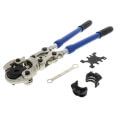
Manual press tools join PEX, copper, and other press-fit piping systems by squeezing a fitting and pipe together through hand-operated leverage rather than a battery-powered actuator. A technician applies force through a handle mechanism, and many designs include a rotating head that pivots up to 360 degrees to reach fittings in tight joist bays or wall cavities where a bulkier powered tool won't fit. These tools handle smaller diameter connections well but require more physical effort per press and work more slowly than a powered alternative, making them a better match for occasional connections than for a job with dozens of joints. Manual press tools cost less upfront than battery models and need no charging or battery replacement, which keeps them in a service van as a reliable backup even on crews that primarily use powered tools. Picking the right jaw size for the fitting being pressed is what actually determines whether the connection seals properly.
Subcategories
- Rotating-Head Manual Press Tools: A head that pivots up to 360 degrees lets a technician position the jaw around a fitting in tight joist bays, wall cavities, or other confined spaces without repositioning the whole tool body. This design is useful on remodel and repair work where access is limited. The rotating mechanism adds cost over a fixed-head model but pays off on jobs with awkward fitting locations.
- Fixed-Head Manual Press Tools: This simpler, non-rotating design is generally lighter and less expensive than a rotating-head model. It suits open mechanical room work where fitting access isn't restricted. A crew doing straightforward runs without tight framing constraints often prefers this option for its lower cost.
- Interchangeable Jaw Sets: Jaws are sold separately to match different fitting diameters and press profiles, such as PEX versus copper press systems. A crew standardizing on one tool body swaps jaws rather than buying a second tool for each pipe size. Confirming jaw compatibility with the specific fitting manufacturer's press profile matters before a purchase.
- Compact/Mini Manual Press Tools: A smaller-frame version targets the tightest access points, such as behind an installed fixture or inside a wall stud bay. It trades some leverage for a reduced footprint compared to a standard manual press tool. This option is worth stocking for jobs where even a rotating-head standard tool can't fit.
Buying Guide
Jaw compatibility is the first thing to confirm on any manual press tool order, since the jaw has to match both the pipe material, PEX or copper press-fit systems most commonly, and the specific fitting manufacturer's press profile, and a mismatched jaw won't seal the connection even if it physically closes. A rotating head that pivots up to 360 degrees earns its higher price on jobs with fittings tucked into joist bays, wall cavities, or other tight framing, letting a technician angle the jaw into position without repositioning the whole tool. Fixed-head designs cost less and work fine in open mechanical rooms where access isn't the limiting factor. Manual Press Tools trade speed and physical ease for a lower price and zero battery dependency compared to powered press tools, which matters most on service calls with only one or two connections rather than new-construction runs with dozens of joints. A crew doing high-volume PEX or copper press work benefits more from a battery tool's consistent force and reduced fatigue, while a technician who presses fittings occasionally, as part of a broader service call, gets full value from a manual tool without the added cost. Buying interchangeable jaw sets rather than a second tool body is the more economical way to cover multiple pipe diameters or fitting brands once the base tool is chosen. Confirming jaw-to-fitting compatibility before a purchase avoids the more common and costly mistake on a manual press tool order.
Frequently Asked Questions
How does a manual press tool differ from a battery-powered one?
A manual tool relies on hand-operated leverage to close the jaw around a fitting, while a battery tool uses a powered actuator to apply consistent force automatically. The manual version costs less and needs no charging, but takes more physical effort and works more slowly.
What's the advantage of a rotating head on a manual press tool?
A head that pivots up to 360 degrees lets a technician angle the jaw into a fitting located in a tight joist bay or wall cavity without repositioning the entire tool. That flexibility matters most on remodel or repair work where access is limited.
Can one manual press tool work with both PEX and copper fittings?
The tool body can often be shared, but the jaw has to match both the pipe material and the specific fitting manufacturer's press profile. Interchangeable jaw sets, sold separately, cover multiple pipe diameters or systems without buying a second tool.
Are manual press tools suitable for high-volume installation work?
They're better suited to occasional connections or service calls than to new-construction runs with many joints, since each press takes more physical effort and time than a battery-powered tool. A crew doing high-volume press work typically gets more value from a powered tool.
What determines whether a press connection actually seals?
Jaw-to-fitting compatibility is the deciding factor. A jaw that doesn't match the fitting's exact press profile can close without creating a proper seal, regardless of how much force is applied.
