




Filters
SORT
Product Availability –
Supply Size –
Number Of Loops –
PEX Size –
Review Score –
 --%3E %3Csvg version='1.1' id='Fill' xmlns='http://www.w3.org/2000/svg' xmlns:xlink='http://www.w3.org/1999/xlink' x='0px' y='0px' viewBox='0 0 100 100' enable-background='new 0 0 100 100' xml:space='preserve'%3E %3Cpath fill='%23F15C02' d='M79.44,0.95H20.56C9.78,0.95,0.95,9.78,0.95,20.56v58.87c0,10.79,8.82,19.61,19.61,19.61h58.87 c10.79,0,19.61-8.83,19.61-19.61V20.56C99.05,9.78,90.22,0.95,79.44,0.95z M65.38,58.24l9.38,29.58L49.69,69.78L24.5,87.82 l9.34-29.6L8.8,39.6l30.73-0.17c0,0,6.98-19.61,10-28.93c0.54,1.36,9.88,29.1,9.88,29.1H91.2L65.38,58.24z'/%3E %3C/svg%3E)
 --%3E %3Csvg version='1.1' id='With-RB' xmlns='http://www.w3.org/2000/svg' xmlns:xlink='http://www.w3.org/1999/xlink' x='0px' y='0px' viewBox='0 0 100 100' enable-background='new 0 0 100 100' xml:space='preserve'%3E %3Cpath fill='%23FBC8B4' d='M79.44,0.95H20.56C9.78,0.95,0.95,9.78,0.95,20.56v58.87c0,10.79,8.82,19.61,19.61,19.61h58.87 c10.79,0,19.61-8.83,19.61-19.61V20.56C99.05,9.78,90.22,0.95,79.44,0.95z M65.38,58.24l9.38,29.58L49.69,69.78L24.5,87.82 l9.34-29.6L8.8,39.6l30.73-0.17c0,0,6.98-19.61,10-28.93c0.54,1.36,9.88,29.1,9.88,29.1H91.2L65.38,58.24z'/%3E %3C/svg%3E)
Price Range –
Caleffi Manifolds & Accessories

 --%3E %3Csvg version='1.1' id='Half' xmlns='http://www.w3.org/2000/svg' xmlns:xlink='http://www.w3.org/1999/xlink' x='0px' y='0px' viewBox='0 0 100 100' enable-background='new 0 0 100 100' xml:space='preserve'%3E %3Cg%3E %3Cpath fill='%23F15C02' d='M30.05,70.23l3.79-12.01L8.8,39.6l30.73-0.17c0,0,6.98-19.61,10-28.93c0.54,1.36,9.88,29.1,9.88,29.1h1.58 L93.71,7.18c-3.58-3.82-8.66-6.23-14.28-6.23H20.56C9.78,0.95,0.95,9.78,0.95,20.56v58.87c0,5.41,2.22,10.32,5.79,13.88 L30.05,70.23z'/%3E %3C/g%3E %3Cpath fill='%23FBC8B4' d='M93.71,7.18L60.98,39.6H91.2L65.38,58.24l9.38,29.58L49.69,69.78L24.5,87.82l5.55-17.59L6.75,93.32 c3.55,3.54,8.44,5.73,13.82,5.73h58.87c10.79,0,19.61-8.83,19.61-19.61V20.56C99.05,15.4,97.01,10.69,93.71,7.18z'/%3E %3C/svg%3E)

 --%3E %3Csvg version='1.1' id='No-RB' xmlns='http://www.w3.org/2000/svg' xmlns:xlink='http://www.w3.org/1999/xlink' x='0px' y='0px' viewBox='0 0 100 100' enable-background='new 0 0 100 100' xml:space='preserve'%3E %3Cpath fill='%23CECECE' d='M79.44,0.95H20.56C9.78,0.95,0.95,9.78,0.95,20.56v58.87c0,10.79,8.82,19.61,19.61,19.61h58.87 c10.79,0,19.61-8.83,19.61-19.61V20.56C99.05,9.78,90.22,0.95,79.44,0.95z M65.38,58.24l9.38,29.58L49.69,69.78L24.5,87.82 l9.34-29.6L8.8,39.6l30.73-0.17c0,0,6.98-19.61,10-28.93c0.54,1.36,9.88,29.1,9.88,29.1H91.2L65.38,58.24z'/%3E %3C/svg%3E)
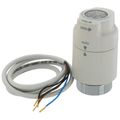
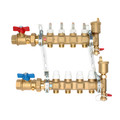
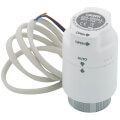

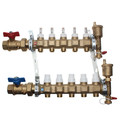
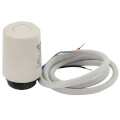
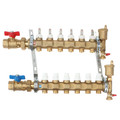
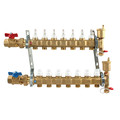
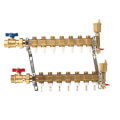
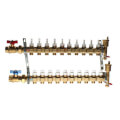
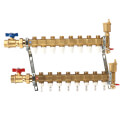
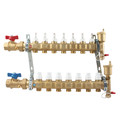
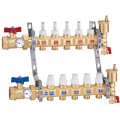
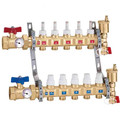
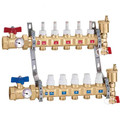
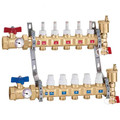
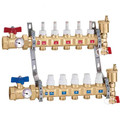
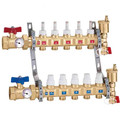
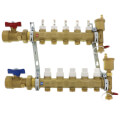
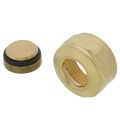
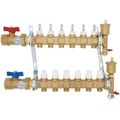
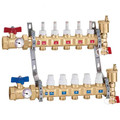
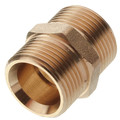
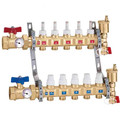
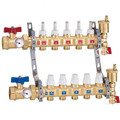
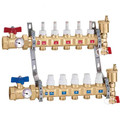

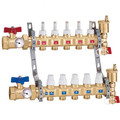
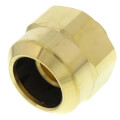
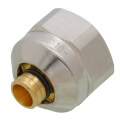
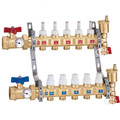
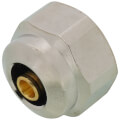
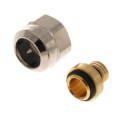


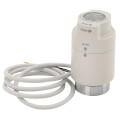
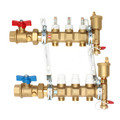
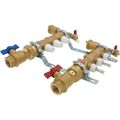
Caleffi Manifolds & Accessories are hydronic distribution manifolds used to split a single supply and return line into multiple individual circuits for radiant floor heating, baseboard zones, or fan coil loops. A manifold lets an installer balance and shut off flow to each circuit independently, which matters when a system serves rooms with different heat loss characteristics or when a single loop needs isolation for repair without draining the entire system. Caleffi manifolds are commonly paired with balancing valves, flow meters, and end caps that convert a bare manifold body into a complete distribution assembly. Contractors specify these manifolds in both new radiant installations and retrofits where an existing boiler or heat source needs to feed several zones from a central mechanical room location. Matching the manifold's port count and connection size to the number of circuits and pipe size in the system is the starting point for any installation.
Subcategories
- Stainless Steel Manifold Bodies: Stainless steel manifold bodies form the core distribution unit that splits supply water into individual circuits and recombines return flow from those same circuits. Port count varies by model to match the number of zones or loops a given system requires. Selecting a body with more ports than currently needed leaves room for future zone additions without replacing the manifold.
- Balancing Valves & Flow Meters: Balancing valves and flow meters mount directly to the manifold to let an installer measure and adjust flow rate on each individual circuit. This matters most in radiant systems where circuit lengths differ, since a longer loop needs more flow than a shorter one to deliver even heat across a floor. Flow meters are typically read visually at the manifold rather than requiring separate test equipment.
- Manifold Brackets & Mounting Accessories: Brackets and mounting hardware secure the manifold assembly to a wall or manifold cabinet, keeping the distribution piping organized and accessible for future service. Proper support also reduces stress on the manifold's port connections from the weight of attached piping. Cabinet-style enclosures are common in finished spaces where the manifold needs to stay out of sight but still reachable for adjustment.
Buying Guide
Sizing a manifold starts with counting the number of circuits the system needs to serve, since manifold bodies are sold in fixed port counts and adding a circuit later generally means replacing the manifold with a larger one rather than adding a port. Planning for one or two extra ports beyond the current zone count is common practice when a future addition to the system is possible.
Connection size and thread type need to match the supply and return piping already specified for the project. Caleffi Manifolds & Accessories are available with different port spacing and end connection styles, so confirming compatibility with the boiler or heat source piping avoids needing an adapter fitting at the manifold itself.
Balancing capability is worth checking closely for radiant floor projects, since circuits of different lengths need different flow rates to deliver even heat output across the floor. A manifold with built-in flow meters on each port simplifies that balancing process compared with one that requires a separate balancing valve installed elsewhere in the loop. Mounting method, whether wall-bracket or enclosed cabinet, should also be decided before rough-in, since cabinet depth requirements can affect wall framing in a finished mechanical closet.
Frequently Asked Questions
What does a hydronic manifold do in a radiant heating system?
A manifold splits a single supply line into multiple individual circuits and recombines the return flow from those circuits back into one return line. This lets each zone or loop in a radiant system be balanced and shut off independently rather than all circuits sharing one uncontrolled connection point.
How many ports does a typical residential manifold need?
Port count depends on the number of separate heating zones or radiant loops in the project, and manifolds are sold in a range of fixed port counts to match. Many installers choose a manifold with one or two more ports than currently needed to allow for a future zone addition.
Can flow meters be added to a manifold that doesn't already have them?
Some manifold bodies accept add-on balancing valves and flow meters as separate accessories, while others are sold with these features already integrated into the manifold body. Checking the specific manifold model's accessory compatibility before ordering avoids purchasing parts that will not fit.
What material are Caleffi manifold bodies typically made from?
Stainless steel is a common material for manifold bodies in this product line, chosen for its resistance to corrosion in a wet hydronic system that stays filled with water continuously. Brass fittings and valve components are often used alongside the stainless body for the individual port connections.
Does a manifold need to be mounted in an enclosed cabinet?
Not necessarily. Wall-mounted brackets are sufficient in mechanical rooms or basements where the manifold does not need to be concealed, while enclosed cabinets are typically chosen for finished living spaces where the manifold needs to stay out of view but remain accessible for balancing adjustments.
