




Filters
SORT
Product Availability –
Paddles –
Material –
Review Score –
 --%3E %3Csvg version='1.1' id='Fill' xmlns='http://www.w3.org/2000/svg' xmlns:xlink='http://www.w3.org/1999/xlink' x='0px' y='0px' viewBox='0 0 100 100' enable-background='new 0 0 100 100' xml:space='preserve'%3E %3Cpath fill='%23F15C02' d='M79.44,0.95H20.56C9.78,0.95,0.95,9.78,0.95,20.56v58.87c0,10.79,8.82,19.61,19.61,19.61h58.87 c10.79,0,19.61-8.83,19.61-19.61V20.56C99.05,9.78,90.22,0.95,79.44,0.95z M65.38,58.24l9.38,29.58L49.69,69.78L24.5,87.82 l9.34-29.6L8.8,39.6l30.73-0.17c0,0,6.98-19.61,10-28.93c0.54,1.36,9.88,29.1,9.88,29.1H91.2L65.38,58.24z'/%3E %3C/svg%3E)
 --%3E %3Csvg version='1.1' id='With-RB' xmlns='http://www.w3.org/2000/svg' xmlns:xlink='http://www.w3.org/1999/xlink' x='0px' y='0px' viewBox='0 0 100 100' enable-background='new 0 0 100 100' xml:space='preserve'%3E %3Cpath fill='%23FBC8B4' d='M79.44,0.95H20.56C9.78,0.95,0.95,9.78,0.95,20.56v58.87c0,10.79,8.82,19.61,19.61,19.61h58.87 c10.79,0,19.61-8.83,19.61-19.61V20.56C99.05,9.78,90.22,0.95,79.44,0.95z M65.38,58.24l9.38,29.58L49.69,69.78L24.5,87.82 l9.34-29.6L8.8,39.6l30.73-0.17c0,0,6.98-19.61,10-28.93c0.54,1.36,9.88,29.1,9.88,29.1H91.2L65.38,58.24z'/%3E %3C/svg%3E)
Taco Flow Switches



 --%3E %3Csvg version='1.1' id='No-RB' xmlns='http://www.w3.org/2000/svg' xmlns:xlink='http://www.w3.org/1999/xlink' x='0px' y='0px' viewBox='0 0 100 100' enable-background='new 0 0 100 100' xml:space='preserve'%3E %3Cpath fill='%23CECECE' d='M79.44,0.95H20.56C9.78,0.95,0.95,9.78,0.95,20.56v58.87c0,10.79,8.82,19.61,19.61,19.61h58.87 c10.79,0,19.61-8.83,19.61-19.61V20.56C99.05,9.78,90.22,0.95,79.44,0.95z M65.38,58.24l9.38,29.58L49.69,69.78L24.5,87.82 l9.34-29.6L8.8,39.6l30.73-0.17c0,0,6.98-19.61,10-28.93c0.54,1.36,9.88,29.1,9.88,29.1H91.2L65.38,58.24z'/%3E %3C/svg%3E)
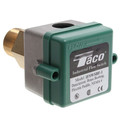
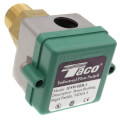
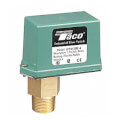
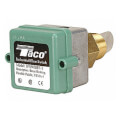


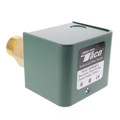
Taco flow switches are hydronic accessories that detect water movement in a pipe and open or close an electrical circuit in response. Installers use them to prove that a pump is actually circulating water, to protect a boiler from firing with no flow, or to trigger an alarm when flow drops unexpectedly. Taco's IFS-WPT model is built as a low turn radius flow switch for liquid lines carrying water, which makes it suited to tight mechanical room piping where a bulkier paddle-style switch would not fit. Flow switches are typically wired into the control circuit of a boiler, chiller, or pump so the equipment shuts down or alarms if flow is interrupted. Getting the right switch sensitivity and pipe size for the application prevents nuisance trips on low-flow systems and missed trips on systems that genuinely lose flow.
Subcategories
- Paddle-Style Flow Switches: Paddle-style switches use a small vane inside the pipe that moves with water flow and trips a microswitch when flow stops. They mount directly into a tee or coupling in the main pipe run and are wired into the equipment's safety or alarm circuit. Contractors favor this style for straightforward pump-proving applications where the pipe has enough straight run to seat the paddle correctly. Sizing the paddle to the pipe diameter is necessary for the switch to trip at the correct flow threshold.
- Low Turn Radius Flow Switches: Taco's IFS-WPT is built with a low turn radius design intended for liquid flow lines carrying water in tighter mechanical spaces. This style reduces the clearance needed around the fitting compared to a standard paddle switch, which helps in crowded boiler rooms or retrofit installations. It still functions as a normally open or normally closed switch depending on wiring, tripping when flow falls below the set threshold. Confirming orientation during installation keeps the internal paddle moving freely.
- Flow Switch Accessories: Accessories for flow switches include mounting tees, gaskets, and wiring connectors sized to match the switch body. Using the manufacturer-specified tee keeps the switch's flow-sensing element positioned correctly in the pipe, which affects how reliably it trips at the intended flow rate. Replacement gaskets and seals help maintain a leak-free connection at the switch body over the life of the system.
Buying Guide
Selecting a Taco flow switch starts with the pipe size at the intended installation point, since the switch tee or fitting has to match the pipe diameter for a proper seal and accurate flow sensing. Next, confirm whether the application needs a normally open or normally closed switch configuration, which depends on how the equipment's control circuit is wired and what should happen when flow is lost.
Available clearance around the pipe matters in tight mechanical rooms. A low turn radius model like the IFS-WPT fits into spaces where a standard paddle switch would not clear surrounding piping or equipment, so measuring the installation area before ordering avoids a mismatch. Flow rate range is another consideration, since a switch calibrated for a wider flow range may not trip reliably at the low flow rates found on smaller circulator loops.
Once the switch is installed, wiring it into the correct point in the control circuit, typically in series with the equipment's safety string, ensures the boiler or pump actually shuts down or alarms when flow is lost rather than just logging an alert. Testing the switch by closing an isolation valve and confirming the circuit trips is a standard commissioning step before leaving the job.
Frequently Asked Questions
What does a flow switch actually protect against?
A flow switch protects equipment like boilers and chillers from operating with no water flow, which can cause overheating or damage. It also serves as pump-proving confirmation in systems where the control logic needs to know water is actually moving before allowing a heat source to fire.
Why choose a low turn radius flow switch over a standard paddle switch?
A low turn radius design, like Taco's IFS-WPT, takes up less clearance around the pipe fitting, which matters in crowded mechanical rooms or retrofit jobs where a standard paddle switch will not fit the available space.
Does pipe size affect which flow switch to order?
Yes. The switch tee or fitting needs to match the pipe diameter at the installation point for both a proper seal and accurate flow detection, so pipe size should be confirmed before ordering.
How is a flow switch tested after installation?
A common commissioning check is closing an isolation valve to stop flow and confirming the switch trips the control circuit as expected, then reopening the valve to confirm normal operation resumes.
Can a flow switch cause nuisance trips?
Yes, if the switch's flow range does not match the actual flow rate in the system. A switch calibrated for a higher flow range than what a small circulator loop produces may fail to sense flow correctly, so matching the switch to the expected flow rate reduces false trips.
