




Filters
SORT
Product Availability –
Review Score –
 --%3E %3Csvg version='1.1' id='Fill' xmlns='http://www.w3.org/2000/svg' xmlns:xlink='http://www.w3.org/1999/xlink' x='0px' y='0px' viewBox='0 0 100 100' enable-background='new 0 0 100 100' xml:space='preserve'%3E %3Cpath fill='%23F15C02' d='M79.44,0.95H20.56C9.78,0.95,0.95,9.78,0.95,20.56v58.87c0,10.79,8.82,19.61,19.61,19.61h58.87 c10.79,0,19.61-8.83,19.61-19.61V20.56C99.05,9.78,90.22,0.95,79.44,0.95z M65.38,58.24l9.38,29.58L49.69,69.78L24.5,87.82 l9.34-29.6L8.8,39.6l30.73-0.17c0,0,6.98-19.61,10-28.93c0.54,1.36,9.88,29.1,9.88,29.1H91.2L65.38,58.24z'/%3E %3C/svg%3E)
 --%3E %3Csvg version='1.1' id='With-RB' xmlns='http://www.w3.org/2000/svg' xmlns:xlink='http://www.w3.org/1999/xlink' x='0px' y='0px' viewBox='0 0 100 100' enable-background='new 0 0 100 100' xml:space='preserve'%3E %3Cpath fill='%23FBC8B4' d='M79.44,0.95H20.56C9.78,0.95,0.95,9.78,0.95,20.56v58.87c0,10.79,8.82,19.61,19.61,19.61h58.87 c10.79,0,19.61-8.83,19.61-19.61V20.56C99.05,9.78,90.22,0.95,79.44,0.95z M65.38,58.24l9.38,29.58L49.69,69.78L24.5,87.82 l9.34-29.6L8.8,39.6l30.73-0.17c0,0,6.98-19.61,10-28.93c0.54,1.36,9.88,29.1,9.88,29.1H91.2L65.38,58.24z'/%3E %3C/svg%3E)
Price Range –
Temperature Sensors

 --%3E %3Csvg version='1.1' id='Half' xmlns='http://www.w3.org/2000/svg' xmlns:xlink='http://www.w3.org/1999/xlink' x='0px' y='0px' viewBox='0 0 100 100' enable-background='new 0 0 100 100' xml:space='preserve'%3E %3Cg%3E %3Cpath fill='%23F15C02' d='M30.05,70.23l3.79-12.01L8.8,39.6l30.73-0.17c0,0,6.98-19.61,10-28.93c0.54,1.36,9.88,29.1,9.88,29.1h1.58 L93.71,7.18c-3.58-3.82-8.66-6.23-14.28-6.23H20.56C9.78,0.95,0.95,9.78,0.95,20.56v58.87c0,5.41,2.22,10.32,5.79,13.88 L30.05,70.23z'/%3E %3C/g%3E %3Cpath fill='%23FBC8B4' d='M93.71,7.18L60.98,39.6H91.2L65.38,58.24l9.38,29.58L49.69,69.78L24.5,87.82l5.55-17.59L6.75,93.32 c3.55,3.54,8.44,5.73,13.82,5.73h58.87c10.79,0,19.61-8.83,19.61-19.61V20.56C99.05,15.4,97.01,10.69,93.71,7.18z'/%3E %3C/svg%3E)

 --%3E %3Csvg version='1.1' id='No-RB' xmlns='http://www.w3.org/2000/svg' xmlns:xlink='http://www.w3.org/1999/xlink' x='0px' y='0px' viewBox='0 0 100 100' enable-background='new 0 0 100 100' xml:space='preserve'%3E %3Cpath fill='%23CECECE' d='M79.44,0.95H20.56C9.78,0.95,0.95,9.78,0.95,20.56v58.87c0,10.79,8.82,19.61,19.61,19.61h58.87 c10.79,0,19.61-8.83,19.61-19.61V20.56C99.05,9.78,90.22,0.95,79.44,0.95z M65.38,58.24l9.38,29.58L49.69,69.78L24.5,87.82 l9.34-29.6L8.8,39.6l30.73-0.17c0,0,6.98-19.61,10-28.93c0.54,1.36,9.88,29.1,9.88,29.1H91.2L65.38,58.24z'/%3E %3C/svg%3E)
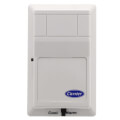
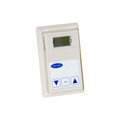

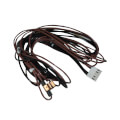
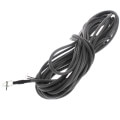
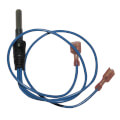

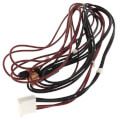
Temperature sensors are components that feed a control board, thermostat, or defrost timer real-time readings from a specific point in an HVAC or refrigeration system, such as the supply air, the evaporator coil, or the outdoor ambient air. Most sensors used in residential and light commercial equipment rely on a thermistor, a resistor whose resistance changes predictably with temperature, which the control board reads and translates into a temperature value. Technicians replace a temperature sensor when a system reports an inaccurate reading, short-cycles unexpectedly, or throws a fault code tied to a specific sensor location. Because a sensor's resistance curve has to match what the control board expects, a replacement needs the correct resistance type and lead length rather than just a similar physical shape. Keeping the common sensor types on the truck helps a technician resolve a control fault on the same visit instead of returning once the exact part is confirmed.
Subcategories
- Defrost and Coil Sensors: Defrost and coil sensors mount directly on or near an evaporator or condenser coil to signal when frost buildup requires a defrost cycle. HVAC and refrigeration technicians replace these when a system runs an excessive defrost cycle, fails to defrost at all, or reports a coil temperature fault. Placement on the coil matters as much as the sensor's electrical rating, since a sensor mounted in the wrong spot reads an inaccurate temperature even if the part itself is functioning correctly. Matching lead length to the original sensor avoids a splice at the connection point.
- Outdoor and Ambient Air Sensors: Outdoor and ambient sensors monitor outside air temperature to help a heat pump or economizer decide when to switch modes or adjust staging. These sensors typically mount in a shaded, ventilated location away from direct sun exposure that could skew the reading. A failed ambient sensor can cause a heat pump to run in the wrong mode for the actual outdoor conditions. Confirming the sensor's resistance curve against the control board's specification prevents a false reading after replacement.
- Supply and Return Air Sensors: Supply and return air sensors sit in the ductwork to track the temperature of air entering or leaving the system, feeding data used for staging, economizer control, or diagnostic alarms on commercial equipment. These sensors typically use a probe or duct-mount housing rather than a coil clip. Technicians select a sensor length and mounting style that matches the existing duct penetration to avoid additional fabrication. A drifting supply air reading often points to a failing sensor before it points to a mechanical fault elsewhere in the system.
- Water and Immersion Temperature Sensors: Water and immersion sensors measure fluid temperature in boilers, hydronic systems, and water heaters, typically threading into a well fitting on the tank or piping rather than clipping onto a surface. These sensors need a pressure and temperature rating suited to the fluid system they monitor. Plumbers replace immersion sensors when a boiler control reports an erratic setpoint or fails to modulate properly. Matching thread size to the existing well fitting avoids leaks at the sensor connection.
Buying Guide
The starting point for any temperature sensor replacement is matching the resistance type to what the control board expects, since two sensors that look identical can report very different resistance values at the same temperature. Temperature sensors are typically listed by resistance curve, such as a specific thermistor type, and installing a mismatched curve causes the control board to read an inaccurate temperature even though the sensor itself is functioning normally.
Mounting style is the second consideration. A coil clip sensor, a duct-mount probe, and a threaded immersion sensor all serve different physical locations and aren't interchangeable even when the electrical specification matches. Lead length matters as well, since a sensor with a shorter lead than the original may not reach the control board connector without an added splice, and every additional connection point is another spot that can fail later. For commercial or OEM-specific equipment, checking the equipment manufacturer's approved sensor list before substituting a generic part confirms the replacement won't trigger a diagnostic fault tied to an unrecognized component. Reviewing resistance type, mounting style, and lead length together before ordering keeps a sensor swap a one-visit repair.
Frequently Asked Questions
How do I test whether a temperature sensor has failed?
Most sensors can be tested with a multimeter by measuring resistance at a known temperature and comparing it against the manufacturer's resistance chart for that sensor type. A reading well outside the expected range at that temperature usually confirms a failed sensor. Testing before replacement avoids swapping a part that wasn't actually the problem.
Can any thermistor be used as a replacement, or does it need to match exactly?
The resistance curve has to match what the control board expects, since two thermistors with different curves report different temperatures at the same physical condition. A visually similar sensor with the wrong curve causes inaccurate readings even though it fits physically. Checking the resistance specification against the original part number confirms compatibility before installation.
Why does my system keep short-cycling after a sensor replacement?
A newly installed sensor that's mounted in the wrong location or has the wrong resistance curve can report inaccurate readings that trigger short-cycling. Reseating the sensor in the exact original mounting position and rechecking its resistance rating against the control board specification usually resolves the issue. If short-cycling continues, the control board itself may need testing rather than the sensor.
What's the difference between a coil sensor and an immersion sensor?
A coil sensor clips onto or near a coil surface to read air-side or refrigerant-side temperature, while an immersion sensor threads into a fitting to read fluid temperature directly inside a pipe or tank. The two aren't interchangeable because of both their mounting style and their pressure rating. Choosing the correct type depends on whether the application involves air or a contained fluid.
Does lead length matter when replacing a temperature sensor?
Lead length affects whether the sensor reaches its control board connector without an added splice, and every splice is a potential point of failure or signal interference. Matching the original lead length keeps the installation as close to the original wiring as possible. When an exact length isn't available, routing the extra length carefully away from heat sources helps avoid a false reading.
