



Filters
SORT
Product Availability –
Review Score –
 --%3E %3Csvg version='1.1' id='Fill' xmlns='http://www.w3.org/2000/svg' xmlns:xlink='http://www.w3.org/1999/xlink' x='0px' y='0px' viewBox='0 0 100 100' enable-background='new 0 0 100 100' xml:space='preserve'%3E %3Cpath fill='%23F15C02' d='M79.44,0.95H20.56C9.78,0.95,0.95,9.78,0.95,20.56v58.87c0,10.79,8.82,19.61,19.61,19.61h58.87 c10.79,0,19.61-8.83,19.61-19.61V20.56C99.05,9.78,90.22,0.95,79.44,0.95z M65.38,58.24l9.38,29.58L49.69,69.78L24.5,87.82 l9.34-29.6L8.8,39.6l30.73-0.17c0,0,6.98-19.61,10-28.93c0.54,1.36,9.88,29.1,9.88,29.1H91.2L65.38,58.24z'/%3E %3C/svg%3E)
Price Range –
Trane Contactors


 --%3E %3Csvg version='1.1' id='No-RB' xmlns='http://www.w3.org/2000/svg' xmlns:xlink='http://www.w3.org/1999/xlink' x='0px' y='0px' viewBox='0 0 100 100' enable-background='new 0 0 100 100' xml:space='preserve'%3E %3Cpath fill='%23CECECE' d='M79.44,0.95H20.56C9.78,0.95,0.95,9.78,0.95,20.56v58.87c0,10.79,8.82,19.61,19.61,19.61h58.87 c10.79,0,19.61-8.83,19.61-19.61V20.56C99.05,9.78,90.22,0.95,79.44,0.95z M65.38,58.24l9.38,29.58L49.69,69.78L24.5,87.82 l9.34-29.6L8.8,39.6l30.73-0.17c0,0,6.98-19.61,10-28.93c0.54,1.36,9.88,29.1,9.88,29.1H91.2L65.38,58.24z'/%3E %3C/svg%3E)
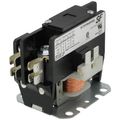

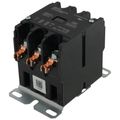
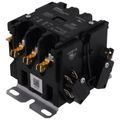
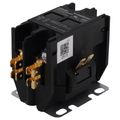
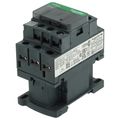
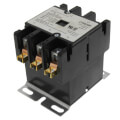
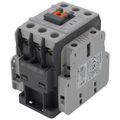

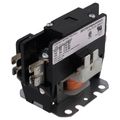
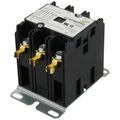
Trane contactors are the electromechanical switches that connect line voltage power to a condensing unit's compressor and outdoor fan motor whenever the thermostat calls for cooling. A low-voltage coil, controlled by the thermostat and control board, pulls the contactor's points closed to complete the high-voltage circuit, and releases them once the call for cooling ends. Contactors carry single-pole and double-pole configurations depending on whether the compressor and fan share one contactor or run on separate circuits within the unit. Pitted or burned contacts are one of the most common reasons a Trane condensing unit fails to start on a hot day, since the unit never receives power even though the thermostat and control board are working correctly. Replacing a worn contactor before it fails completely is a routine part of seasonal maintenance on any Trane cooling system.
Subcategories
- Single-Pole Contactors: Single-pole contactors switch one leg of line voltage power, typically to a compressor or fan motor that only needs one side of the circuit interrupted. Techs find these on smaller residential condensing units where cost and simplicity outweigh the redundancy of switching both legs. A single-pole contactor that fails still leaves one leg of the circuit energized, which matters for safe servicing.
- Double-Pole Contactors: Double-pole contactors switch both legs of line voltage power at once, fully de-energizing the circuit when the coil drops out. Commercial Trane equipment and larger residential systems commonly specify double-pole contactors for the added safety margin during service. A tech working on equipment with a double-pole contactor can be confident the circuit is fully open once the contactor releases.
- Contactor Coils: The coil is the low-voltage component inside a contactor that pulls the contacts closed when energized by the thermostat and control board. A coil that hums, chatters, or fails to pull in fully is a common reason a Trane unit will not start even though line voltage is present at the contactor. Replacing just the coil rather than the whole contactor is possible on some designs but not all.
- Replacement Contact Kits: Contact kits replace only the switching contacts inside a contactor housing rather than the entire assembly, extending the life of an otherwise sound contactor. Techs use these kits on equipment where the housing and coil remain in good condition but the contacts have pitted or burned from repeated cycling. Confirming contact kit compatibility with the specific contactor model prevents a mismatch that leaves the unit unable to start.
Buying Guide
Replacing a Trane contactor starts with matching pole configuration to the original part. A single-pole contactor will not safely substitute for a double-pole unit on equipment that specifies full circuit disconnect, and swapping in the wrong configuration can leave part of the circuit energized during service. Pulling the failed contactor and checking its pole count against the replacement before ordering avoids most of the mismatches technicians run into in the field.
Coil voltage matters just as much as pole configuration. Trane Contactors ship with coils rated for the control voltage the equipment's transformer supplies, and installing a contactor with the wrong coil voltage means the coil either fails to pull in or burns out quickly under sustained power. Checking the existing contactor's coil rating, rather than assuming a standard voltage, prevents a callback for a part that looks right but does not hold in.
Amperage rating rounds out the decision. A contactor sized for the compressor and fan motor load it will switch handles the inrush current at startup without excessive contact wear over time. Undersized contactors show pitted or burned contacts far sooner than properly sized ones, turning what should be a multi-year part into an annual replacement. Confirming amperage against the equipment's nameplate data, not just the failed part's physical size, gives the most reliable match.
Frequently Asked Questions
What is the difference between a single-pole and double-pole Trane contactor?
A single-pole contactor switches one leg of line voltage, while a double-pole version switches both legs and fully de-energizes the circuit when it releases. Larger residential and commercial equipment more often specifies double-pole contactors for the added safety margin during service.
What are common signs a Trane contactor is failing?
A condensing unit that will not start on a hot day, a humming or chattering sound from the contactor, or visibly pitted and burned contacts all point to a failing contactor. Contacts wear down over years of daily cycling, so failure is often gradual rather than sudden.
Can just the coil be replaced instead of the whole contactor?
On some contactor designs the coil is a separate replaceable component, but not all manufacturers build them that way. Checking the specific contactor's construction before ordering a coil-only replacement avoids buying a part that will not fit.
Does contactor amperage rating need to match the compressor exactly?
The contactor's amperage rating needs to meet or exceed the combined load of the compressor and fan motor it switches, based on the equipment's nameplate data. An undersized contactor wears out much faster than one properly matched to the load.
Why would a contactor coil hum without pulling the contacts closed?
A humming coil that fails to fully pull in often points to low control voltage, a weak or failing coil, or debris preventing the contacts from seating. Checking control voltage at the coil terminals is usually the first troubleshooting step.
