




Utility Ball Valves


 --%3E %3Csvg version='1.1' id='No-RB' xmlns='http://www.w3.org/2000/svg' xmlns:xlink='http://www.w3.org/1999/xlink' x='0px' y='0px' viewBox='0 0 100 100' enable-background='new 0 0 100 100' xml:space='preserve'%3E %3Cpath fill='%23CECECE' d='M79.44,0.95H20.56C9.78,0.95,0.95,9.78,0.95,20.56v58.87c0,10.79,8.82,19.61,19.61,19.61h58.87 c10.79,0,19.61-8.83,19.61-19.61V20.56C99.05,9.78,90.22,0.95,79.44,0.95z M65.38,58.24l9.38,29.58L49.69,69.78L24.5,87.82 l9.34-29.6L8.8,39.6l30.73-0.17c0,0,6.98-19.61,10-28.93c0.54,1.36,9.88,29.1,9.88,29.1H91.2L65.38,58.24z'/%3E %3C/svg%3E)




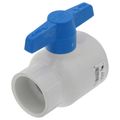


Utility Ball Valves are economical, quarter-turn shutoff valves built primarily from PVC for irrigation, pool, and spa plumbing where a lightweight, corrosion-resistant valve is preferred over metal. Common sizes run from 1/2 inch up to 4 inches, with socket connections designed to solvent-weld directly into PVC pipe runs. Spears manufactures a widely used line in this category, offering models with features like an O-ring seal for smoother handle operation and a longer service life under repeated cycling. Because these valves use a quarter-turn open-to-close motion, a contractor can shut off a zone or fixture quickly during service or a repair without dealing with a gate valve that takes several turns to close. Choosing the correct size and connection type keeps an irrigation or pool plumbing shutoff point leak-free and easy to operate for years.
Subcategories
- Small-Diameter Valves (1/2" to 1"): Small-diameter utility ball valves, generally 1/2 inch through 1 inch, cover most residential irrigation zone shutoffs and small pool equipment pad connections. Installers use this size range to isolate individual sprinkler zones or a single piece of pool equipment without shutting down the entire system. Socket connections solvent-weld directly into PVC pipe, avoiding the need for threaded adapters in a straight pipe run. An O-ring seal on models like those from Spears keeps the handle turning smoothly over repeated seasonal use.
- Large-Diameter Valves (1-1/4" to 4"): Large-diameter utility ball valves, ranging from 1-1/4 inch up to 4 inches, handle higher-flow applications like commercial irrigation mainlines and pool circulation piping. Pool and spa contractors use these larger sizes at the equipment pad to isolate a pump, filter, or heater for service without draining the entire system. Socket connections in this size range still solvent-weld into PVC pipe, keeping installation consistent with the smaller sizes in the same product line. Higher flow capacity at these sizes reduces pressure drop across the valve compared with using an undersized valve.
- O-Ring Seal Valves: O-ring seal utility ball valves add a rubber O-ring around the ball or stem to improve the seal and smooth out handle operation compared with basic PTFE-seat-only designs. Spears offers models with this feature across its utility ball valve line for irrigation and pool and spa use. The added seal helps the valve continue turning smoothly after repeated seasonal shutoffs and reopenings. Contractors specify O-ring models when a valve will see frequent cycling rather than sitting in one position for years at a time.
Buying Guide
Sizing a utility ball valve starts with matching the pipe diameter already installed, since these valves use socket connections designed to solvent-weld directly into PVC pipe rather than adapt to a threaded fitting. Smaller sizes, from 1/2 inch through 1 inch, cover most residential irrigation zone valves and small pool equipment connections, while sizes from 1-1/4 inch up to 4 inches handle higher-flow mainlines and pool circulation piping at the equipment pad. Utility Ball Valves used in irrigation systems typically need to isolate one zone at a time, so placing a valve at each zone's takeoff point, rather than relying on a single main shutoff, makes seasonal maintenance and repairs faster. Pool and spa installations often call for larger valves near the pump, filter, and heater so any one component can be serviced without draining the entire system. O-ring seal options add smoother handle operation and better long-term sealing compared with basic PTFE-seat designs, which matters most in valves that get opened and closed frequently across a swimming season rather than left in one position. PVC construction resists the corrosion that a metal valve would face in a wet, chemically treated pool environment, but it also means these valves are rated for lower pressure and temperature than a comparable bronze or brass valve, so checking the pressure rating against the system's operating pressure before installation avoids a valve failure under load.
Frequently Asked Questions
What sizes do utility ball valves come in?
Utility ball valves typically range from 1/2 inch up to 4 inches in diameter, covering everything from a single residential irrigation zone to a larger commercial mainline or pool circulation line. Smaller sizes fit most sprinkler zone shutoffs, while larger sizes handle higher-flow applications at a pool or spa equipment pad. Matching the valve size to the existing pipe diameter keeps the socket connection solvent-welding cleanly without needing a bushing or adapter. Checking the pipe's outside diameter before ordering avoids a sizing mistake.
Are utility ball valves rated for pool and spa use?
Utility ball valves are commonly used in pool and spa plumbing to isolate a pump, filter, or heater for service without draining the entire system. PVC construction resists the corrosion and chemical exposure typical of a chlorinated or salt-treated pool environment. Sizing at the equipment pad usually runs larger than a typical irrigation zone valve, often in the 1-1/4 inch to 4 inch range. Confirming the valve's pressure rating against the pool system's operating pressure before installation prevents a failure under load.
What does the O-ring seal feature do on a utility ball valve?
An O-ring seal adds a rubber ring around the ball or stem that improves the seal and keeps the handle turning smoothly across repeated open-and-close cycles. Basic PTFE-seat-only valves can stiffen up over time with frequent cycling, while an O-ring design tends to hold smoother operation longer. Spears offers O-ring seal options across its utility ball valve line for both irrigation and pool and spa applications. Choosing this feature matters most for valves that get operated frequently rather than left in one position for years.
How does a utility ball valve connect to PVC pipe?
Utility ball valves in this category use socket connections designed to solvent-weld directly into a PVC pipe run, rather than threaded connections. Solvent welding creates a permanent, leak-free joint once the cement cures, which suits buried irrigation lines and pool equipment pad plumbing. A socket connection means the valve can't be unthreaded for replacement, so it has to be cut out and a new section solvent-welded in. Planning valve placement with future service access in mind avoids a difficult replacement later.
What does quarter-turn operation mean on a utility ball valve?
Quarter-turn operation means the valve handle needs only a ninety-degree rotation to go from fully open to fully closed, compared with a gate valve that takes several full turns. Quarter-turn design lets a contractor shut off a zone or fixture quickly during an emergency repair or routine service call. Handle position also gives a clear visual indication of whether the valve is open or closed, unlike some gate valve designs. Ball valves generally hold this quarter-turn design across all sizes in the utility ball valve line.
