



'/%3E%3C/svg%3E)
 --%3E %3Csvg version='1.1' id='Fill' xmlns='http://www.w3.org/2000/svg' xmlns:xlink='http://www.w3.org/1999/xlink' x='0px' y='0px' viewBox='0 0 100 100' enable-background='new 0 0 100 100' xml:space='preserve'%3E %3Cpath fill='%23F15C02' d='M79.44,0.95H20.56C9.78,0.95,0.95,9.78,0.95,20.56v58.87c0,10.79,8.82,19.61,19.61,19.61h58.87 c10.79,0,19.61-8.83,19.61-19.61V20.56C99.05,9.78,90.22,0.95,79.44,0.95z M65.38,58.24l9.38,29.58L49.69,69.78L24.5,87.82 l9.34-29.6L8.8,39.6l30.73-0.17c0,0,6.98-19.61,10-28.93c0.54,1.36,9.88,29.1,9.88,29.1H91.2L65.38,58.24z'/%3E %3C/svg%3E)


MANUALS (1)
Product Highlights


Description
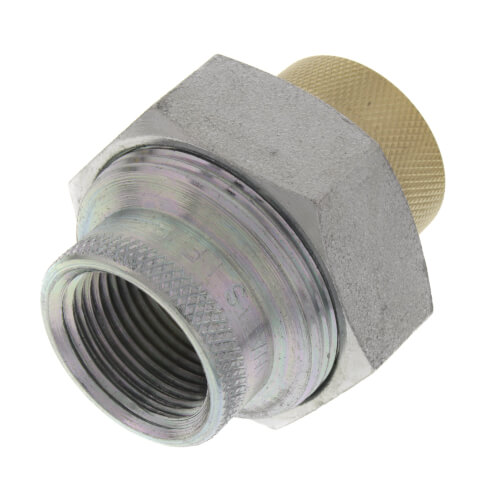
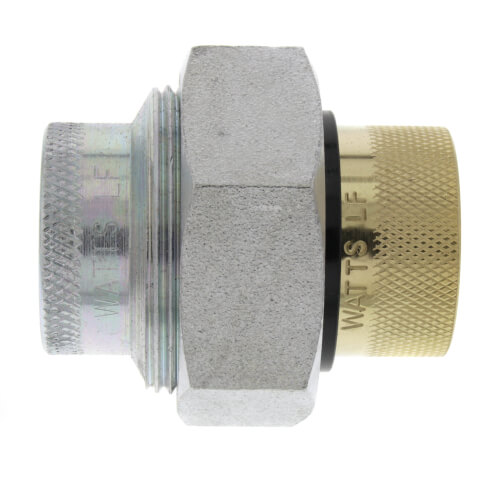
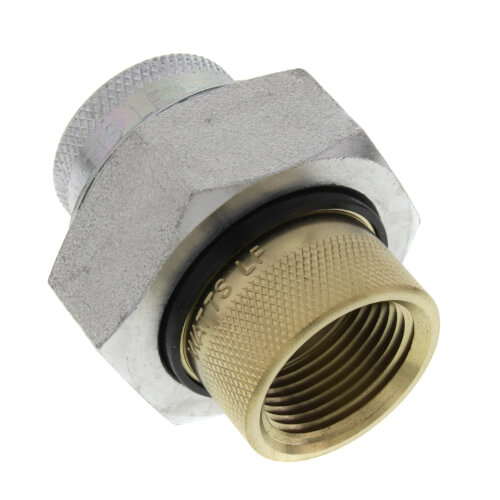
Series LF3003 Lead Free Dielectric Unions are used in commercial and residential applications to prevent accelerated corrosion and deterioration in the piping system due to galvanic and stray current. It is installed between pipes made from dissimilar metals, and features a female iron pipe thread to female brass pipe thread connection. It consists of a union nut, two tailpieces, and a gasket that separates the tailpieces to prevent an electric current from occurring. Series LF3003 is ideal in applications such as hot water storage tanks, water and air conditioners, processing tanks, steam, gas, and water piping.
Specs
| Product Type: | Dielectric Union |
|---|---|
| Size: | 3/4" |
| Connection Type: | FNPT x FNPT |
| Material: | Brass Steel |
| Lead Free: | Yes |
| Pressure Rating: | 180°F @ 250 psi |
| Max Pressure (PSI): | 250 |


Questions?
Compare Similar Products
Steel
You May Also Need
Product Reviews
 --%3E %3Csvg version='1.1' id='With-RB' xmlns='http://www.w3.org/2000/svg' xmlns:xlink='http://www.w3.org/1999/xlink' x='0px' y='0px' viewBox='0 0 100 100' enable-background='new 0 0 100 100' xml:space='preserve'%3E %3Cpath fill='%23FBC8B4' d='M79.44,0.95H20.56C9.78,0.95,0.95,9.78,0.95,20.56v58.87c0,10.79,8.82,19.61,19.61,19.61h58.87 c10.79,0,19.61-8.83,19.61-19.61V20.56C99.05,9.78,90.22,0.95,79.44,0.95z M65.38,58.24l9.38,29.58L49.69,69.78L24.5,87.82 l9.34-29.6L8.8,39.6l30.73-0.17c0,0,6.98-19.61,10-28.93c0.54,1.36,9.88,29.1,9.88,29.1H91.2L65.38,58.24z'/%3E %3C/svg%3E)
Good product but Buna N?
Just what was needed
Would buy again.
Easy installation on hot water boiler, no leaks
Excellent product...fast shipping...would recommend
Necessary part when installing a new water heater
Solid fitting.
Excellent service
Dielectric union
great American made fitting
Product Q&A
5 QuestionsQ: Can I buy spare insulating material? 10 years and an earth quake call for replacement.
Asked by Handy 8 years ago
Add your answer
Verified Reply- Supplyhouse.com TeamWhat type of insulation do you require? We sell radiant heat, pipe and pre-insulated Aquapex tubing insulation available here: https://www.supplyhouse.com/Insulation-21812000 What specifically do you mean when you say "10 years and an earth quake call for replacement" Please call us at 1-888-757-4774 for further assistance with the insulation.
Q: Can they be installed underground
Asked by Mike 10 years ago
Add your answer
A dielectric union creates a* local* open-circuit to the flow of electric charge (corrosion current) between water-carrying pipes of different metals - typically iron and copper or brass - at what would otherwise be a closed/short circuit between them, and thereby eliminates galvanic corrosion *at that junction *and slows it elsewhere, especially if the total interior (wet) surface of the iron pipe is much less than that of the copper or brass. It's also more effective if the water in the pipes is "dead" (has little or no dissolved oxygen). If the exterior surfaces of both connected pipes are in non-dry soil rather than air, the protective effect is still there *right at the joint*, but is lessened elsewhere by the additional electrical conductivity of the parallel path through the damp soil, and is even more reduced if the soil is saturated with water. A partial "fix" for that situation is that the iron pipe AND the iron side of the union be carefully painted or otherwise kept dry, for instance by an overlapped wrapping of vinyl electrical tape, for a considerable distance from the union - so as to increase the minimum length of the parallel conductive path through the soil. Painting or wrapping the copper/brass side of the union and piping helps, too. None of the above should be considered as an alternative to following locally applicable codes. Most introductory college textbooks about Engineering Materials Science include a basic (not typically not very practical) treatment of corrosion of dissimilar metals.
Q: Is the 1/2 inch diameter the outside or the inside dimension?
Asked by Kling 12 years ago
Add your answer
Verified Reply- SupplyHouse StaffThe inside diameter of this union is 1/2". The outside diameter of the part at the union nut is 1-1/2"
Q: The specs for the product give the temperature rating as "180°F (82°C) with standard gasket A; 300ºF (149ºC) with optional gasket B" Does this part come with both gaskets, or must gasket B be ordered separately?
Asked by Alex 14 years ago
Add your answer
FWIW, the submittal sheet PDF says "Option GB".
I do not remember more than 1 gasket coming with the union. It has been long enough ago that I can't be sure.
It only comes with the standard gasket
I only got 1 gasket, which I presume is the standard gasket. lpg
The high temperature gasket must be ordered seperately. I'm trying to track down the part number now. These ship with the low-temp gasket, and will fail prematurely if used in a hidronic heating system. I've ordered the high temp units before; wish I remembered the part number.
Q: I would like to replace the majority of my galvanized piping in my home with pex. However, the galvanized water lines come into the house from the outside. Would this be the best option to transition from galvanized to a copper peice with a pex attatchment on it. Or is there an easier way? Can i just buy a Male or Female brass pex conversion fitting and screw onto the galvanized pipe?
Asked by Jay 16 years ago
Add your answer
Verified Reply- PexSupply StaffYou can either use this or just get a PEX adapter.
you should be able to purchase a fitting that will attach to the galvy (which is sized "IPS"... iron pipe size) and allow you to switch directly to pex. Just make sure that the female thread is not sized for "CTS"... copper tube size.