




ZoomLock Ball Valves

 --%3E %3Csvg version='1.1' id='No-RB' xmlns='http://www.w3.org/2000/svg' xmlns:xlink='http://www.w3.org/1999/xlink' x='0px' y='0px' viewBox='0 0 100 100' enable-background='new 0 0 100 100' xml:space='preserve'%3E %3Cpath fill='%23CECECE' d='M79.44,0.95H20.56C9.78,0.95,0.95,9.78,0.95,20.56v58.87c0,10.79,8.82,19.61,19.61,19.61h58.87 c10.79,0,19.61-8.83,19.61-19.61V20.56C99.05,9.78,90.22,0.95,79.44,0.95z M65.38,58.24l9.38,29.58L49.69,69.78L24.5,87.82 l9.34-29.6L8.8,39.6l30.73-0.17c0,0,6.98-19.61,10-28.93c0.54,1.36,9.88,29.1,9.88,29.1H91.2L65.38,58.24z'/%3E %3C/svg%3E)
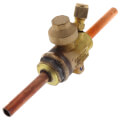
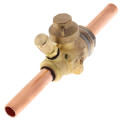
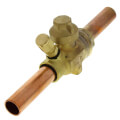
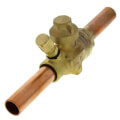
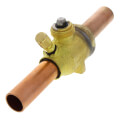
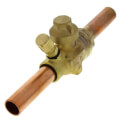

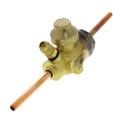
ZoomLock ball valves are press-connect refrigerant valves that install onto copper line sets without brazing, using a press tool to form a sealed joint at each end instead of applying heat. HVAC and refrigeration technicians specify these valves when working near flammable materials, occupied spaces, or job sites where hot work permits and fire watch requirements would slow down a brazed installation. Because the valve seals mechanically rather than through soldered joints, it can be installed on a line that still has refrigerant or oil residue present, which matters on service and retrofit calls where fully purging a line before every valve swap is not practical. The valve body includes a full-port ball design so pressure drop through the open valve stays close to what a same-size brazed ball valve would deliver.
Because no flame is involved, ZoomLock ball valves also cut down on fire watch and hot work paperwork on commercial jobs, which shortens the time between rough-in and startup on schedule-sensitive projects.
Subcategories
- Full-Port Ball Valves: Standard press-connect ball valves used for line isolation and service access on refrigerant circuits. The full-port design keeps flow restriction low compared to a reduced-port valve of the same line size. These are the most commonly stocked size range for split-system and light commercial service work.
- Access Valves: Valves that include a schrader or ball-type access port for gauge connections and refrigerant charging alongside normal line isolation. Technicians use these where a dedicated charging or evacuation point is needed along the line set. Port style should match the gauge set and hose fittings already in use on the service truck.
- Replacement Valve Cores and Caps: Service parts for the access port on valves already installed in the field, including the internal core that seals the port and the protective cap that keeps debris out between service calls. A worn core is a common source of a slow refrigerant leak at an access point. These are typically stocked alongside the valves themselves for quick field replacement.
Buying Guide
Confirm the line size on the job matches the valve's rated connection diameter before ordering ZoomLock ball valves, since the press tool used to form the joint is sized to the connection and will not seal correctly on a mismatched diameter. Line set size should be measured directly rather than assumed from the equipment's nameplate connection size, since field-installed line sets sometimes differ from factory recommendations.
Decide whether the application needs a standard full-port valve or one with an integrated access port before finalizing the order. Adding a valve with a built-in access port at a strategic point in the line set can save a separate access fitting elsewhere, particularly on retrofit work where minimizing the number of connections matters for long-term reliability.
Check that the press tool and jaws on hand are rated for the valve's connection size and refrigerant line material, since press-connect systems from different manufacturers are not always interchangeable at the tool level. Confirming compatibility before the job starts avoids a delay waiting on the correct tooling.
For jobs where hot work restrictions are a factor, such as occupied buildings or spaces with flammable storage nearby, specifying press-connect valves throughout the line set rather than mixing brazed and press connections keeps the installation consistent and simplifies the inspection process.
Frequently Asked Questions
Can ZoomLock ball valves be installed on a line that still has refrigerant in it?
The press connection does not require an open flame, which makes it more forgiving on lines with residual refrigerant or oil compared to brazing, though the line should still be evacuated of pressure per standard service practice before cutting into it.
Do press-connect ball valves need a special tool to install?
Yes, a press tool with jaws matched to the valve's connection size is required to form the seal, and the tool must be compatible with the specific press-connect system being installed.
How does a press-connect ball valve compare to a brazed valve on flow performance?
A full-port press-connect valve is designed to have flow characteristics close to a same-size brazed ball valve, since the internal ball opening is not reduced to accommodate the press fitting.
Why would a technician choose a press-connect valve over brazing on a commercial job?
Press-connect valves avoid the need for a hot work permit and fire watch, which speeds up installation on occupied buildings or sites with strict fire safety requirements.
What should be checked before replacing a valve core on an access port?
Confirm the refrigerant has been recovered and the line is at a safe pressure before removing the core, and match the replacement core's port type to the original to keep a proper seal.
