




B&G Hydraulic Separators

 --%3E %3Csvg version='1.1' id='No-RB' xmlns='http://www.w3.org/2000/svg' xmlns:xlink='http://www.w3.org/1999/xlink' x='0px' y='0px' viewBox='0 0 100 100' enable-background='new 0 0 100 100' xml:space='preserve'%3E %3Cpath fill='%23CECECE' d='M79.44,0.95H20.56C9.78,0.95,0.95,9.78,0.95,20.56v58.87c0,10.79,8.82,19.61,19.61,19.61h58.87 c10.79,0,19.61-8.83,19.61-19.61V20.56C99.05,9.78,90.22,0.95,79.44,0.95z M65.38,58.24l9.38,29.58L49.69,69.78L24.5,87.82 l9.34-29.6L8.8,39.6l30.73-0.17c0,0,6.98-19.61,10-28.93c0.54,1.36,9.88,29.1,9.88,29.1H91.2L65.38,58.24z'/%3E %3C/svg%3E)

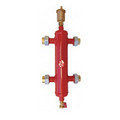
B&G hydraulic separators are Bell & Gossett components that decouple the primary boiler or chiller loop from secondary distribution loops in a hydronic heating or cooling system, letting each loop operate at its own flow rate without interfering with the other. Bell & Gossett, now a Xylem brand, builds its Rolairtrol-based separators to ASME Section VIII, Division 1 code for a 125 psi maximum working pressure and 350 degree Fahrenheit maximum working temperature, with body sizes spanning 2 inches through 36 inches and NPT, flanged, or grooved connection options. A hydraulic separator's low-velocity chamber also functions as an air and dirt separation point, since slowing the fluid allows entrained air to rise and settle out at the same time the primary and secondary loops are being separated. Designers spec these separators into primary-secondary and variable-primary hydronic layouts to keep pump interaction from causing flow or temperature problems across zones.
Subcategories
- NPT Hydraulic Separators: NPT-connected hydraulic separators thread directly into the piping on smaller hydronic systems, typically in the 2 to 3 inch size range. The threaded connection style suits residential and light commercial installations where threaded pipe is already the standard throughout the mechanical room. Sizing the separator to match the system's design flow rate keeps the low-velocity separation effect working as intended.
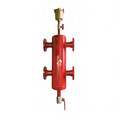
- Flanged Hydraulic Separators: Flanged hydraulic separators bolt into larger commercial piping runs and scale up to the larger body sizes used on high-flow hydronic systems. The flanged connection simplifies maintenance access, since the separator can be unbolted from the line without cutting pipe. Flanged units are common in commercial boiler and chiller plants with multiple secondary loops.
- Grooved Hydraulic Separators: Grooved-end hydraulic separators use mechanical couplings instead of flanges or threads, which speeds up installation and future servicing on commercial mechanical room piping. The grooved connection type is popular on retrofit and renovation projects where matching existing grooved piping simplifies the tie-in. A grooved separator still performs the same air, dirt, and hydraulic separation function as its flanged or NPT counterparts.
- Separator Trim & Accessories: Trim and accessories for hydraulic separators include air vents, drain valves, and strainer baskets that support the unit's air and dirt removal function. A clogged strainer basket or a stuck automatic air vent can reduce a separator's effectiveness even when the body itself is sized correctly. Servicing these components on a regular schedule keeps the separator performing at its rated capacity.
Buying Guide
Sizing a B&G hydraulic separator starts with the system's design flow rate rather than the pipe size alone, since a separator that's undersized for its flow won't achieve the low-velocity condition needed for effective air and dirt removal. Reviewing the mechanical drawings or the original equipment schedule for the specified flow rate is the most reliable starting point.
Connection type should match the piping already in place or specified for the project. NPT works well for smaller threaded systems, while flanged and grooved options scale to the larger commercial installations where bolted or coupled connections are standard.
Pressure and temperature ratings matter most on commercial and industrial systems running closer to code maximums. Confirming a separator's ASME-stamped working pressure and temperature against the system's actual operating conditions avoids specifying a unit that's underrated for the application.
Because a hydraulic separator also functions as an air and dirt separator, plan for the trim components, vents, drains, and strainer access, at the same time as the separator body itself. Skipping the trim package on the initial order often means a return trip once the unit is already piped into the system.
Frequently Asked Questions
What does a hydraulic separator do in a hydronic system?
It decouples the primary boiler or chiller loop from secondary distribution loops so each can run at its own flow rate without one pump's operation affecting the other, while also removing entrained air and dirt from the system.
How do I size a B&G hydraulic separator?
Sizing is based on the system's design flow rate, not just the connecting pipe size. Pulling the flow rate from the mechanical drawings or original equipment schedule gives the most accurate starting point.
What's the difference between NPT, flanged, and grooved separators?
The difference is the connection method: NPT threads into smaller piping, flanged bolts into larger commercial runs, and grooved uses mechanical couplings for faster installation and servicing. All three perform the same separation function at different scales.
What pressure and temperature can a B&G hydraulic separator handle?
Bell & Gossett builds its separators to ASME Section VIII, Division 1 code for a 125 psi maximum working pressure and 350 degree Fahrenheit maximum working temperature.
Does a hydraulic separator remove air and dirt as well as separating loops?
Yes. The same low-velocity chamber that decouples the primary and secondary loops also lets entrained air rise and dirt settle out, which is why trim components like air vents and strainers matter alongside the separator body.
