






'/%3E%3C/svg%3E)
 --%3E %3Csvg version='1.1' id='Fill' xmlns='http://www.w3.org/2000/svg' xmlns:xlink='http://www.w3.org/1999/xlink' x='0px' y='0px' viewBox='0 0 100 100' enable-background='new 0 0 100 100' xml:space='preserve'%3E %3Cpath fill='%23F15C02' d='M79.44,0.95H20.56C9.78,0.95,0.95,9.78,0.95,20.56v58.87c0,10.79,8.82,19.61,19.61,19.61h58.87 c10.79,0,19.61-8.83,19.61-19.61V20.56C99.05,9.78,90.22,0.95,79.44,0.95z M65.38,58.24l9.38,29.58L49.69,69.78L24.5,87.82 l9.34-29.6L8.8,39.6l30.73-0.17c0,0,6.98-19.61,10-28.93c0.54,1.36,9.88,29.1,9.88,29.1H91.2L65.38,58.24z'/%3E %3C/svg%3E)
' fill='%23F15C02' d='M49 0C21.938 0 0 21.938 0 49s21.938 49 49 49 49-21.938 49-49S76.062 0 49 0m0 82.709a7.54 7.54 0 1 1 0-15.08 7.54 7.54 0 0 1 0 15.08m7.54-28.412a7.541 7.541 0 0 1-15.08 0V22.831a7.54 7.54 0 0 1 15.08 0v31.466z'/%3E%3C/svg%3E)
MANUALS (4)


Product Highlights


Description
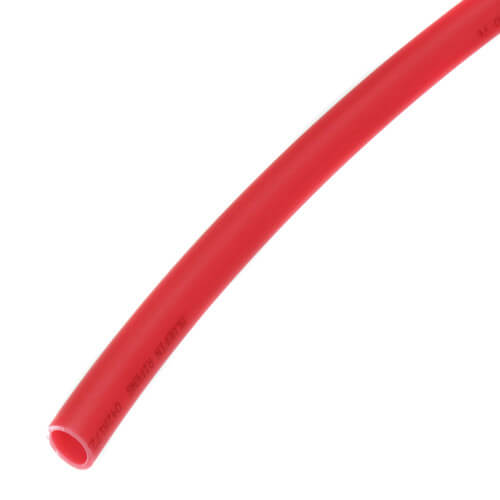
Bluefin PEX-b pipe is produced with crosslinked polyethylene. Crosslinking is obtained through a chemical process that increases the bonds between macromolecules to form a more complex structure than the normal polyethylene. Due to the crosslinking, the polyethylene's performance is greatly enhanced and maintains the excellent properties of thermoplastics. Offering excellent corrosion resistance, incredible flexibility and unusual toughness, Bluefin PEX-b pipe allows for fast and easy installation.
Specs
| Length (Feet): | 100' |
|---|---|
| Size: | 3/4" |
| Material: | PEX |
| Fitting System Compatibility: | Push Fit Clamp Crimp PEX Compression PEX Press |
| Grade: | PEX-b |
| Color: | Red |
| Application: | Plumbing |
| Tubing Type: | Non-Oxygen Barrier |
| Shape: | Coil |
| Inside Diameter: | 0.671" |
| Warranty: | 25 Year |
| Outside Diameter: | 0.875" |


Questions?
Compare Similar Products
Clamp
Crimp
PEX Compression
PEX Press
You May Also Need
Product Reviews
Most Liked Positive Review
 --%3E %3Csvg version='1.1' id='With-RB' xmlns='http://www.w3.org/2000/svg' xmlns:xlink='http://www.w3.org/1999/xlink' x='0px' y='0px' viewBox='0 0 100 100' enable-background='new 0 0 100 100' xml:space='preserve'%3E %3Cpath fill='%23FBC8B4' d='M79.44,0.95H20.56C9.78,0.95,0.95,9.78,0.95,20.56v58.87c0,10.79,8.82,19.61,19.61,19.61h58.87 c10.79,0,19.61-8.83,19.61-19.61V20.56C99.05,9.78,90.22,0.95,79.44,0.95z M65.38,58.24l9.38,29.58L49.69,69.78L24.5,87.82 l9.34-29.6L8.8,39.6l30.73-0.17c0,0,6.98-19.61,10-28.93c0.54,1.36,9.88,29.1,9.88,29.1H91.2L65.38,58.24z'/%3E %3C/svg%3E)
Good Product and Easy to work with.
Most Liked Negative Review
No
i would purchase again

Quality pex roll
I would buy it again!
I would buy this again
Works Like It Should
Pex good quality
Great Product
Great Product
This size is a terrible, terrible product
I would buy this again
Product Q&A
152 QuestionsQ: can the same pex pipe used indoors be barried under ground?
Asked by none 13 years ago
Add your answer
Yes. Wilmer Gingerich
Q: want to use 1/2 and 3/4 on outside well it gets down to 18 deg plan to use shark bite fittings and light bulb
Asked by howard 13 years ago
Add your answer
No this tubing is not designed to be used below freezing
In my opinion it should work very well. May want to reconsider the shark fittings. They work well, but are very expensive especially if you need very many. I normally just use the crimping clamps.
Q: Is it OK to install PEX tubing in vertical direction without any vertical support? I am going to install it in the ceiling and then drop down to floor lever fixtures between studs behind drywall. I plan to support it only when transitioning from horizontal to vertical and back to horizontal direction by plastic bend supports. This would let me minimize drywall cutting.
Asked by jfkn 13 years ago
Add your answer
Codes vary from municipality to municipality but a general rule of thumb is: *308.5 Interval of support.* Pipe shall be supported in accordance with Table 308.5. *TABLE 308.5 HANGER SPACING* *PIPING MATERIAL**MAXIMUM HORIZONTAL SPACING (feet)**MAXIMUM VERTICAL SPACING (feet)*ABS pipe410bAluminum tubing1015Brass pipe1010Cast-iron pipe5a 15Copper or copper-alloy pipe1210Copper or copper-alloy tubing, 11/4-inch diameter and smaller610Copper or copper-alloy tubing, 11/2-inch diameter and larger1010 *Cross-linked polyethylene (PEX) pipe* *2.67(32 inches)**10b*Cross-linked polyethylene/aluminum/cross-linked polyethylene (PEX-AL-PEX) pipe2.67 (32 inches)4CPVC pipe or tubing, 1 inch and smaller310bCPVC pipe or tubing, 11/4 inches and larger410bSteel pipe1215Lead pipeContinuous4 Polyethylene/aluminum/polyethylene (PE-AL-PE) pipe2.67 (32 inches)4Polypropylene (PP) pipe or tubing 1 inch and smaller2.67 (32 inches)10bPolypropylene (PP) pipe or tubing, 11/4 inches and larger410bPVC pipe410bStainless steel drainage systems1010b For SI: 1 inch = 25.4 mm, 1 foot = 304.8 mm. a. The maximum horizontal spacing of cast-iron pipe hangers shall be increased to 10 feet where 10-foot lengths of pipe are installed. b. Midstory guide for sizes 2 inches and smaller. *Exception:* The interval of support for piping systems designed to provide for expansion/contraction shall conform to the engineered design in accordance with Section 105.4.
Deleted yes anything to get out of more sheet rock and spackle
If the run is shorter than 8 feet and your elbow connections are secure I don't see a problem. I usually secure it every 4' but that is on new construction.
Q: I am replacing a garden tub with a double shower. The existing pex tubing to the tub is 1/2 inch fed from a 3\4 pex line. The new shower will have multiple heads and two rain showers heads. Should I use the existing 1\2 inch pex or should I extend the 3\4 inch pex to the shower valves? I am concerned about water pressure.
Asked by Knight Traveler 13 years ago
Add your answer
I think you’ve answered your own question. I would definitely use the ¾” line to supply the shower. Good Luck WKM
The most important consideration is that your hot and cold lines are the same size and length from the source or as close as possible, and that your hot water heater have the capacity to satisfy the showers demand. Regards Wilmer Gingerich
Pex has manifolds with multiple 1/2 in lines outward from a 3/4 in feed. Split the 1/2 in feed line.
Q: I will be running 210F hot water at only 11 psi of for radiant heating. Will Pex work for my situation?
Asked by MadMarv 13 years ago
Add your answer
Verified Reply- PexSupply StaffRifeng PEX is only rated up to 180°F, so we would not recommend it.
To whom it may concern. I have used the white 3/4" but have used the oxygen barrier for my radient heat. I used the regular pipe for domestic water. The oxgyen barrier pipe will keep much longer because with a furnace/boiler the water is exposed to the steel inside which does something to the pipe. So long story short I use oxgyen barrier for heat and regular for domestic water. Sent from my Verizon Wireless 4G LTE smartphone
Q: what is the max. temperature rating on this pex tubing?
Asked by n\a 13 years ago
Add your answer
Verified Reply- PexSupply StaffRifeng PEX is rated to 180°F at 100 psi.
Q: what is the heat limit for hot water through this pipe? I read else where that at 200 degrees the pipe will hold at 80 psi but that was in a response to air pressure is it the same for water? Really what is the max temp?
Asked by me 13 years ago
Add your answer
Verified Reply- PexSupply StaffRifeng PEX is rated to 180°F at 100 psi. There are other type of PEX (including hePEX and AquaPEX from Uponor) that are rated to 200°F at 80 psi. These ratings are for water only. No PEX we carry is approved for use with compressed air.
180 degrees. Wilmer Gingerich
Q: I have a Aqua Therm wood stove which is a sealed unit that runs at approximately 15 to 20 psi at 160 to 180 degrees. The lines would run along the wall in my garage to the inside of my house. Can I use this line or do I need the oxygen barrier stuff and why. Thanks
Asked by Chad 13 years ago
Add your answer
Verified Reply- PexSupply StaffRifeng PEX is rated to 180°F at 100 psi. There would be no benefit to using oxygen barrier PEX if you have an open-loop wood boiler, unless you may change heat sources in the future.
All the oxygen barrier pex is for is to help protect your boiler from rusting. There are a lot of wood boilers in my neck of the woods and they're all using regular pex piping. Like always you get what you pay for. so if you want the best, get the oxygen barrier pex. Is it really necessary? It's doubtful. Regards Wilmer Gingerich
Use the Oxygen Barrier...from what I have read, it will decrease the rust buildup in the cast iron boiler vessel. Having said that, I did not in the installations completed with gas fired boilers, but I think your stove just may run at a hotter temp...I run my gas boilers not over 140 degrees. The oxygen barrier is not that more than regular PEX.... those are my thoughts, keep doing your research.
Q: Can you use one color pipe throughout your house. By code is two colors required. For shipping purposes there is no sense in needed 50' or less of pipe and everything comes in 100' roles. left is hot right is cold is the norm, see no reason to use red left and blue right as long as the main branch line is colored.
Asked by Dan 13 years ago
Add your answer
Verified Reply- PexSupply StaffThere would be no issue using red PEX with cold water or blue PEX with hot water. The tubing is the same except for the color. It might be less confusing to use white PEX if you want to stick with one color. It is unlikely that there are any local codes prohibiting the use of single color of PEX throughout a house, but you should double check to be sure.
Would not recommend this, but if you do, I would label the RED line supplying cold water as "Cold". I assume this is for your personal home job. Absolutely do not mix colors on a customer's job. Good Luck! WKM
I'm completely unaware of any color code requirements for Pex piping. It's just a good way to not get your hot and colds mixed up. Feel free to use clear Pex for all of your piping if you want to. Regards Wilmer Gingerich
as far as i know there is no code that requires two colors (copper only comes in copper!) good luck.
I USED BLUE IN THE WHOLE HOSE. WHEN HOOKING UP TO Faucets I used 2 different smaller colors. As for code. That is a question for your local building inspector. Code depends on where you live.
Q: when is it safe to use water thru this tubing
Asked by sam 13 years ago
Add your answer
As long as you stay within the temp/pressure specs. It is designed for water.
Blue PEX is intended for use in cold domestic water as soon as you installl it.
Depends upon what you are going to use the water for... basically, immediately if the roll of PEX was a new roll with sealed ends. Otherwise, you might flush it out for 10 to 15 minutes. (it's your water bill) Since no grease or other lubricating/sealent product is used to make a fittings, and assuming the fittings are new, the water will never be as clean. New galv. pipe is not as clean. If you are worried about the plastic, well plastic, PEX and others, is used in most all new city lines, long distance water transpostation lines, water plants, etc. It's used everywhere. Dr. VFK, retired.