




Class J Power Fuses

 --%3E %3Csvg version='1.1' id='No-RB' xmlns='http://www.w3.org/2000/svg' xmlns:xlink='http://www.w3.org/1999/xlink' x='0px' y='0px' viewBox='0 0 100 100' enable-background='new 0 0 100 100' xml:space='preserve'%3E %3Cpath fill='%23CECECE' d='M79.44,0.95H20.56C9.78,0.95,0.95,9.78,0.95,20.56v58.87c0,10.79,8.82,19.61,19.61,19.61h58.87 c10.79,0,19.61-8.83,19.61-19.61V20.56C99.05,9.78,90.22,0.95,79.44,0.95z M65.38,58.24l9.38,29.58L49.69,69.78L24.5,87.82 l9.34-29.6L8.8,39.6l30.73-0.17c0,0,6.98-19.61,10-28.93c0.54,1.36,9.88,29.1,9.88,29.1H91.2L65.38,58.24z'/%3E %3C/svg%3E)


 --%3E %3Csvg version='1.1' id='Fill' xmlns='http://www.w3.org/2000/svg' xmlns:xlink='http://www.w3.org/1999/xlink' x='0px' y='0px' viewBox='0 0 100 100' enable-background='new 0 0 100 100' xml:space='preserve'%3E %3Cpath fill='%23F15C02' d='M79.44,0.95H20.56C9.78,0.95,0.95,9.78,0.95,20.56v58.87c0,10.79,8.82,19.61,19.61,19.61h58.87 c10.79,0,19.61-8.83,19.61-19.61V20.56C99.05,9.78,90.22,0.95,79.44,0.95z M65.38,58.24l9.38,29.58L49.69,69.78L24.5,87.82 l9.34-29.6L8.8,39.6l30.73-0.17c0,0,6.98-19.61,10-28.93c0.54,1.36,9.88,29.1,9.88,29.1H91.2L65.38,58.24z'/%3E %3C/svg%3E)


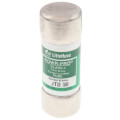
Class J Power Fuses are current-limiting fuses rated for branch circuit and motor protection applications up to 600 volts AC, with amperage ratings spanning 1 to 600 amps depending on the model. Bussmann's LPJ Low-Peak series, a common time-delay Class J option, carries a 300,000 amp interrupting rating at 600 volts AC and delivers a minimum of 10 seconds of ride-through at 500 percent of rated current, letting motors start without nuisance blowing. Electricians and HVAC technicians specify Class J fuses on disconnects and panels feeding compressors, pumps, and other inductive loads where a standard fuse would open on inrush current. Because Class J fuses fit a narrower, standardized mounting dimension than Class H or Class R fuses, using the correct fuse holder matters as much as the amperage rating. Correctly sized Class J fuses protect downstream wiring and equipment from short-circuit currents while riding through normal motor starting surges.
Subcategories
- Time-Delay (Dual-Element) Class J Fuses: Time-delay Class J fuses, such as Bussmann's LPJ Low-Peak series, use two separate elements, one for overload protection and one for short-circuit protection, built into a single body. The dual-element design lets the fuse ride through motor starting inrush for a minimum of 10 seconds at 500 percent of rated current without opening. HVAC and refrigeration technicians specify time-delay Class J fuses on compressor and pump circuits where inrush current regularly exceeds running current. The LPJ series covers amperage ratings from 1 to 600 amps at 600 volts AC.
- Fast-Acting Class J Fuses: Fast-acting Class J fuses, such as Bussmann's JKS Limitron series, open quickly under overload conditions without the built-in delay of a dual-element design. Electricians specify fast-acting fuses on circuits without significant inrush current, such as lighting panels or resistive loads, where rapid clearing matters more than surge tolerance. The JKS series covers ratings up to 600 amps at 600 volts AC. Fast-acting fuses generally cost less than time-delay versions for equivalent amperage.
- High-Speed Class J Fuses (for Drives): High-speed Class J fuses, such as Bussmann's DFJ series, protect variable frequency drives and other semiconductor-based equipment that need faster clearing times than standard time-delay fuses provide. Electrical contractors working on commercial HVAC drive installations specify this style when the drive manufacturer calls for semiconductor-rated protection. DFJ-style fuses maintain the same physical mounting dimensions as other Class J fuses, so standard Class J fuse holders and disconnects still apply. Selecting the correct series matters because a standard time-delay fuse won't provide the clearing speed a drive manufacturer specifies.
- Class J Fuse Holders and Disconnects: Class J fuse holders and disconnect blocks are sized specifically to accept Class J fuse dimensions, which differ from Class H, R, and T fuse bodies. Panel builders and electricians match the fuse holder's amperage and voltage rating to the fuse installed rather than assuming interchangeability across fuse classes. Modular fuse holder blocks allow single, double, or triple-pole configurations depending on the panel design. Using a mismatched holder can prevent proper current limiting even when the correct fuse is installed.
Buying Guide
Start with the equipment's inrush current characteristics before selecting a fuse type, since motor-driven loads like compressors and pumps need time-delay protection while resistive circuits can use faster-acting fuses. Class J Power Fuses come in time-delay and fast-acting versions, and installing a fast-acting fuse on a motor circuit often causes nuisance blowing during normal startup. Amperage rating should match the circuit's full-load current and the equipment manufacturer's maximum fuse size, found on the equipment nameplate rather than estimated from wire gauge alone. Voltage rating matters just as much as amperage. Class J fuses commonly carry a 600 volt AC rating, which covers the vast majority of commercial and light industrial panels, but confirming the system voltage against the fuse rating avoids an undersized selection. Interrupting rating deserves attention on services with high available fault current, since a fuse with an inadequate interrupting rating can fail to safely clear a fault. Physical fuse holder compatibility is the next check: Class J fuses use dimensions distinct from Class H, R, and T fuses, so the disconnect or panel must be built for Class J sizing specifically. Drive and semiconductor equipment often specifies a high-speed Class J fuse rather than a standard time-delay type, so checking the drive manufacturer's documentation before substituting a standard fuse prevents inadequate protection on sensitive electronics.
Frequently Asked Questions
What makes a Class J fuse different from other fuse classes?
Class J fuses use a standardized, more compact body dimension than Class H or Class R fuses and carry a higher interrupting rating, commonly up to 300,000 amps at 600 volts AC on time-delay versions. The higher interrupting rating lets Class J fuses safely clear faults on services with high available fault current. Because the physical dimensions differ from other fuse classes, Class J fuses require a fuse holder or disconnect built specifically for that class.
When should a time-delay Class J fuse be used instead of a fast-acting one?
Time-delay Class J fuses suit motor-driven equipment like compressors, pumps, and blower motors, since these loads draw several times their running current for a few seconds during startup. Fast-acting fuses lack that built-in ride-through and can open on normal motor inrush, causing nuisance outages. Circuits without significant startup surge, such as lighting or resistive heating elements, can use fast-acting Class J fuses without an issue.
What amperage and voltage ratings are available for Class J fuses?
Class J fuses cover a range from 1 amp up to 600 amps, with a standard voltage rating of 600 volts AC across most manufacturers. The exact amperage needed depends on the circuit's full-load current and the equipment manufacturer's maximum fuse size listed on the equipment nameplate. Selecting a fuse below the equipment's maximum fuse size but above the circuit's normal operating current provides both protection and reliable operation.
Can a Class J fuse be installed in a Class H or Class R fuse holder?
A Class J fuse can't be installed in a Class H or Class R fuse holder because the physical dimensions differ between fuse classes. Panels and disconnects need to be built specifically for Class J dimensions, or fitted with a compatible Class J fuse holder, before that fuse class can be used. Attempting to force an incompatible fuse into the wrong holder compromises the safety rating of the installation.
Why do variable frequency drives need a specific fuse type?
Variable frequency drives and other semiconductor-based equipment need faster clearing times than a standard time-delay Class J fuse provides, since semiconductor components can be damaged by fault currents well before a standard fuse opens. High-speed Class J fuses, such as Bussmann's DFJ series, are built specifically for this faster clearing requirement while maintaining standard Class J physical dimensions. Checking the drive manufacturer's fuse specification before substituting a standard time-delay fuse protects the drive from damage.
