




Domestic Bulkhead Fittings

 --%3E %3Csvg version='1.1' id='Fill' xmlns='http://www.w3.org/2000/svg' xmlns:xlink='http://www.w3.org/1999/xlink' x='0px' y='0px' viewBox='0 0 100 100' enable-background='new 0 0 100 100' xml:space='preserve'%3E %3Cpath fill='%23F15C02' d='M79.44,0.95H20.56C9.78,0.95,0.95,9.78,0.95,20.56v58.87c0,10.79,8.82,19.61,19.61,19.61h58.87 c10.79,0,19.61-8.83,19.61-19.61V20.56C99.05,9.78,90.22,0.95,79.44,0.95z M65.38,58.24l9.38,29.58L49.69,69.78L24.5,87.82 l9.34-29.6L8.8,39.6l30.73-0.17c0,0,6.98-19.61,10-28.93c0.54,1.36,9.88,29.1,9.88,29.1H91.2L65.38,58.24z'/%3E %3C/svg%3E)

 --%3E %3Csvg version='1.1' id='No-RB' xmlns='http://www.w3.org/2000/svg' xmlns:xlink='http://www.w3.org/1999/xlink' x='0px' y='0px' viewBox='0 0 100 100' enable-background='new 0 0 100 100' xml:space='preserve'%3E %3Cpath fill='%23CECECE' d='M79.44,0.95H20.56C9.78,0.95,0.95,9.78,0.95,20.56v58.87c0,10.79,8.82,19.61,19.61,19.61h58.87 c10.79,0,19.61-8.83,19.61-19.61V20.56C99.05,9.78,90.22,0.95,79.44,0.95z M65.38,58.24l9.38,29.58L49.69,69.78L24.5,87.82 l9.34-29.6L8.8,39.6l30.73-0.17c0,0,6.98-19.61,10-28.93c0.54,1.36,9.88,29.1,9.88,29.1H91.2L65.38,58.24z'/%3E %3C/svg%3E)
 --%3E %3Csvg version='1.1' id='With-RB' xmlns='http://www.w3.org/2000/svg' xmlns:xlink='http://www.w3.org/1999/xlink' x='0px' y='0px' viewBox='0 0 100 100' enable-background='new 0 0 100 100' xml:space='preserve'%3E %3Cpath fill='%23FBC8B4' d='M79.44,0.95H20.56C9.78,0.95,0.95,9.78,0.95,20.56v58.87c0,10.79,8.82,19.61,19.61,19.61h58.87 c10.79,0,19.61-8.83,19.61-19.61V20.56C99.05,9.78,90.22,0.95,79.44,0.95z M65.38,58.24l9.38,29.58L49.69,69.78L24.5,87.82 l9.34-29.6L8.8,39.6l30.73-0.17c0,0,6.98-19.61,10-28.93c0.54,1.36,9.88,29.1,9.88,29.1H91.2L65.38,58.24z'/%3E %3C/svg%3E)
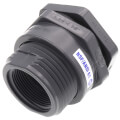
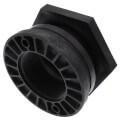
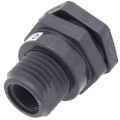
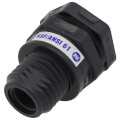
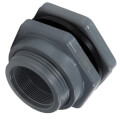
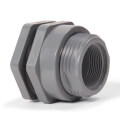
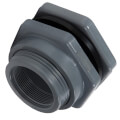
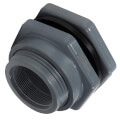
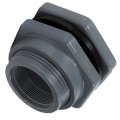

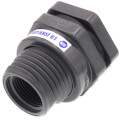
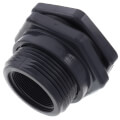
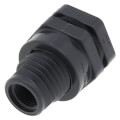
Domestic Bulkhead Fittings are through-wall connectors that let a pipe pass through the side of a tank or vessel with a watertight seal, sized from 1/2 inch up to 2 inch for household and light commercial water storage setups. Red Flag Products models in this line use ABS plastic bodies with EPDM gaskets and are available in slip, thread, or a mix of both connection types on either end. A flange sits inside the tank wall while a locknut tightens from the outside, compressing the gasket against the tank to keep water from leaking around the pipe penetration. Installers glue the slip-style connections to PVC pipe with standard solvent cement, while the threaded versions accept a male-threaded pipe or adapter directly. Plumbers and irrigation techs use these fittings any time a storage tank, cistern, or holding vessel needs a controlled point for water to enter or exit through its wall rather than through the top.
Subcategories
- Slip x Slip Bulkhead Fittings: Slip x slip bulkhead fittings glue directly to PVC pipe on both the inside and outside connection using standard solvent cement. Sizes run from 1/2 inch up to 2 inch in the Red Flag Products domestic line, with an ABS body and EPDM gasket sealing against the tank wall. Installers use this style when the connection is permanent and the pipe on both sides is already PVC. A glued joint on both ends means the fitting will not back apart once cured, so it suits a fixed installation that will not need future disassembly.
- Thread x Thread Bulkhead Fittings: Thread x thread bulkhead fittings carry female NPT threads on both the tank side and the discharge side, letting a male-threaded pipe or adapter connect on either end. The same 1/2 inch to 2 inch size range applies as the slip version, still built with an ABS body and EPDM gasket. Plumbers reach for this style when a valve, union, or other threaded fitting needs to thread directly onto the bulkhead without a glued transition. Threaded connections on both sides also make future disassembly for service or replacement simpler than a glued joint would.
- Thread x Slip and Slip x Thread Bulkhead Fittings: Thread x slip and slip x thread bulkhead fittings combine one threaded end with one solvent-glue end, giving an installer a transition fitting in a single part. Sizes in the Red Flag Products domestic line cover 1/2 inch through 1-1/2 inch in this combination configuration. Plumbers use this style when the tank side needs a glued PVC connection but the discharge side needs to thread onto a valve or fitting without an extra adapter. Choosing the correct orientation depends on which side of the tank wall each connection type needs to land on.
Buying Guide
Choosing the right Domestic Bulkhead Fittings starts with matching connection type to what is already piped on each side of the tank. A tank feeding into PVC pipe on both sides works fine with a slip x slip fitting, since both ends glue directly with solvent cement and never need to come apart. A tank that connects to a valve or threaded adapter on the discharge side calls for a thread x thread or thread x slip fitting instead, so the fitting can screw directly onto that valve without an extra transition piece.
Size selection comes down to matching the fitting to the pipe already run to the tank, since a bulkhead fitting sized larger or smaller than the pipe needs a reducing fitting on one side to make the connection work. The Red Flag Products domestic line covers 1/2 inch through 2 inch, which spans most residential and light commercial storage tank setups.
Gasket and body material matter for long-term sealing. An EPDM gasket compressed by the locknut is what actually seals the fitting against the tank wall, so confirming the gasket sits flat and evenly compressed during installation prevents a slow leak from developing later. ABS body construction holds up to typical potable and non-potable water storage applications without the added cost of a more specialized plastic.
Confirming which end is threaded before installing matters most on the combination fittings, since installing one flipped puts the wrong connection on the wrong side of the tank wall.
Frequently Asked Questions
What sizes do Domestic Bulkhead Fittings come in?
Red Flag Products Domestic Bulkhead Fittings run from 1/2 inch up to 2 inch, covering most residential and light commercial storage tank setups. Selecting a size that matches the pipe already run to the tank avoids needing a reducing fitting on either side. Larger sizes handle higher flow tanks, while smaller sizes suit typical household cisterns or holding tanks.
What is the difference between slip and thread connections on a bulkhead fitting?
Slip connections glue directly to PVC pipe with standard solvent cement, creating a permanent joint that will not need to come apart later. Thread connections use female NPT threads that accept a male-threaded pipe, valve, or adapter, which makes future disassembly for service simpler. Choosing between the two depends on whether the connection on either side of the tank wall needs to be permanent or serviceable.
What material are Domestic Bulkhead Fittings made from?
Red Flag Products Domestic Bulkhead Fittings use an ABS plastic body paired with an EPDM gasket that compresses against the tank wall. ABS construction holds up to typical potable and non-potable water storage applications. The EPDM gasket is what actually creates the watertight seal once the locknut is tightened down.
How does a bulkhead fitting create a watertight seal through a tank wall?
A bulkhead fitting uses a flange that sits against the inside of the tank wall and a locknut that tightens from the outside. Tightening the locknut compresses an EPDM gasket between the flange and the tank wall, closing off any gap around the pipe penetration. Confirming the gasket sits flat and evenly compressed during installation is what keeps the connection from developing a slow leak later.
When would a thread x slip fitting be the right choice over a slip x slip fitting?
A thread x slip fitting makes sense when one side of the tank connects to PVC pipe with a glued joint and the other side needs to thread directly onto a valve or adapter. A slip x slip fitting only works when both sides are glued PVC connections. Confirming which end needs which connection type before ordering keeps the fitting oriented correctly during installation.
