



Double Check Valve Assemblies
Double check valve assemblies prevent backflow from contaminating a potable water supply, using two independently operating check valves in series. The category covers assemblies from Febco, Watts, and Wilkins across a range of body materials and pipe sizes.
Local plumbing code typically dictates where a double check assembly is required versus a reduced pressure zone assembly, so confirming the code requirement before ordering avoids a failed inspection. Matching the assembly's body material and connection size to the existing piping keeps installation straightforward.
-13980000.jpg)
-13990000.jpg)

Subcategories
- Febco 805YD Double Check Valve Assemblies: Febco 805YD assemblies use a ductile iron body with stainless steel check assemblies and replaceable bronze seats, rated to 175 psi maximum working pressure for commercial installations from 2 1/2" through 10".
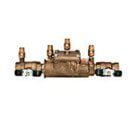
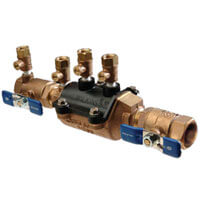
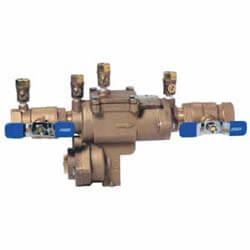
- Febco 850 Double Check Valve Assemblies: Febco 850 assemblies cover smaller 1/2" to 2" bronze-body installations, built with NPT connections, quarter-turn ball valve shutoffs, and captured springs rated to 175 psi working pressure and 350 psi hydrostatic test pressure.
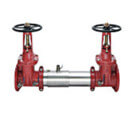
- Febco 870V Double Check Valve Assemblies: Febco 870V assemblies feature a fused epoxy-coated ductile iron body with ArmorTek coating for corrosion resistance, available from 2 1/2" to 10" with a choice of NRS or OSY resilient wedge gate shutoffs.
- Watts 007 Double Check Valve Assemblies: Watts 007 assemblies use a cast bronze body with union end connections in 1/2" to 3" sizes, meeting ASSE 1015 and AWWA C510 standards for non-health-hazard cross connections at 175 psi maximum working pressure.
- Watts 757 Double Check Valve Assemblies: Watts 757 assemblies are built with a lightweight 300 series stainless steel housing and grooved end connections from 2 1/2" to 10", using torsion spring check modules that can be serviced without special tools.
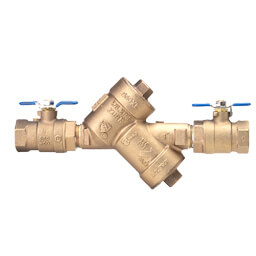
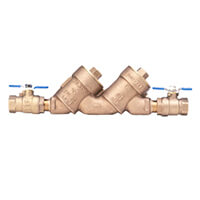
- Wilkins 350 Double Check Valve Assemblies: Wilkins 350 assemblies from Zurn use a ductile iron body listed to ASSE 1015 and AWWA C510/C550, with NORYL seat rings and check valves on larger sizes and a choice of NRS shutoff valves with grooved or flanged connections.
Buying Guide
Confirm the assembly is approved by the local water authority before ordering. Many jurisdictions maintain an approved products list for backflow prevention, and installing an unlisted model can mean a failed inspection regardless of how well it performs.
Size the assembly to the actual demand of the system it protects, not just the pipe diameter. An oversized assembly can create excess pressure loss, while an undersized one restricts flow during peak demand like a fire sprinkler activation.
Choose body material based on installation size and setting. Bronze bodies dominate smaller 1/2" to 2" residential and light commercial applications, while ductile iron and stainless steel cover larger commercial and fire protection sizes.
Check shutoff valve style, NRS versus OSY, against the application. Fire protection installations often specify OSY (outside stem and yoke) shutoffs so the valve position is visible at a glance, which matters for supervised fire systems.
Plan for accessible mounting height and clearance for testing. Test cocks need to be reachable for the periodic testing most jurisdictions require, and installers should follow the manufacturer's minimum clearance and drain proximity guidance.
Frequently Asked Questions
What's the difference between a double check valve assembly and a reduced pressure zone assembly?
A double check valve assembly uses two check valves in series and protects against non-health-hazard backflow, while a reduced pressure zone assembly adds a relief valve between the checks and is required for health-hazard cross connections. The local water authority determines which type is required for a given application.
How often does a double check valve assembly need to be tested?
Testing frequency is set by the local water authority or jurisdiction, and most require annual testing at minimum through the assembly's built-in test cocks, though some settings call for more frequent checks.
Can a bronze body assembly be used on a fire sprinkler system?
It depends on the size and the specific fire code requirements for that installation. Larger fire protection lines typically call for ductile iron or stainless steel assemblies, while smaller bronze assemblies are more common in residential or light commercial domestic water applications.
What does NRS versus OSY mean on the shutoff valves?
NRS stands for non-rising stem, where the stem doesn't move visibly when the valve operates, while OSY stands for outside stem and yoke, where the stem visibly rises and falls to show valve position at a glance. Fire protection systems often specify OSY for supervised visual confirmation.
Why do these assemblies need to be installed above grade with drain access?
Manufacturers specify a minimum height above adequate drains so that any water discharged during testing or relief has somewhere to go, and so techs have enough clearance to access test cocks and shutoff valves for service.
Resources
Subcategories
- Febco 805YD Double Check Valve Assemblies: Febco 805YD assemblies use a ductile iron body with stainless steel check assemblies and replaceable bronze seats, rated to 175 psi maximum working pressure for commercial installations from 2 1/2" through 10".
- Febco 850 Double Check Valve Assemblies: Febco 850 assemblies cover smaller 1/2" to 2" bronze-body installations, built with NPT connections, quarter-turn ball valve shutoffs, and captured springs rated to 175 psi working pressure and 350 psi hydrostatic test pressure.
- Febco 870V Double Check Valve Assemblies: Febco 870V assemblies feature a fused epoxy-coated ductile iron body with ArmorTek coating for corrosion resistance, available from 2 1/2" to 10" with a choice of NRS or OSY resilient wedge gate shutoffs.
- Watts 007 Double Check Valve Assemblies: Watts 007 assemblies use a cast bronze body with union end connections in 1/2" to 3" sizes, meeting ASSE 1015 and AWWA C510 standards for non-health-hazard cross connections at 175 psi maximum working pressure.
- Watts 757 Double Check Valve Assemblies: Watts 757 assemblies are built with a lightweight 300 series stainless steel housing and grooved end connections from 2 1/2" to 10", using torsion spring check modules that can be serviced without special tools.
- Wilkins 350 Double Check Valve Assemblies: Wilkins 350 assemblies from Zurn use a ductile iron body listed to ASSE 1015 and AWWA C510/C550, with NORYL seat rings and check valves on larger sizes and a choice of NRS shutoff valves with grooved or flanged connections.
Buying Guide
Confirm the assembly is approved by the local water authority before ordering. Many jurisdictions maintain an approved products list for backflow prevention, and installing an unlisted model can mean a failed inspection regardless of how well it performs.
Size the assembly to the actual demand of the system it protects, not just the pipe diameter. An oversized assembly can create excess pressure loss, while an undersized one restricts flow during peak demand like a fire sprinkler activation.
Choose body material based on installation size and setting. Bronze bodies dominate smaller 1/2" to 2" residential and light commercial applications, while ductile iron and stainless steel cover larger commercial and fire protection sizes.
Check shutoff valve style, NRS versus OSY, against the application. Fire protection installations often specify OSY (outside stem and yoke) shutoffs so the valve position is visible at a glance, which matters for supervised fire systems.
Plan for accessible mounting height and clearance for testing. Test cocks need to be reachable for the periodic testing most jurisdictions require, and installers should follow the manufacturer's minimum clearance and drain proximity guidance.
Frequently Asked Questions
What's the difference between a double check valve assembly and a reduced pressure zone assembly?
A double check valve assembly uses two check valves in series and protects against non-health-hazard backflow, while a reduced pressure zone assembly adds a relief valve between the checks and is required for health-hazard cross connections. The local water authority determines which type is required for a given application.
How often does a double check valve assembly need to be tested?
Testing frequency is set by the local water authority or jurisdiction, and most require annual testing at minimum through the assembly's built-in test cocks, though some settings call for more frequent checks.
Can a bronze body assembly be used on a fire sprinkler system?
It depends on the size and the specific fire code requirements for that installation. Larger fire protection lines typically call for ductile iron or stainless steel assemblies, while smaller bronze assemblies are more common in residential or light commercial domestic water applications.
What does NRS versus OSY mean on the shutoff valves?
NRS stands for non-rising stem, where the stem doesn't move visibly when the valve operates, while OSY stands for outside stem and yoke, where the stem visibly rises and falls to show valve position at a glance. Fire protection systems often specify OSY for supervised visual confirmation.
Why do these assemblies need to be installed above grade with drain access?
Manufacturers specify a minimum height above adequate drains so that any water discharged during testing or relief has somewhere to go, and so techs have enough clearance to access test cocks and shutoff valves for service.