




Filters
SORT
Product Availability –
Product Type –
Finish Family –
Flow Rate (GPM) –
Application –
Faucet Configuration –
Installation Type –
Handle Style –
Number Of Handles –
Number Of Holes –
Approvals –
Series –
Review Score –
 --%3E %3Csvg version='1.1' id='Fill' xmlns='http://www.w3.org/2000/svg' xmlns:xlink='http://www.w3.org/1999/xlink' x='0px' y='0px' viewBox='0 0 100 100' enable-background='new 0 0 100 100' xml:space='preserve'%3E %3Cpath fill='%23F15C02' d='M79.44,0.95H20.56C9.78,0.95,0.95,9.78,0.95,20.56v58.87c0,10.79,8.82,19.61,19.61,19.61h58.87 c10.79,0,19.61-8.83,19.61-19.61V20.56C99.05,9.78,90.22,0.95,79.44,0.95z M65.38,58.24l9.38,29.58L49.69,69.78L24.5,87.82 l9.34-29.6L8.8,39.6l30.73-0.17c0,0,6.98-19.61,10-28.93c0.54,1.36,9.88,29.1,9.88,29.1H91.2L65.38,58.24z'/%3E %3C/svg%3E)
Price Range –
Krowne Kitchen Faucets

 --%3E %3Csvg version='1.1' id='No-RB' xmlns='http://www.w3.org/2000/svg' xmlns:xlink='http://www.w3.org/1999/xlink' x='0px' y='0px' viewBox='0 0 100 100' enable-background='new 0 0 100 100' xml:space='preserve'%3E %3Cpath fill='%23CECECE' d='M79.44,0.95H20.56C9.78,0.95,0.95,9.78,0.95,20.56v58.87c0,10.79,8.82,19.61,19.61,19.61h58.87 c10.79,0,19.61-8.83,19.61-19.61V20.56C99.05,9.78,90.22,0.95,79.44,0.95z M65.38,58.24l9.38,29.58L49.69,69.78L24.5,87.82 l9.34-29.6L8.8,39.6l30.73-0.17c0,0,6.98-19.61,10-28.93c0.54,1.36,9.88,29.1,9.88,29.1H91.2L65.38,58.24z'/%3E %3C/svg%3E)

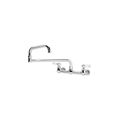
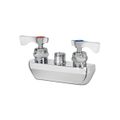
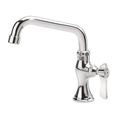
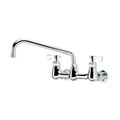
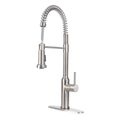
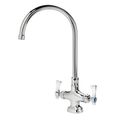
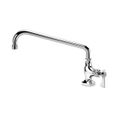
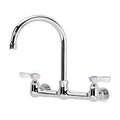
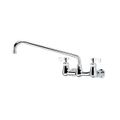
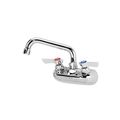
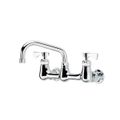
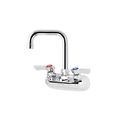

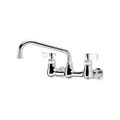
Krowne Kitchen Faucets are commercial-grade fixtures built for the volume and abuse of restaurant and foodservice kitchens, where a residential faucet would fail within months. The lineup spans three series, from entry-level chrome-plated models to solid brass construction rated for continuous use. Every faucet in the range uses a high-performance ceramic cartridge valve, a design that resists the mineral buildup and washer wear that cause residential-style faucets to drip and stick. Spout styles include gooseneck, swing, and jointed configurations, giving kitchen designers options for reaching deep pot-filler sinks, pivoting between multiple basins, or fitting tight equipment lines. Because foodservice faucets run for hours during service and get shut off hard between shifts, valve quality and body material matter more here than in a typical residential purchase. Contractors specifying replacement or new-build fixtures for commercial kitchens need faucets that hold up to that daily cycle without needing frequent parts swaps, which is where Krowne's series lineup gives buyers a clear choice based on budget and duty cycle.
Subcategories
- Diamond Series Kitchen Faucets: Diamond Series faucets sit at the value end of Krowne's kitchen faucet lineup and use solid brass construction for the faucet body. Kitchens on tighter equipment budgets specify this series for pantry sinks, prep stations, and secondary hand-wash areas where full-duty pre-rinse hardware is not necessary. The series still uses the same ceramic cartridge valve technology found across Krowne's higher lines, so contractors are not trading away valve life for a lower price point. It fits well in new builds where dozens of faucets need to be specified without pushing the fixture budget too high.
- Royal Series Kitchen Faucets: Royal Series faucets step up to solid chrome-plated brass construction, giving operators a heavier-duty fixture for high-traffic kitchen lines. The series offers the widest range of configurations in Krowne's catalog, covering gooseneck, swing, and jointed spout styles for nearly any sink layout. Restaurants and institutional kitchens with round-the-clock service typically default to Royal Series faucets because the added plating and body mass hold up better to constant use than lighter fixtures. Ceramic cartridge valves carry over from the rest of the lineup, keeping repair parts consistent across a kitchen that mixes faucet series.
- Silver Series Kitchen Faucets: Silver Series faucets use a chrome-plated finish, positioned as Krowne's other standard-duty option for kitchen and pantry applications. Operators choose this series when a straightforward faucet is needed for a lower-traffic station without paying for the heavier brass body of the Royal line. The same ceramic cartridge valve used across Krowne's kitchen faucet range carries into the Silver Series, so maintenance staff work with one valve type regardless of which series is installed. Facilities running mixed fixture ages benefit from that standardization when stocking spare cartridges.
Buying Guide
Start by matching faucet duty cycle to the station it serves. A hand-wash sink or low-traffic pantry area does not need the same body material as a faucet running for hours during dinner service, so match Diamond Series fixtures to lighter-duty spots and reserve Royal Series faucets for high-traffic prep and dish stations. Spout style comes next: gooseneck spouts clear deep pots and large stock containers, swing spouts share supply between two basins, and jointed spouts fit tight equipment runs where a fixed spout would collide with shelving or backsplash-mounted equipment.
Material matters as much as configuration. Solid brass bodies resist the daily impact of pots, pans, and hard shutoffs better than lighter chrome-plated alternatives, which is worth the added cost on a fixture that runs constantly. Krowne Kitchen Faucets standardize on ceramic cartridge valves across every series, so maintenance teams do not need to stock different valve types for different faucet lines in the same kitchen, a detail worth confirming before mixing series in one build.
Finally, plan installation around the sink deck or wall configuration already in place. Deck-mounted faucets need matching hole spacing on the sink, while wall-mounted models need blocking and rough-in coordinated with the plumber before the wall closes up. Confirming spout reach and hole centers against the existing sink saves a return trip after installation.
Frequently Asked Questions
What is the difference between Krowne's Diamond, Royal, and Silver series faucets?
Diamond Series faucets use solid brass construction at a lower price point, Royal Series faucets step up to solid chrome-plated brass for heavier-duty use, and Silver Series faucets offer a chrome-plated finish as another standard-duty option. All three series share the same ceramic cartridge valve, so operators mixing series in one kitchen still use consistent replacement parts.
What spout styles are available on Krowne kitchen faucets?
Krowne kitchen and pantry faucets come in gooseneck, swing, and jointed spout configurations. Gooseneck spouts clear deep pots and stock containers, swing spouts share water supply between two basins, and jointed spouts fit tight equipment runs where a fixed spout would not clear shelving or backsplash equipment.
Are Krowne kitchen faucets built for commercial kitchen use?
Krowne kitchen faucets are built specifically for commercial foodservice environments, using solid brass or chrome-plated brass bodies rated for continuous daily service. Ceramic cartridge valves across the lineup resist the mineral buildup and wear that shorten the life of residential-grade faucets under heavy commercial use.
What valve technology do Krowne kitchen faucets use?
Every faucet across Krowne's kitchen and pantry lineup uses a high-performance ceramic cartridge valve. Ceramic cartridge technology resists the drip and stick issues common with older washer-based faucet designs, which matters on fixtures that get turned on and off dozens of times during a single shift.
Should a deck-mounted or wall-mounted kitchen faucet be chosen for a new install?
The choice between deck-mounted and wall-mounted kitchen faucets depends on the existing sink and wall configuration in the kitchen. Deck-mounted faucets need matching hole spacing on the sink itself, while wall-mounted models need blocking and rough-in plumbing coordinated with the wall before it closes up.
