




Mini Split Accessories

 --%3E %3Csvg version='1.1' id='No-RB' xmlns='http://www.w3.org/2000/svg' xmlns:xlink='http://www.w3.org/1999/xlink' x='0px' y='0px' viewBox='0 0 100 100' enable-background='new 0 0 100 100' xml:space='preserve'%3E %3Cpath fill='%23CECECE' d='M79.44,0.95H20.56C9.78,0.95,0.95,9.78,0.95,20.56v58.87c0,10.79,8.82,19.61,19.61,19.61h58.87 c10.79,0,19.61-8.83,19.61-19.61V20.56C99.05,9.78,90.22,0.95,79.44,0.95z M65.38,58.24l9.38,29.58L49.69,69.78L24.5,87.82 l9.34-29.6L8.8,39.6l30.73-0.17c0,0,6.98-19.61,10-28.93c0.54,1.36,9.88,29.1,9.88,29.1H91.2L65.38,58.24z'/%3E %3C/svg%3E)


 --%3E %3Csvg version='1.1' id='Fill' xmlns='http://www.w3.org/2000/svg' xmlns:xlink='http://www.w3.org/1999/xlink' x='0px' y='0px' viewBox='0 0 100 100' enable-background='new 0 0 100 100' xml:space='preserve'%3E %3Cpath fill='%23F15C02' d='M79.44,0.95H20.56C9.78,0.95,0.95,9.78,0.95,20.56v58.87c0,10.79,8.82,19.61,19.61,19.61h58.87 c10.79,0,19.61-8.83,19.61-19.61V20.56C99.05,9.78,90.22,0.95,79.44,0.95z M65.38,58.24l9.38,29.58L49.69,69.78L24.5,87.82 l9.34-29.6L8.8,39.6l30.73-0.17c0,0,6.98-19.61,10-28.93c0.54,1.36,9.88,29.1,9.88,29.1H91.2L65.38,58.24z'/%3E %3C/svg%3E)

Mini split accessories are the mounting hardware, line set covers, condensate management parts, and wiring components that complete a ductless mini split installation beyond the indoor and outdoor units themselves. A ductless system rarely ships with everything a job needs, so contractors round out the install with wall brackets or ground pads to support the outdoor condenser, decorative line set covers to route refrigerant lines and control wiring cleanly along an exterior wall, and condensate pumps for indoor units that can't gravity drain to an existing line. Getting these parts right matters because a mini split's appearance and long-term reliability depend as much on how the lines and drainage are handled as on the equipment rating itself. A wall sleeve installed without proper support settles over time, and a condensate line without a working pump backs up and shuts the unit down on a safety switch. Stocking the right accessories ahead of a job keeps an installation on schedule and keeps a callback from turning into a second trip for a part that should have been on the truck the first time.
Subcategories
- Mounting Brackets and Pads: Mounting brackets and ground pads support the outdoor condensing unit, whether it's wall-hung above grade or set on a level pad at ground level. Installers choose wall brackets for tight lots or elevated placement away from snow and debris, and pads for units set directly on the ground. Getting the mounting method right up front avoids vibration noise and uneven settling later. Weight rating and material durability are the main things a contractor checks before ordering.
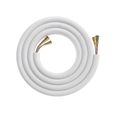
- Line Set Covers: Line set covers route the refrigerant lines, condensate line, and control wiring between the indoor and outdoor units behind a clean, paintable channel instead of exposed tubing. Contractors use these on any finished exterior wall where appearance matters, especially on residential jobs. Covers come in straight sections along with corner and end pieces to handle real-world wall layouts. Proper support inside the cover also protects the lines from UV exposure and physical damage over time.
- Condensate Pumps: Condensate pumps move indoor unit condensate to a drain line when gravity drainage isn't an option, which is common on interior wall installations or units mounted below the nearest drain point. HVAC technicians size a pump to the unit's expected condensate output and the vertical lift required. A pump that fails or clogs is one of the most common reasons a mini split shuts down on an error code, so reliable float switch operation matters as much as pumping capacity.
- Wiring and Electrical Accessories: Wiring and electrical accessories cover the communication cable, disconnect boxes, and whips that connect the indoor and outdoor units and tie the system into its power source. Electricians and HVAC installers rely on correctly rated cable and a properly sized disconnect to keep the installation code compliant. Contractors typically order these parts alongside the main equipment rather than as an afterthought, since a job can't be signed off without them.
Buying Guide
Start any mini split accessory order with the physical layout of the job. The distance between the indoor and outdoor units, the height of the wall-mounted condenser, and whether the condensate line can gravity drain all determine which accessories actually apply before a single part number gets picked.
Mounting method should be settled early. A wall bracket needs to be rated for the specific outdoor unit's weight, while a ground pad needs to sit level and above expected snow or standing water. Skipping this step is one of the more common causes of a callback for vibration noise or a unit that has shifted out of level.
Line set covers are worth planning as a full run rather than piecing it together on site. Ordering matching straight sections, corners, and end caps up front avoids a mismatched appearance and extra trips for a missing fitting once the lines are already run.
Condensate handling deserves its own check. If the indoor unit can't gravity drain to an existing line, a condensate pump sized for the unit's output and the vertical lift needed is not optional, since undersized or unreliable pumps are a leading cause of nuisance shutdowns.
Finally, confirm wiring and disconnect requirements against the local code and the specific equipment being installed. Communication cable type and disconnect sizing vary by manufacturer and unit capacity, so matching accessories to the exact system being installed avoids a failed inspection or a redone connection.
Frequently Asked Questions
Do I need a condensate pump for every mini split installation?
No. A condensate pump is only needed when the indoor unit can't gravity drain to an existing drain line, which is common on interior walls or units mounted below the nearest drain point.
Should I mount the outdoor unit on a wall bracket or a ground pad?
It depends on the site. Wall brackets work well for tight lots or elevated placement away from snow and debris, while ground pads suit installations with enough clear space at grade level.
What's the benefit of using a line set cover instead of leaving the lines exposed?
A line set cover protects the refrigerant lines, condensate line, and wiring from UV exposure and physical damage while giving the installation a cleaner, paintable finish along the exterior wall.
Can I use any wiring for the connection between indoor and outdoor units?
No. The communication cable and disconnect need to match the specific manufacturer's requirements and the unit's electrical rating to stay code compliant and keep the system functioning correctly.
What causes a mini split to shut down with a drain-related error code?
A clogged or failed condensate pump, or a float switch that isn't operating correctly, is one of the most common causes of a mini split shutting itself down on a drain-related fault.
