




PVC Schedule 80 45° Street Elbows

 --%3E %3Csvg version='1.1' id='No-RB' xmlns='http://www.w3.org/2000/svg' xmlns:xlink='http://www.w3.org/1999/xlink' x='0px' y='0px' viewBox='0 0 100 100' enable-background='new 0 0 100 100' xml:space='preserve'%3E %3Cpath fill='%23CECECE' d='M79.44,0.95H20.56C9.78,0.95,0.95,9.78,0.95,20.56v58.87c0,10.79,8.82,19.61,19.61,19.61h58.87 c10.79,0,19.61-8.83,19.61-19.61V20.56C99.05,9.78,90.22,0.95,79.44,0.95z M65.38,58.24l9.38,29.58L49.69,69.78L24.5,87.82 l9.34-29.6L8.8,39.6l30.73-0.17c0,0,6.98-19.61,10-28.93c0.54,1.36,9.88,29.1,9.88,29.1H91.2L65.38,58.24z'/%3E %3C/svg%3E)


 --%3E %3Csvg version='1.1' id='Fill' xmlns='http://www.w3.org/2000/svg' xmlns:xlink='http://www.w3.org/1999/xlink' x='0px' y='0px' viewBox='0 0 100 100' enable-background='new 0 0 100 100' xml:space='preserve'%3E %3Cpath fill='%23F15C02' d='M79.44,0.95H20.56C9.78,0.95,0.95,9.78,0.95,20.56v58.87c0,10.79,8.82,19.61,19.61,19.61h58.87 c10.79,0,19.61-8.83,19.61-19.61V20.56C99.05,9.78,90.22,0.95,79.44,0.95z M65.38,58.24l9.38,29.58L49.69,69.78L24.5,87.82 l9.34-29.6L8.8,39.6l30.73-0.17c0,0,6.98-19.61,10-28.93c0.54,1.36,9.88,29.1,9.88,29.1H91.2L65.38,58.24z'/%3E %3C/svg%3E)
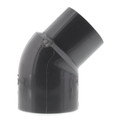
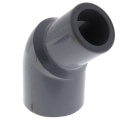
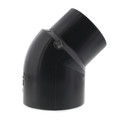
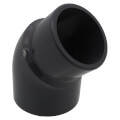

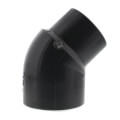
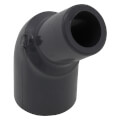
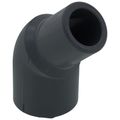
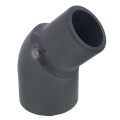
PVC Schedule 80 45° Street Elbows are solvent weld fittings that connect directly into a valve or fitting socket on one end while accepting standard pipe on the other end, eliminating a joint compared to a standard elbow and coupling combination. Manufactured to ASTM D2467 for use with Schedule 80 PVC pipe built to ASTM D1785, these fittings carry a maximum internal pressure rating of 235 psi at 73 degrees Fahrenheit in sizes from 1/2 inch to 2 inches, with lower ratings in larger diameters. The spigot end slides straight into an adjacent socket, cutting installation time in tight fitting clusters where space for a full coupling isn't available. Heavier Schedule 80 wall thickness holds up under higher pressure and mechanical stress than Schedule 40, making the street elbow a common choice on chemical feed lines and industrial water systems. Manufacturer specifications do not recommend these fittings for compressed air or gas service, so confirming the application matches liquid distribution use avoids a compliance issue on process piping. Contractors specify the street configuration to remove a joint from congested valve manifolds and equipment connections.
Subcategories
- 1/2" to 2" Street Elbows: This size range carries the highest pressure rating in the lineup at 235 psi maximum internal pressure at 73 degrees Fahrenheit, making it the go-to range for pressurized branch lines and chemical feed connections. Plumbers and process piping installers use these smaller sizes on equipment connections and valve manifolds where a street fitting saves a joint in a crowded layout. Spigot x socket construction lets the fitting solvent weld directly into an adjacent valve or fitting body. This range covers the sizes most commonly stocked for service and repair work.
- 3" to 6" Street Elbows: Mid-size street elbows in this range carry a 150 psi maximum internal pressure rating at 73 degrees Fahrenheit, lower than the smaller diameters due to wall geometry. Commercial plumbers and industrial contractors use this range on larger process piping and drainage runs where a street configuration still saves a coupling in a tight equipment room. Fittings remain manufactured to ASTM D2467 for compatibility with Schedule 80 pipe. These sizes see regular use in commercial mechanical rooms with larger diameter distribution piping.
- 8" and Larger Street Elbows: Large diameter street elbows carry a 100 psi maximum internal pressure rating at 73 degrees Fahrenheit, the lowest in the lineup, since fittings at this size are fabricated rather than molded. Industrial contractors and municipal water system installers specify this range for large-diameter liquid distribution piping. The lower pressure rating means system design has to account for reduced headroom compared to smaller diameter fittings. These sizes are less commonly stocked and often ordered for a specific large-scale project.
Buying Guide
Start sizing selection with the actual pipe diameter already run on the job, since PVC Schedule 80 45° Street Elbows are sold in dedicated sizes from 1/2 inch up to 8 inches and are not interchangeable across schedules. Confirm the pressure rating for the specific diameter before specifying a fitting for a pressurized system; smaller diameters up to 2 inches carry a 235 psi rating at 73 degrees Fahrenheit, while 3-inch to 6-inch sizes drop to 150 psi and 8-inch and larger sizes carry 100 psi. Verify the application involves pressurized liquid rather than compressed air or gas, since manufacturer specifications don't recommend Schedule 80 PVC fittings for gas or compressed air service regardless of diameter. Choose the street configuration specifically when the layout has a tight fitting cluster or when eliminating a coupling saves labor time on a manifold or equipment connection; a standard socket by socket elbow works fine where space isn't constrained. Solvent cement compatible with PVC Schedule 80 material is required for a proper joint, and using the wrong cement type undermines the pressure rating regardless of the fitting's spec sheet numbers. For potable water or process piping subject to inspection, confirm NSF certification on the specific part before ordering, since not every PVC fitting on the market carries that certification. Buying in bulk for a job with repeated fitting clusters can reduce per-joint labor across a large installation.
Frequently Asked Questions
What does 'street' mean on a PVC Schedule 80 45° elbow?
A street fitting has one spigot end that inserts directly into a valve or fitting socket instead of two socket ends that both need a length of pipe. The design removes one joint from an assembly, which speeds up installation in tight fitting clusters. PVC Schedule 80 45° Street Elbows use this configuration specifically to connect straight into adjacent equipment or manifold ports.
What pressure rating applies to these fittings?
Sizes from 1/2 inch to 2 inches carry a maximum internal pressure rating of 235 psi at 73 degrees Fahrenheit. Ratings drop to 150 psi for 3-inch to 6-inch sizes and 100 psi for 8-inch and larger sizes, since wall geometry changes with diameter. Checking the rating against system operating pressure before ordering prevents an undersized fitting from ending up on a pressurized line.
Can these fittings carry compressed air or gas?
Manufacturer specifications for PVC Schedule 80 fittings, including street elbows, don't recommend them for compressed air or gas service. Using them on a gas or compressed air line falls outside the stated application and creates a compliance problem on inspection. Piping systems carrying gas or compressed air need a material rated specifically for that service.
What standard governs Schedule 80 PVC fitting construction?
Schedule 80 PVC 45-degree elbows are manufactured to ASTM D2467 for use with Schedule 80 pipe built to ASTM D1785. The pairing of standards keeps fitting and pipe dimensions compatible across manufacturers. Confirming both standards on a spec sheet helps verify a fitting matches the pipe already specified for the job.
Is a street elbow always the right choice over a standard elbow?
Street elbows work best where a fitting connects directly into a valve, equipment port, or another fitting's socket without a length of pipe in between. Standard socket by socket elbows make more sense where the layout already has enough room for a coupling and a short pipe run. Choosing between the two comes down to the specific fitting cluster layout on that section of the job.
