




ProPEX Ball Valves
ProPEX Ball Valves expand directly onto PEX tubing to create a full-flow shutoff point, giving a plumber a quarter-turn handle to isolate a branch line or fixture without cutting into the tubing run or adding a separate coupling. The expansion connection keeps the joint free of solder, glue, or clamps, matching the rest of the ProPEX tubing system.
This line covers several connection variations built around that same core function. They range from a basic in-line shutoff to versions with a drain port, a press-fit transition to copper, or connections sized for male or female threaded fittings. The right variation depends on what the valve needs to connect to on each side.
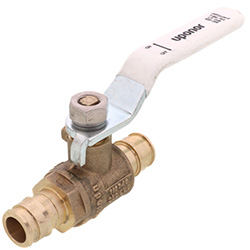

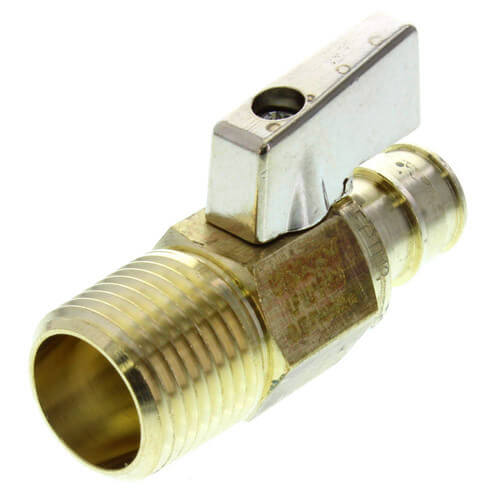

Subcategories
- Drop Ear Ball Valves: Drop Ear Ball Valves include mounting ears built into the valve body so it can be screwed to a wall stud or framing member, giving the connection extra support at a fixture supply stop or hose bib.
- ProPEX Ball Valves w/ Drain: ProPEX Ball Valves w/ Drain add a small drain port to the standard valve body, letting a plumber empty the downstream line without opening a separate fitting elsewhere in the run.
- ProPEX x Copper Press Ball Valves: ProPEX x Copper Press Ball Valves combine a PEX expansion connection on one side with a copper press connection on the other, letting a plumber transition between the two piping materials at a single fitting.
- ProPEX x Female Ball Valves: ProPEX x Female Ball Valves pair a PEX expansion connection with a female threaded outlet, giving a direct connection point for a male-threaded fixture, appliance, or fitting.
- ProPEX x Male Ball Valves: ProPEX x Male Ball Valves pair a PEX expansion connection with a male threaded outlet, suited to connecting into a female-threaded fixture or fitting without an extra adapter.
- ProPEX x Sweat Ball Valves: ProPEX x Sweat Ball Valves pair a PEX expansion connection with a sweat outlet sized for copper tube, giving a plumber a way to transition from PEX to a soldered copper connection at a single valve.
Buying Guide
Start with what the valve needs to connect to on both sides. A straightforward PEX-to-PEX shutoff calls for the standard valve. A line that needs periodic draining calls for the drain-equipped version. A transition point to copper or threaded pipe calls for one of the press, sweat, or threaded variations.
The expansion side of each valve connects to PEX tubing the same way as other ProPEX fittings. The expansion tool already used for tubing installation applies there, so no separate tool is needed for that side.
On the copper press variation, confirming the press tool and jaw size match the valve's press connection before the job starts avoids a mismatched crimp, since press tools vary by manufacturer and jaw profile.
Drain-equipped valves are worth specifying anywhere seasonal shutdown or line draining is a recurring task, such as an irrigation supply or an outdoor fixture, rather than adding a separate drain fitting downstream of a standard valve.
Because these valves shut off with a quarter-turn handle, a plumber can standardize on one valve family across a job. Only the connection style needs to change at each specific point in the run.
Frequently Asked Questions
What does the drain port on a ProPEX ball valve do?
The drain port lets a plumber empty the line downstream of the valve without disconnecting a separate fitting, which is useful ahead of winterizing an outdoor line or seasonal equipment.
Can a ProPEX ball valve connect to copper pipe directly?
The copper press variation has one copper press connection built into the body, letting it connect directly to copper pipe on that side while the other side expands onto PEX tubing.
Does the copper press connection need a special tool?
Yes, it needs a copper press tool with a jaw sized to match the valve's press connection, which is a separate tool from the PEX expansion tool used on the other side of the valve.
What's the difference between the male and female threaded variations?
The female variation has a threaded outlet that accepts a male-threaded fixture or fitting. The male variation has a threaded outlet built to screw into a female-threaded connection. The choice depends on which thread type is already on the other end of the connection.
How is the ball valve operated once installed?
A quarter-turn handle on top of the valve body opens or closes the ball inside.
Resources
Subcategories
- Drop Ear Ball Valves: Drop Ear Ball Valves include mounting ears built into the valve body so it can be screwed to a wall stud or framing member, giving the connection extra support at a fixture supply stop or hose bib.
- ProPEX Ball Valves w/ Drain: ProPEX Ball Valves w/ Drain add a small drain port to the standard valve body, letting a plumber empty the downstream line without opening a separate fitting elsewhere in the run.
- ProPEX x Copper Press Ball Valves: ProPEX x Copper Press Ball Valves combine a PEX expansion connection on one side with a copper press connection on the other, letting a plumber transition between the two piping materials at a single fitting.
- ProPEX x Female Ball Valves: ProPEX x Female Ball Valves pair a PEX expansion connection with a female threaded outlet, giving a direct connection point for a male-threaded fixture, appliance, or fitting.
- ProPEX x Male Ball Valves: ProPEX x Male Ball Valves pair a PEX expansion connection with a male threaded outlet, suited to connecting into a female-threaded fixture or fitting without an extra adapter.
- ProPEX x Sweat Ball Valves: ProPEX x Sweat Ball Valves pair a PEX expansion connection with a sweat outlet sized for copper tube, giving a plumber a way to transition from PEX to a soldered copper connection at a single valve.
Buying Guide
Start with what the valve needs to connect to on both sides. A straightforward PEX-to-PEX shutoff calls for the standard valve. A line that needs periodic draining calls for the drain-equipped version. A transition point to copper or threaded pipe calls for one of the press, sweat, or threaded variations.
The expansion side of each valve connects to PEX tubing the same way as other ProPEX fittings. The expansion tool already used for tubing installation applies there, so no separate tool is needed for that side.
On the copper press variation, confirming the press tool and jaw size match the valve's press connection before the job starts avoids a mismatched crimp, since press tools vary by manufacturer and jaw profile.
Drain-equipped valves are worth specifying anywhere seasonal shutdown or line draining is a recurring task, such as an irrigation supply or an outdoor fixture, rather than adding a separate drain fitting downstream of a standard valve.
Because these valves shut off with a quarter-turn handle, a plumber can standardize on one valve family across a job. Only the connection style needs to change at each specific point in the run.
Frequently Asked Questions
What does the drain port on a ProPEX ball valve do?
The drain port lets a plumber empty the line downstream of the valve without disconnecting a separate fitting, which is useful ahead of winterizing an outdoor line or seasonal equipment.
Can a ProPEX ball valve connect to copper pipe directly?
The copper press variation has one copper press connection built into the body, letting it connect directly to copper pipe on that side while the other side expands onto PEX tubing.
Does the copper press connection need a special tool?
Yes, it needs a copper press tool with a jaw sized to match the valve's press connection, which is a separate tool from the PEX expansion tool used on the other side of the valve.
What's the difference between the male and female threaded variations?
The female variation has a threaded outlet that accepts a male-threaded fixture or fitting. The male variation has a threaded outlet built to screw into a female-threaded connection. The choice depends on which thread type is already on the other end of the connection.
How is the ball valve operated once installed?
A quarter-turn handle on top of the valve body opens or closes the ball inside.